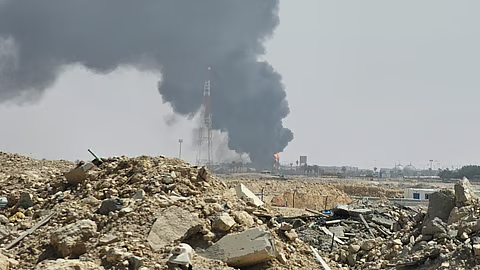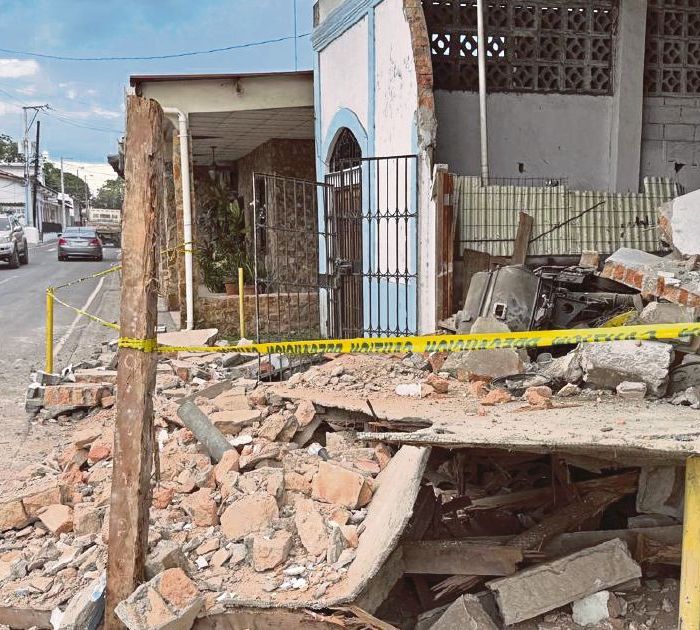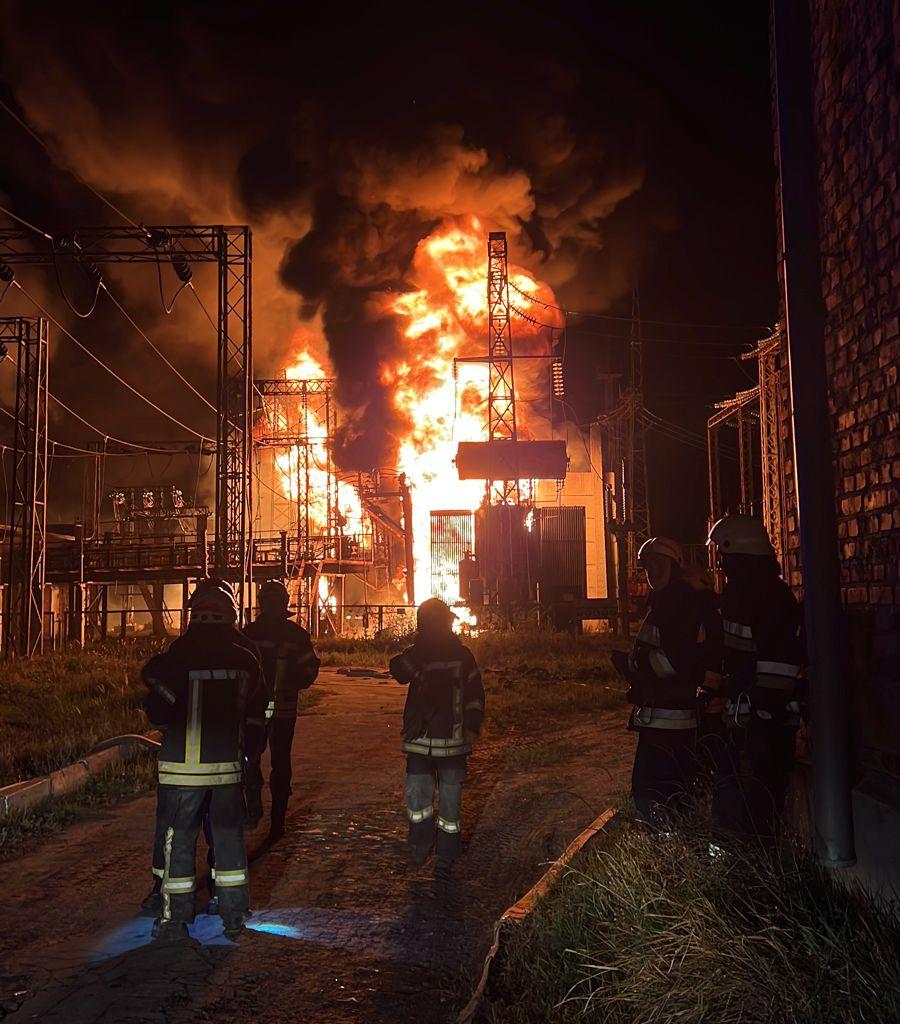
The missiles that have been killing people in Kyiv this month are launched from a single Russian region: Bryansk.
And Bryansk, until recently, was protected by electronic warfare towers designed to keep Ukrainian drones away from those launchers.
The Ukrainian partisan movement ATESH says it has now burned those towers down.
Why Bryansk Matters
Russia has moved its missile launchers right up against the Bryansk border, according to Ukrainian Volunteer Army spokesperson Serhii Bratchuk, speaking on Kyiv24 TV.
The consequence is measured in seconds.
Flight time has been compressed so severely that Kyiv’s air raid siren now sounds after the first explosions have already landed.
Residents are being warned about an attack that has already happened.
Ukraine cannot intercept most of these strikes. The reason is straightforward and grim: an acute shortage of Patriot missiles, the only widely available system capable of stopping ballistic weapons.
The Toll
Every Russian ballistic strike on Kyiv in the past week has originated from Bryansk.
The record is brutal:
- July 11: Six Iskander-M or S-400 ballistic missiles fired from Bryansk struck four Kyiv districts, wounding 10 people. The first explosions were heard more than 90 seconds before the siren sounded.
- July 8: Five ballistic missiles hit Kyiv.
- July 5-6: Twenty-three Iskander-M and S-400 missiles launched from Bryansk, Oryol and Kursk struck the capital, killing at least 16 and injuring 58.
Sixteen dead in a single night, from a region roughly 100 kilometres away.
What ATESH Says It Did
ATESH announced a coordinated operation targeting communication and electronic warfare nodes in two Bryansk Oblast cities: Fokino and Karachev.
According to the group, the towers housed EW complexes designed to suppress drones and jam their navigation systems.
The claims have not been independently verified.
The geography is significant. Fokino is a closed city roughly 100 kilometres from the Ukrainian border. Karachev sits around 180 kilometres away. Both fall within the zone where Russia has concentrated the launchers hitting Kyiv.
The Strategic Logic
ATESH described the effect in two directions, and both matter.
First, destroying the towers created a gap in Russian border defence, blinding local air defence and stripping it of the ability to target incoming Ukrainian drones.
That opens what the group called a direct tactical corridor — a route for Ukrainian drones to penetrate deeper into central Russia.
Second, and more pointedly: the same EW towers that shielded the region also protected Russia’s ballistic launchers from Ukrainian counterstrikes.
Burn the shield, and the thing it was shielding becomes reachable.
Who ATESH Is
The movement is a Ukrainian-Crimean Tatar partisan organisation founded in September 2022, in direct response to Russia’s full-scale invasion.
It operates both in occupied Ukrainian territory and inside Russia itself.
Its membership is notable: Crimean Tatars, Ukrainians, and Russians who were mobilised into the Russian army but now work for Ukraine.
That last category — soldiers in Russian uniform reporting to Kyiv — explains a great deal about how the group reaches targets deep inside Russian territory.
A Repeatable Method
ATESH has followed a consistent operational pattern throughout 2026.
The template:
- Burn electronic warfare towers
- Damage air-defence transformers
- Wait for Ukrainian drones to exploit the resulting corridor
In March 2026, the group burned three EW towers in Novgorod Oblast. That opened a route allowing Ukrainian drones to reach a military aircraft repair plant in Staraya Russa.
The Bryansk operation follows the same script — with a far more consequential target.
ATESH has struck the region before. In October 2025, it disabled a communications tower coordinating Russian occupation forces and border units in Bryansk Oblast.
The Asymmetry
What makes this campaign interesting is its economics.
Russia is firing Iskander-M missiles — expensive, sophisticated weapons — from launchers protected by an elaborate electronic warfare network.
ATESH is answering with fire and sabotage, carried out by small teams operating inside hostile territory.
If the claims are accurate, a handful of people with incendiary devices have degraded a defensive system that cost enormous sums to build.
What This Changes
Nothing, immediately. Kyiv still lacks Patriots. The launchers in Bryansk are presumably still operational. The sirens will still sound late.
But the calculus shifts.
Russia moved its launchers close to the border because proximity meant speed, and speed meant Ukrainian air defences could not respond.
That proximity now cuts both ways. A launcher 100 kilometres from Ukraine is a launcher 100 kilometres from Ukrainian drones — and the towers that were supposed to stop those drones are, according to ATESH, no longer standing.
Author