Supreme Court Virginia Redistricting Ruling Hands Republicans a Major Win in National Map Battle
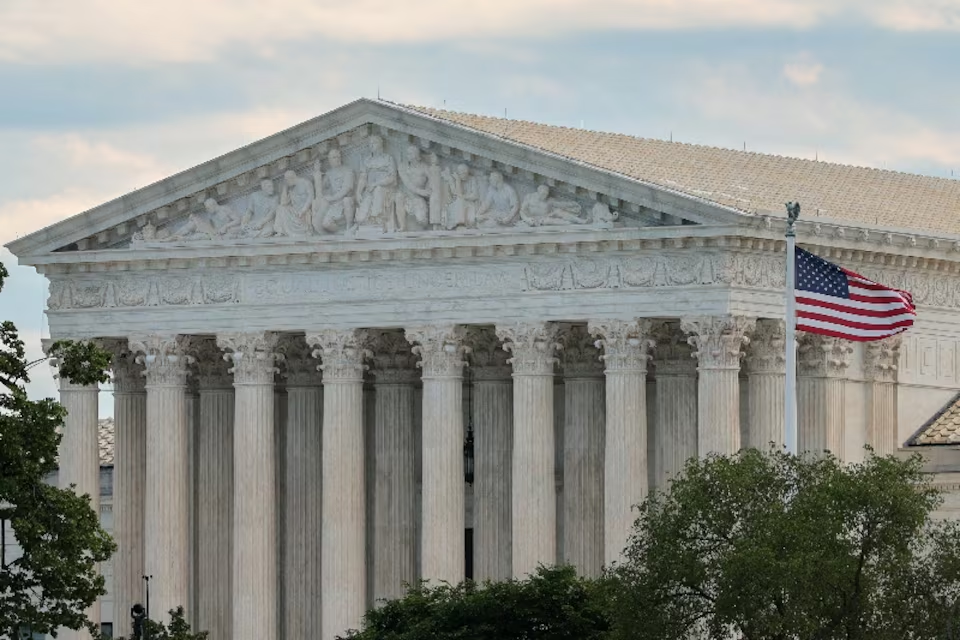
The Supreme Court Virginia redistricting decision delivered a sharp setback to Democrats on Friday, as the nation’s highest court declined to step in and rescue a set of redrawn congressional maps that could have significantly improved the party’s standing in the state.
In a short, unsigned order, the justices turned away an emergency appeal filed by Democratic lawmakers in Virginia. The court offered no explanation for its refusal, leaving the appeal dead without any accompanying reasoning. For Democrats, the timing could hardly have been worse. The ruling lands in the middle of an intense, coast-to-coast struggle over how political district lines are drawn, a fight in which Republicans have recently pulled ahead.
What the Rejected Maps Would Have Done
At the center of the dispute were congressional maps that had already cleared one major hurdle: approval by Virginia voters. Had they survived legal challenge, the redrawn boundaries could have shifted as many as four additional U.S. House seats into the Democratic column, a substantial gain in a closely divided Congress.
But that voter approval was not the end of the story. The Virginia Supreme Court intervened and struck the maps down, and the U.S. Supreme Court’s refusal to revive them effectively closed off the last avenue Democrats had to put the maps back in play.
Why Virginia’s Top Court Rejected the Plan
The state’s highest court ruled the previous week that the redistricting referendum never should have reached voters in the first place. The justices concluded that the measure had been placed on the ballot improperly, in conflict with the procedures laid out in Virginia’s constitution for handling ballot initiatives. Because of that procedural failure, the court declared the entire referendum invalid.
That outcome was far from unanimous. The decision split the court along ideological lines, with a narrow 4-3 majority carrying the day. The practical effect was to keep the existing congressional map in place, the version originally drawn in 2021. Under those boundaries, Democrats currently control six of Virginia’s eleven House seats, while Republicans hold the remaining five.
A Long Shot From the Start
Many observers were not surprised by the outcome. Legal analysts had described the Democrats’ appeal to Washington as a steep uphill climb from the moment it was filed. The reason comes down to a long-standing principle in American law: federal courts typically avoid second-guessing state courts when the question at hand turns on the interpretation of that state’s own constitution and laws.
Because Virginia’s ruling rested squarely on state constitutional procedure, the U.S. Supreme Court had little reason to override it. Seen in that light, the rejection looks less like a dramatic intervention and more like the predictable result of a case that was always unlikely to succeed.
Part of a Larger Redistricting War
The Virginia clash is just one front in a much broader national conflict. Across the country, Democrats are scrambling to counter Republican efforts to redraw district lines in ways that shield the GOP’s slim majority in the House of Representatives, a majority that looks vulnerable given the difficult political climate facing conservatives.
What makes this period unusual is the timing of the map changes. Several Republican-led states have moved to redraw their congressional districts in the middle of the decade, rather than waiting for the next census, which traditionally triggers redistricting once every ten years. Some Democratic-controlled states, including California, have pushed back with redistricting efforts of their own. The trouble for Democrats is one of opportunity: their states generally offer fewer realistic chances to flip seats, leaving them at a structural disadvantage in this tit-for-tat exchange.
The Voting Rights Act Factor
Republicans have also gained ground thanks to a separate Supreme Court ruling issued last month, one that substantially scaled back the protections of the Voting Rights Act. That decision opened the door for GOP-controlled states, particularly across the South, to dismantle majority-minority districts, which have largely sent Democrats to Congress.
The ripple effects came quickly. Pointing directly to that earlier ruling, the Supreme Court acted again days later to back Alabama Republicans in their push to claim yet another House seat. Each of these moves builds on the last, compounding the advantage.
The Bottom Line for November
Taken together, this string of legal victories carries real weight heading into the fall. Analysts estimate that the combined redistricting efforts could ultimately deliver Republicans somewhere in the neighborhood of a dozen extra seats when voters head to the polls in November.
For a party defending a fragile majority, that cushion could prove decisive. And for Democrats, the rejection in Virginia is a reminder of how much ground they have lost in a battle that is increasingly being settled not at the ballot box, but in the courtroom. With the maps now locked in across multiple states, the shape of the next Congress may already be taking form, long before a single vote is cast.
Author