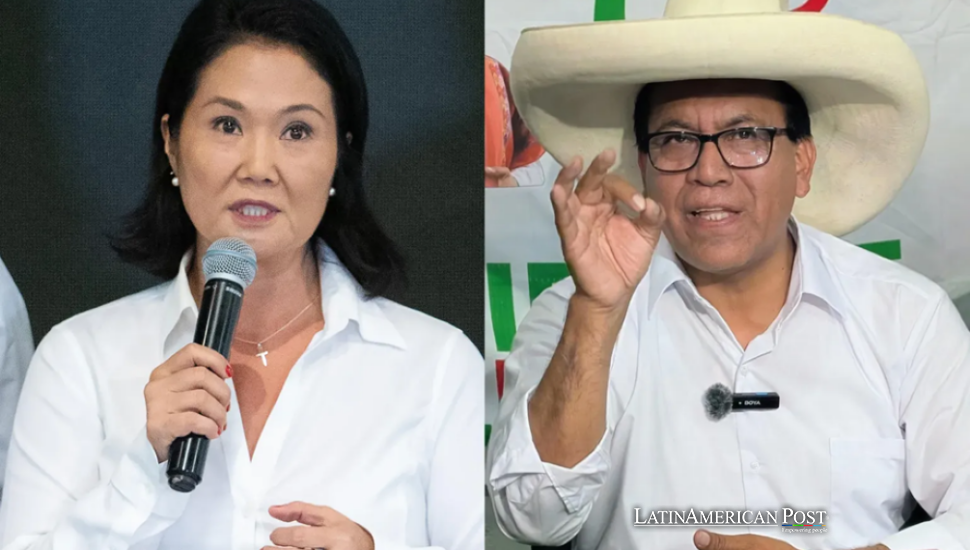
The Peru presidential runoff arriving this Sunday is far more than a domestic contest — it could determine whether the country becomes the next domino to fall in Latin America’s broader swing toward the right. After a chaotic first round, voters now face a stark choice between a newly moderated left and a right-wing candidate carrying the divisive legacy of an authoritarian past, all against a backdrop of surging violence and deep institutional distrust.
A Rocky Road to the Runoff
The path to Sunday’s vote has been anything but smooth.
The first round descended into chaos, taking weeks to resolve because of logistical failures and unproven fraud accusations that sparked widespread outrage. Adding to the uncertainty, the two finalists who emerged are sharply opposed ideologically yet together captured less than 30 percent of the initial vote.
That leaves a large pool of undecided voters up for grabs — and recent polling has shown the two candidates locked in a dead heat as they battle for that crucial middle ground.
A Region Shifting Right
The stakes extend well beyond Peru’s borders.
The election unfolds amid an anti-incumbent wave pushing Latin America toward right-wing, law-and-order governments. This trend has already reshaped leadership in Argentina, Bolivia, and Ecuador. With elections approaching in Brazil and Colombia — where a tough-on-crime conservative outsider recently won the first round — Sunday’s outcome will help answer whether Peru joins the rightward shift sweeping the region.
Meet the Candidates
The runoff pits two figures with starkly different visions against each other.
On the right stands Keiko Fujimori, a conservative whose name carries enormous historical weight. Her father, Alberto Fujimori, was Peru’s authoritarian president, credited with dismantling brutal leftist rebel groups but also blamed for unraveling the country’s democracy in the process.
On the left is Roberto Sánchez, a leftist lawmaker and political heir to the jailed former President Pedro Castillo. In the campaign’s final weeks, Sánchez made a notable pivot toward the center, working to win over undecided moderates. Backed by a fresh team of center-left technical advisers, he has pledged to:
- Maintain fiscally responsible policies
- Protect private property
- Preserve the central bank’s autonomy
Fujimori, meanwhile, has leaned into her right-wing base as a tough-on-crime candidate, casting Sánchez as a communist and would-be authoritarian who would scare off private investment. Analysts say her strategy is twofold: count on economic anxieties to naturally pull moderates her way, while her hard-line posture guarantees her base shows up to vote.
What’s at Stake for Governing
The result won’t just decide who leads — it could determine whether the next president can govern at all.
If Sánchez wins, he would face a hostile, right-wing-dominated Congress lacking the votes to block an impeachment. According to Mauricio Zavaleta, a political scientist at the University of Pittsburgh, that could doom his presidency to the same cycle of gridlock and turnover that has plagued Peru in recent years.
A Fujimori victory would look very different. Analysts say she could quickly consolidate power because her political coalition already controls the legislature. In recent years, her legislative bloc has:
- Appointed allies to the high court and state watchdogs
- Altered laws to favor Congress in legal battles
- Used the constant threat of impeachment to keep the executive branch weak
Backed by corporate elites, mainstream media, and a projected one-third of the legislature, Fujimori would have the leverage to fend off any impeachment attempts. Critics warn that such concentrated power could erode democratic checks and balances and open the door to authoritarianism.
What’s Driving Voters
The concerns shaping this election are deeply felt and interconnected.
At the top of the list is a surge in violent crime and extortion, compounded by deep anger over rampant government corruption and a profound distrust of Peru’s unstable political institutions. These anxieties have given both candidates an opening to position themselves as the answer.
Fujimori has made security the centerpiece of her campaign, drawing heavily on her father’s iron-fisted legacy. She has called for deploying the military to borders and prisons and for expelling undocumented Venezuelan migrants who have arrived in large numbers in recent years.
Sánchez, while also supporting the use of the military to assist police, has focused his platform elsewhere. His priorities include raising the minimum wage, expanding welfare and pensions, subsidizing loans for informal workers, and cutting corporate tax exemptions. He has also campaigned on the traditional left-wing promise to scrap the 1993 Constitution written during Fujimori’s tenure, though analysts say he lacks the political capital to actually push such a change through.
Does the Hard-Line Approach Resonate?
Interestingly, the appetite for harsh crackdowns may be more limited than it appears.
Across Latin America, many voters have expressed support for the heavy-handed security tactics popularized by El Salvador’s president, Nayib Bukele, even as critics argue those measures have led to widespread human rights violations.
But Peru tells a more complicated story. The most hard-line candidates actually performed poorly in the first round. After years of ineffective states of emergency, voters have grown skeptical that aggressive crackdowns can dismantle entrenched extortion networks. As political analyst Eduardo Dargent observed, security hasn’t proven to be a highly effective campaign issue, because it’s hard for voters to believe major changes will come quickly.
Who Is the Real Incumbent?
One of the most fascinating dynamics in this race is the battle over who represents the unpopular status quo.
In much of Latin America, the rightward tilt has been fueled by voters punishing leftist incumbents. But Peru’s revolving presidential door makes identifying an incumbent unusually tricky.
Fujimori has blamed recent years of chaos on leftists like Sánchez, citing his ties to the imprisoned Castillo. Yet experts note that many voters see the deeply unpopular, conservative-led Congress as the true incumbent. Because Fujimori’s party dominates that legislature, she effectively represents the status quo — which has allowed Sánchez to cast himself as the outsider by attacking Congress as a “mafia pact.”
As Peruvian political analyst Alberto Vergara put it, both candidates accuse each other of being the incumbent.
When to Expect Results
Voters will head to the polls Sunday, with polling stations open from 7 a.m. to 5 p.m.
If one candidate pulls ahead by a wide margin in the preliminary counts, results could become clear by Sunday night. However, given how tight the race appears, a closer contest would most likely take weeks to settle — raising the specter of the same prolonged uncertainty that marred the first round.
Why This Matters
The Peru presidential runoff captures a moment of profound consequence, both for the country and for the region.
A few threads make this election especially significant:
- It could tip Peru into Latin America’s accelerating rightward shift.
- It pits a moderated left against a candidate tied to an authoritarian legacy.
- The outcome will shape whether the next president can govern effectively or face immediate paralysis.
What Comes Next
Whatever the result, Peru faces difficult challenges ahead. A Sánchez win could mean confrontation with a hostile Congress, while a Fujimori victory raises questions about the future of democratic safeguards.
For now, the country stands at a crossroads, weighing fear of crime, frustration with corruption, and distrust of its institutions against two very different visions for the future. As the votes are cast, the Peru presidential runoff will not only choose a leader but also signal where one of Latin America’s most volatile democracies is headed — and whether the region’s rightward wave continues to gather force.
Author