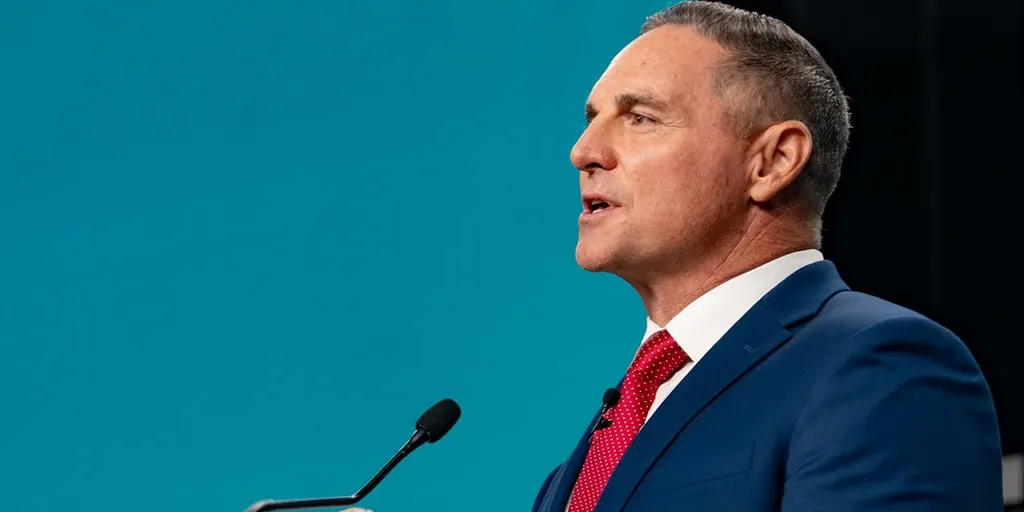
The Jay Feely primary win in Arizona’s 1st Congressional District handed Republicans a Trump-endorsed nominee in one of the handful of races that will decide who controls the House next year.
Feely, who spent his career kicking field goals in the NFL, defeated former state lawmaker Joseph Chaplik and businessman John Trobough to claim the Republican nomination Tuesday.
He’ll be running for an open seat, and the circumstances that created it are worth noting.
An Open Seat Created by a Failed Gamble
Rep. David Schweikert gave up this district to run for governor. That bid ended Tuesday night when he lost his primary badly.
So Schweikert leaves Congress without the governorship, and the seat he vacated becomes one of the most contested races in the country.
The district covers northeastern Maricopa County and substantial portions of Scottsdale, Paradise Valley and Fountain Hills. It’s suburban, affluent, and genuinely competitive, which is a rarer combination than it used to be.
Trump Stepped In Late
Feely picked up what Trump described as his complete and total endorsement in the closing days of the campaign, delivered by video message.
Trump called him a true America First conservative and urged voters to back him in the July 21 primary.
The institutional support followed. The National Republican Congressional Committee placed Feely in its MAGA Majority program, which the committee describes as an effort to support America First candidates running in battleground districts.
For a first-time congressional candidate best known for a football career, that combination of presidential endorsement and party infrastructure did a great deal of work.
The Haiti Fight
The primary turned unusually personal in its final stretch, and the dispute centered on Feely’s charitable work abroad.
Chaplik posted on X accusing Feely of having imported Haitians. Feely called the remark racist and said it targeted men he regards as family.
Chaplik didn’t retreat.
“This tweet had NOTHING to do with your two family members and everything to do with your history of bringing large numbers of Haitian migrants to NGOs in an attempt to get amnesty here,” he wrote. “You have a history of opposing Trump on TPS for Haiti.”
Feely’s Explanation
Feely has done nonprofit relief work in Haiti for years, beginning after the catastrophic 2010 earthquake.
He has described that work as humanitarian rather than political. Speaking to Axios Phoenix, he said he helped two young Haitian men come to the United States: a translator he worked with, and the translator’s brother. He considers both family, and he has tried to assist several of their relatives with relocating as well.
The exchange captured a real tension inside Republican politics right now. Charitable work involving immigration can be read as compassion or as ideological deviation, depending on who’s doing the reading, and Chaplik bet that primary voters would see it the second way.
They didn’t, or at least not enough of them did.
Why This Race Matters Nationally
The general election here will draw money and attention out of proportion to its size, for a straightforward reason: House majorities are built from districts exactly like this one.
Republicans need to hold a seat they’ve held, in a suburban area where the party has lost ground in recent cycles. Democrats see an open race in competitive territory as one of their better opportunities on the map.
Neither side gets an incumbent advantage. That’s what makes it valuable.
The Feely Profile
Celebrity candidates cut both ways, and Feely’s is worth examining honestly.
The advantages are real. Name recognition costs money to build, and he arrived with it. Athletes tend to poll well on likability and often reach voters who tune out conventional politicians. The Trump endorsement layered party enthusiasm on top of that.
The disadvantages are equally real. He has never held office, which means no legislative record but also no demonstrated capacity for the job. General election voters in a suburban swing district scrutinize candidates differently than primary voters do, and the Haiti issue that his Republican opponent used against him may be reframed by Democrats in the opposite direction.
What Comes Next
Feely now moves into a general election contest that will be counted among the most closely watched House races in the country.
Republicans will work to keep Schweikert’s old seat in the column. Democrats will argue that an open race in a district trending their way is exactly where the House majority gets decided.
Between now and November, expect saturation advertising, national money and considerably more attention on Scottsdale than it usually receives in an election year.
The former kicker has cleared the first hurdle. The harder one is still ahead.
Author
-
Lucienne Albrecht is Luxe Chronicle’s wealth and lifestyle editor, celebrated for her elegant perspective on finance, legacy, and global luxury culture. With a flair for blending sophistication with insight, she brings a distinctly feminine voice to the world of high society and wealth.