SK Hynix stock plunged 15.4 percent in Seoul on Monday, marking the steepest single-session drop the chipmaker has ever recorded. The collapse came just days after the company staged one of the most celebrated market debuts in recent memory, leaving investors to grapple with an uncomfortable question: was the enthusiasm ever justified?
A Debut That Broke Records
To understand Monday’s reversal, it helps to rewind to July 10.
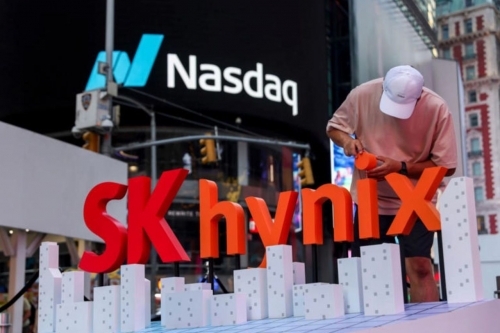
That was the day SK Hynix listed its American depositary receipts on the Nasdaq, and the reception was extraordinary. The ADRs opened 14 percent above their $149 offer price and closed the session up 12.8 percent.
The numbers behind the offering were staggering. The listing pulled in $26.51 billion, making it the largest share sale ever completed by a non-U.S. company. Investor appetite was so intense that the deal was oversubscribed by more than seven times the shares on offer.
Each ADR represents one-tenth of a common share, giving American investors a smaller, more accessible slice of the Korean giant.
Then Came Monday
The mood curdled fast.
Selling in Seoul was so aggressive that a 20-minute market-wide trading halt was triggered as the broader Kospi index tumbled 9 percent. Samsung Electronics, SK Hynix’s larger domestic rival, dropped nearly 11 percent alongside it.
Foreign money headed for the exits. Exchange data showed overseas investors unloading roughly 1.7 trillion won, equivalent to about $1.1 billion, in Kospi-listed equities. The bulk of that outflow came from SK Hynix positions.
The Strange Gap Between New York and Seoul
One of the odder wrinkles of the selloff involves the pricing disconnect between the two markets.
Ahead of Monday’s New York open, SK Hynix ADRs were trading at $152.50, down 9.2 percent from Friday’s $168 close. Even after that decline, the American receipts still carried a premium of roughly 37 percent over the value of the underlying shares in Seoul.
That kind of spread is unusual, and it hints at how differently the two investor bases are pricing the same asset.
So What Actually Went Wrong?
Analysts pointed to a combination of forces rather than a single cause.
Profit-Taking After a Long-Awaited Event
Chan H Lee, managing partner at Seoul-based hedge fund Petra Capital Management, framed the drop as a straightforward case of investors banking gains once a heavily anticipated catalyst had passed. In his reading, nothing fundamental changed about the business. The event people had been waiting for simply happened, and the trade unwound.
Disappointment Over HBM4 Volumes
A more substantive concern surfaced around the company’s high-bandwidth memory pipeline.
Ryu Young-ho, senior analyst at NH Investment and Securities, told Reuters that the market had expected a meaningful ramp in HBM4 chip shipments beginning in the second quarter. That acceleration did not materialise at the scale investors had priced in.
For a company whose valuation leans heavily on AI-driven memory demand, a shortfall in HBM4 momentum is not a minor footnote. It goes to the heart of the growth story.
A Sobering Research Note
Sentiment took another hit from a note by Korea Investment and Securities that circulated among traders. The note suggested SK Hynix’s quarterly operating profit could land as much as 8 percent below analyst expectations.
That kind of figure, arriving in an already jittery market, is enough to accelerate a selloff on its own.
Nobody Knows What It Is Actually Worth
Perhaps the most revealing comment came from Daniel Yoo, global strategist at Yuanta Securities. He argued that the Nasdaq listing effectively created a new valuation yardstick, and that investors are now struggling to reconcile it with what they thought they knew.
Yoo told CNBC that confusion around memory demand and fair value is widespread. That admission cuts to the core of the problem. When a stock has run this hard, the anchor point disappears, and price discovery becomes a genuinely messy process.
The Trillion-Dollar Club, Briefly
By the close on Monday, SK Hynix’s market capitalisation had slid to $875 billion.
That represents a retreat from the $1 trillion threshold the company had crossed earlier this year, a milestone that had cemented its status among the world’s most valuable corporations.
Context Matters: The Bigger Picture
It would be easy to read Monday as a disaster. The longer view complicates that.
Despite the brutal session, SK Hynix’s Seoul-listed shares have still risen roughly sixfold over the past twelve months. A 15 percent drop, however dramatic, sits against a backdrop of extraordinary gains.
Here is what that trajectory has been built on:
- Surging global demand for AI infrastructure
- SK Hynix’s leading position in high-bandwidth memory
- A supply-constrained memory market that has favoured producers
- Massive capital spending by hyperscalers and chip designers
What Investors Should Watch Next
The immediate question is whether Monday’s move was a healthy correction or the start of something more prolonged.
Several things will determine the answer. HBM4 shipment volumes need to demonstrate that the ramp is real, not merely delayed. Quarterly results will need to address the profit concerns raised in that Korea Investment note. And the gap between ADR and Seoul pricing will have to narrow, one way or another.
The Broader Lesson
SK Hynix stock has become a proxy for something larger: the market’s confidence in the durability of the AI memory boom.
When a stock moves this violently in both directions within a single week, it signals that conviction is thinner than the headline gains suggest. Investors are enthusiastic, but they are also nervous, and nervous enthusiasm tends to produce exactly this kind of volatility.
For now, the story remains unresolved. What is clear is that a record-breaking debut guarantees nothing about what comes next.
Author