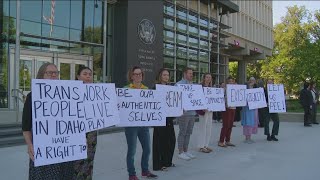
The Idaho transgender bathroom law has hit a major legal roadblock after a federal judge blocked the state from fully enforcing one of the most restrictive measures of its kind in the country. The ruling, issued on June 16, temporarily limits a statute that would have made it a crime for transgender people to use public restrooms that don’t align with the sex they were assigned at birth.
What the Law Would Have Done
The Idaho statute was scheduled to take effect on July 1 and stands out as the harshest among similar laws passed in roughly 20 states. Under the measure, using a restroom, changing room, or shower designated for the opposite biological sex in public spaces would carry serious criminal consequences.
The penalties escalate quickly:
- A first offense would be treated as a misdemeanor, punishable by up to one year in jail.
- A second offense within five years would rise to a felony, carrying a maximum sentence of five years in prison.
The law applies broadly, covering not just government buildings but also restaurants, stores, and other private businesses whose facilities are open to the public.
The Judge’s Decision
U.S. District Judge Amanda Brailsford, based in Boise, granted a preliminary injunction that curtails enforcement while a class-action lawsuit challenging the law’s constitutionality moves forward.
The order doesn’t strike down the entire statute. Instead, it carves out specific protections for transgender individuals during the litigation. Under the ruling, transgender people may continue using single-stall restrooms that match their gender identity. If no single-stall option is available on the same floor of a building, they may use a multi-stall facility instead.
Beyond those carve-outs, the state remains free to enforce the law as it applies to multi-user bathrooms. The provisions covering public locker rooms and shower facilities were not part of the court challenge and remain in effect.
The Legal Argument at the Center
The lawsuit contends that the statute violates several constitutional protections guaranteed by the 14th Amendment, specifically the rights to due process, equal protection, and privacy.
In her 30-page opinion, Brailsford focused on the due process claim. She found that the plaintiffs were likely to succeed in arguing that the law’s enforcement provisions are unconstitutionally vague. That conclusion alone, she wrote, was enough to justify an injunction and outweigh the state’s public safety arguments — without yet needing to rule on the privacy and equal protection claims.
While the plaintiffs requested a narrow injunction targeting only what they saw as the most burdensome parts of the law, their ultimate goal is a final ruling that would eliminate the restroom restrictions entirely.
Weighing Safety Against Rights
Supporters of the law have framed it as a public safety measure. They argue it would help prevent sexual assault and voyeurism in women’s restrooms by stopping men from posing as transgender to gain access.
Brailsford acknowledged that the state has a legitimate interest in protecting bodily privacy and safeguarding women and children in public restrooms from anyone who might intend harm. However, she concluded that existing criminal laws can already address those concerns without trampling on the constitutional rights of transgender people.
The plaintiffs see the law’s effect very differently. They argue that rather than making restrooms safer, the statute would expose transgender individuals to a heightened risk of violence, harassment, and psychological harm. The lawsuit further claims that Idaho’s Republican-controlled legislature leaned on inaccurate assumptions and stereotypes, wrongly equating transgender people with sexual predators.
How Idaho Compares Nationally
Idaho is far from alone in restricting bathroom access for transgender people, but its approach goes further than most. According to a tally by the Movement Advancement Project, a think tank that advocates for LGBTQ rights, about 20 states have some form of restriction on the books.
What sets Idaho apart is the severity of its enforcement:
- Only three other states — Utah, Kansas, and Florida — use the threat of incarceration to enforce such laws.
- Even among those, Idaho’s measure is broader in scope and carries tougher criminal penalties.
A Pattern of Legislation
This isn’t Idaho’s first move to limit bathroom access. The state previously enacted two laws restricting facilities in public schools and on college campuses, requiring access to align with a student’s birth sex.
Those earlier measures take a different enforcement approach, allowing students to file lawsuits if they encounter a transgender person using a facility in violation of the rules. Both statutes are currently being challenged in court but remain in effect as the legal process unfolds.
What Happens Next
For now, the injunction keeps the strictest parts of the new law from taking effect while the case proceeds. The plaintiffs will continue pressing for a final ruling that throws out the restroom restrictions altogether, arguing the measure is both unconstitutional and harmful.
The outcome could carry implications well beyond Idaho’s borders. As more states wrestle with similar legislation, the resolution of this case may help shape how courts balance claims of public safety against the constitutional rights of transgender individuals across the country.
Author