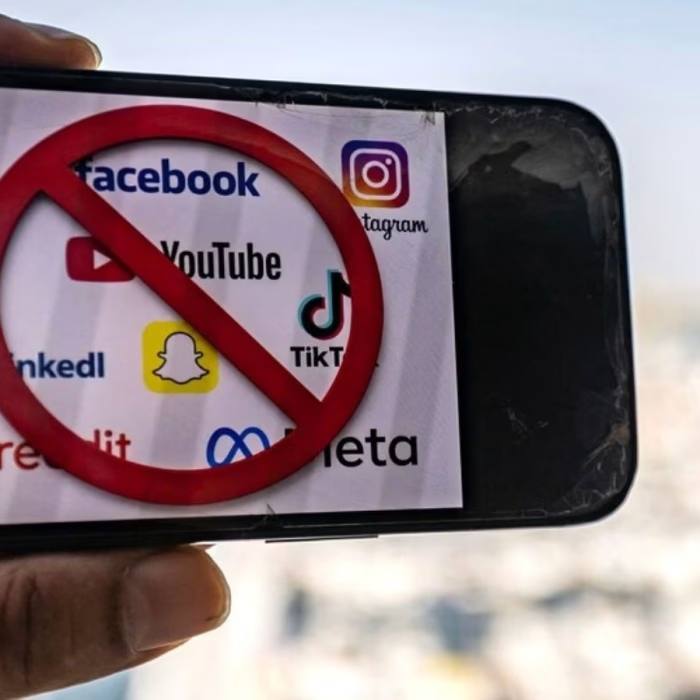
The proposed Canada social media ban has thrust a thorny question into the spotlight: when it comes to keeping kids off social platforms, who should actually be responsible for enforcing the rules? New legislation aims to restrict social media access for children under 16 and tighten oversight of AI chatbots to curb harmful content, but the path to making it work remains far from clear.
A Tug of War Over Gatekeeping
As Canada joins a growing list of countries moving toward youth social media bans, tech companies have found themselves locked in a dispute over who should serve as the gatekeepers.
Executives from Snapchat and Meta, which owns Instagram, Facebook, and Threads, argue that app stores rather than individual platforms should be responsible for verifying users’ ages when they try to download an app. Apple and Google, which operate the App Store and Play Store respectively, have rolled out some age-gating measures but appear to disagree with the platforms over where that responsibility ultimately lies.
Experts, however, suggest that pinning the burden on any single party misses the point.
‘It’s All of Our Problem’
For many observers, the finger-pointing is a distraction from a shared obligation. Kaitlynn Mendes, a sociology professor at Western University and the Canada Research Chair in inequality and gender, argued that no company should be allowed to claim it’s merely the host and wash its hands of the issue. In her view, the responsibility falls on app store owners, platforms, governments, and parents alike. As she put it, it’s all of our problem.
Years of Mounting Pressure
The fight over who should police youth access to social media has been building for years, as child safety advocates pushed for help in addressing the evolving dangers young people face online.
That tension reached a turning point late last year when Australia banned anyone under 16 from using social media. The results have been mixed at best. A subsequent study suggested that 70 percent of the country’s Instagram, Snapchat, and TikTok users under 16 had managed to keep their accounts despite the crackdown.
Australia’s move has nonetheless inspired a wave of similar action. The United Kingdom, France, Poland, Indonesia, and now Canada are among the countries pursuing comparable measures.
Canada Makes Its Move
The federal government announced Wednesday that social media companies will eventually be required to block access for Canadian users under 16 unless they follow certain safeguards, the details of which have yet to be specified.
The vagueness around those safeguards lies at the heart of the current uncertainty, leaving platforms and app stores unsure of exactly what will be expected of them.
Where the Platforms Stand
Social media companies largely oppose youth bans outright. But they argue that if such bans are going to exist, app stores should shoulder the heavy lifting rather than each individual app.
Snapchat CEO Evan Spiegel made this case in a February opinion piece, explaining that the company had advocated for age verification at the app store level. He clarified that this stance did not reflect support for under-16 bans, but rather a belief that if the policy exists, it needs uniform implementation that protects users’ privacy and security.
Meta has echoed that position, pressing the Canadian government to adopt app store-level age verification since at least last year.
Google Pushes Back
Google has little appetite for that proposal. Kareem Ghanem, the company’s senior director of government affairs and public policy, framed the platforms’ approach as part of a consistent pattern of advancing proposals more focused on shifting responsibility than accepting it.
He argued that, time and again around the world, companies like Meta have pushed for app stores to change their practices and take on new burdens without making any changes themselves.
Apple’s Latest Steps
Apple, meanwhile, has begun introducing new tools. Earlier this week, the company rolled out features for its child accounts that can limit access to adult websites and set age-based restrictions for the App Store. Child accounts are required for children under 13 and available for those up to 18. Apple CEO Tim Cook attributed the move directly to Australia’s social media ban.
Crafty Kids and the Enforcement Problem
A central challenge running through the entire debate is just how difficult these bans are to enforce. Mendes noted that some companies try to dodge responsibility precisely because enforcement is so hard, pointing fingers at others in the process.
She emphasized that children are remarkably resourceful. In Australia, she said, kids have used technology to obscure their location and keep their accounts, enlisted older siblings or even parents to open accounts for them, or migrated to other apps not covered by the bans.
Mendes warned that this dynamic risks misdirecting everyone’s energy. Because kids are so motivated to find workarounds, she argued, society ends up policing children when that effort would be better spent compelling companies to design products that are safe in the first place.
Why Both Sides Must Step Up
The sheer difficulty of enforcement is exactly why both app stores and platforms need to take action, according to Jenna Poste, the national technology impact adviser at Unplugged Canada, a grassroots group encouraging parents to delay their children’s access to phones and social media.
Poste pointed out that app stores alone cannot effectively age-gate, since children can still reach social media through web browsers or on devices that don’t run on Google or Apple systems. A child could simply turn to a browser instead of an app, sidestepping store-level controls entirely.
No Easy Answers
As Canada moves forward with its plan, the practical questions remain largely unanswered. The legislation sets a clear goal of keeping under-16s off social media, but the mechanics of how that will be achieved, and who will be held accountable, are still being worked out.
What experts seem to agree on is that there is no single silver bullet. Effective protection will likely require app stores, platforms, governments, and parents all playing a part, rather than any one group serving as the sole line of defense. Until those roles are clearly defined, both the companies and the families affected are left waiting to see what Canada’s ban will actually look like in practice.
Author