The Abhijeet Dipke Cockroach movement began with a single sarcastic question typed out in a Boston apartment. Two months later, it ended with India’s education minister out of a job and thousands of young people celebrating at a protest camp in the heart of New Delhi.
When word reached him on Saturday afternoon, Dipke stared at a phone screen to confirm it was real. Then he dropped to his knees and hammered the makeshift stage with his fists before grabbing a microphone and shouting the news to the crowd. Student power, he yelled, fist in the air. They had done it.
The response was deafening — cheering, hugging, arms thrown skyward. At 30 years old, Dipke had gone from anonymous jobseeker to something close to a folk hero, and he had done it by taking on Prime Minister Narendra Modi’s government and winning.
Two Months Earlier
The transformation is difficult to overstate. Not long before, he was, in his own description, simply another international student from India — a Boston University master’s graduate in public relations, fitting workouts around job applications and unwinding with FIFA on his PlayStation.
The turn came on May 16, when he woke in Boston to news of remarks by India’s Chief Justice, Surya Kant, who had likened unemployed young Indians to parasites and cockroaches.
Dipke said the comparison landed hard. Hearing the country’s most senior judge speak about young people in those terms left him feeling hurt and humiliated.
So he posted a question on X: what would happen if all the cockroaches got together?
The Joke That Refused to Stay a Joke
He did not expect much from it. What followed was millions of people treating the line as more than a punchline — as an invitation.
Within two days he had assembled a website using AI tools and pulled in friends to help. The Cockroach Janta Party existed, its name an open parody of the ruling Bharatiya Janata Party. Membership was extended to the lazy, the unemployed and anyone who simply wanted to complain. Inside a fortnight, its Instagram account had gathered 22 million followers.
Timing carried it. Barely two weeks earlier, India’s medical entrance examination — taken by 2.2 million hopeful doctors and dentists — had been scrapped after leaked questions surfaced. Paper leaks are close to a permanent feature of the Indian education system, and they reliably produce rage that has nowhere useful to go.
This time it had somewhere to go.
Coming Home
Converting online energy into pressure was the harder problem, and it required physical presence.
India has a deep tradition of democratic protest, but the room for it has narrowed considerably under the current administration. Dipke decided to return anyway in early June, aware that he might be jailed or attacked. He framed his position simply: he was not a national security threat, just a citizen who loved his country.
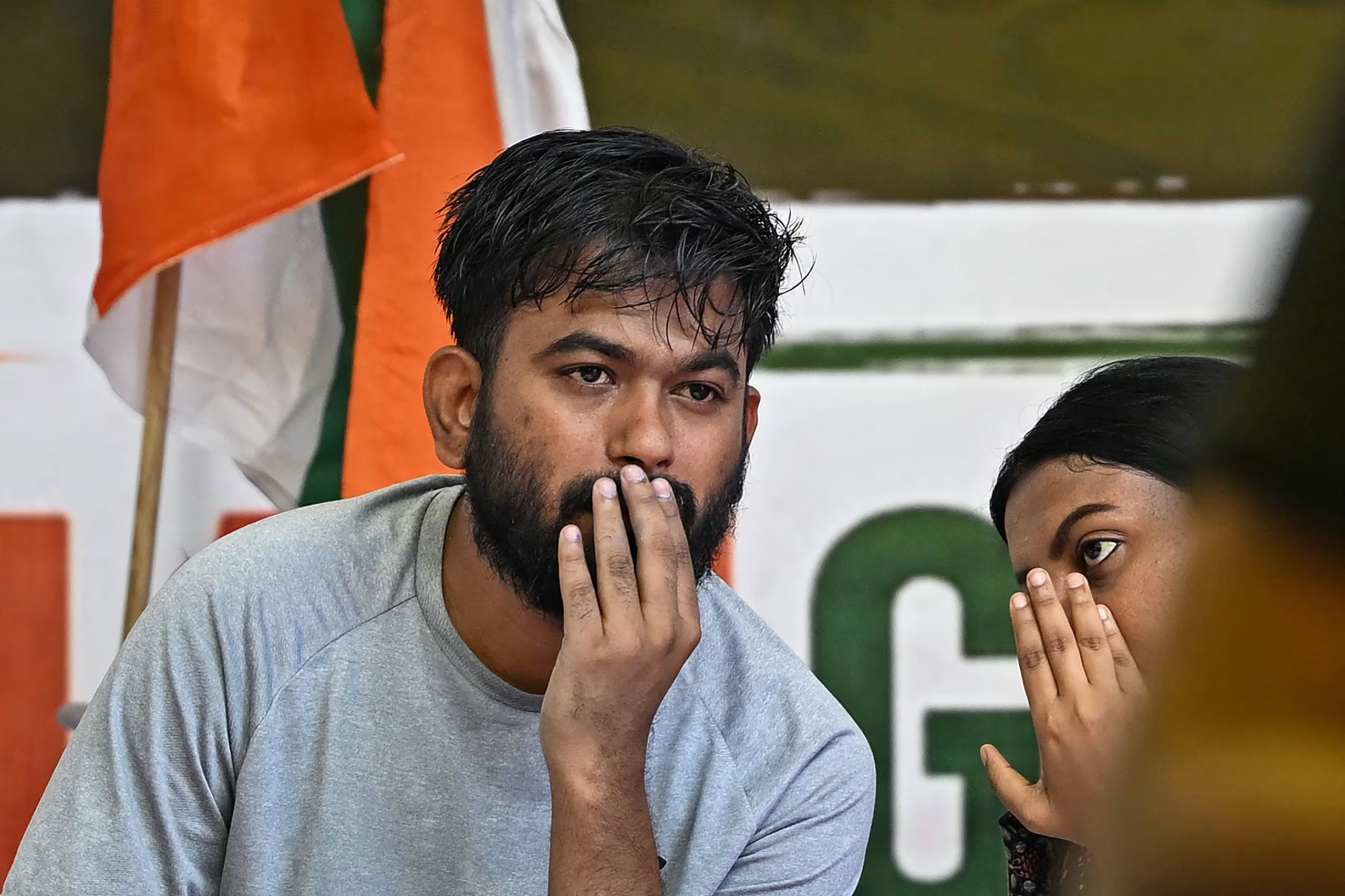
Less than two weeks after his original post, the movement set up outside Jantar Mantar, the 18th-century observatory in New Delhi that has long served as the capital’s designated protest ground. Addressing the hundreds who first assembled, he asked how much longer they intended to live in fear of the government.
Discipline as Strategy
Demonstrators camped there for weeks under a heavy security presence, and Dipke’s team repeatedly pushed one message: keep it peaceful.
That instruction was tactical as much as moral. A movement built on mockery and youth frustration is easily dismissed as chaos, and violence would have handed authorities an immediate justification for clearing the site. Many protesters carried images of Gandhi and B.R. Ambedkar, deliberately anchoring themselves in India’s own tradition of nonviolent resistance.
Dipke insisted on Saturday that the movement had remained peaceful, blaming authorities for the clashes that broke out on Monday when protesters attempted to march toward Parliament. Police described the demonstrators that day as unruly, aggressive and violent.
The Demand, and the Wait
The movement started with one specific ask: Education Minister Dharmendra Pradhan should resign, since the leak occurred on his watch.
For a long stretch, the government largely ignored what was happening, even as the protests spread and broadened. Students formed the core, but people of all ages joined, demanding accountability. The education activist Sonam Wangchuk sustained a 26-day hunger strike in support.
The first crack appeared as public anger grew over protesters being beaten. Officials proposed talks at a senior minister’s residence — an offer the movement refused, insisting that ministers either come to Jantar Mantar or meet on neutral ground. They also rejected partial concessions, dismissing a proposed law against exam leaks as insufficient.
Three rounds of negotiation eventually took place at a neutral venue across five days, between a Cockroach party delegation and senior ministers Jagat Prakash Nadda and Jitendra Singh.
What They Won
The call that reached Dipke onstage late Saturday brought agreement on nearly everything.
The government committed to compensating the families of students who died by suicide following the exam leak. It agreed to drop police cases filed against protesters. And it promised to open discussions on a five-point charter covering wider reform of examinations and education.
Afterward, movement leaders announced they were calling off the protests in good faith, shaking hands with officials in a scene that would have been unimaginable weeks earlier.
The Reluctant Leader
Despite crowds queuing for hours each day simply to shake his hand, Dipke seems uncertain about what he has become. He describes himself as a serious introvert who prefers history books and documentaries, and says he wants attention on the movement rather than himself.
He also worries about his parents in Maharashtra. His mother breaks down on every phone call, which he admitted weakens him. Since returning to India he has spent only two days at home, and while recovering from typhoid he has avoided video calls so his family cannot see how he looks.
By Sunday morning the street outside Jantar Mantar had gone quiet. Yellow barricades were stacked at the roadside. Workers cleared rubbish and painted over the graffiti left on brick walls.
Vijay Solanki, 26, a recent engineering graduate, offered perhaps the clearest explanation of what changed. Most of them were already frustrated, he said — they simply had no idea where to direct it. Dipke brought students together for the first time, and it felt as though their voices were finally reaching someone.
Author
-
Lucienne Albrecht is Luxe Chronicle’s wealth and lifestyle editor, celebrated for her elegant perspective on finance, legacy, and global luxury culture. With a flair for blending sophistication with insight, she brings a distinctly feminine voice to the world of high society and wealth.