NEW DELHI — The India Gen Z cockroach protest that began as a satirical response to an offhand remark by the country’s top judge is about to test its strength against the state, with tens of thousands expected to march on Parliament on Monday.
Their demands have escalated. What started as a call for the education minister’s resignation now includes Prime Minister Narendra Modi’s.
How It Started
The movement takes its name from an insult.
India’s chief justice casually compared government critics and unemployed young people to cockroaches and parasites. The remark caused an uproar.
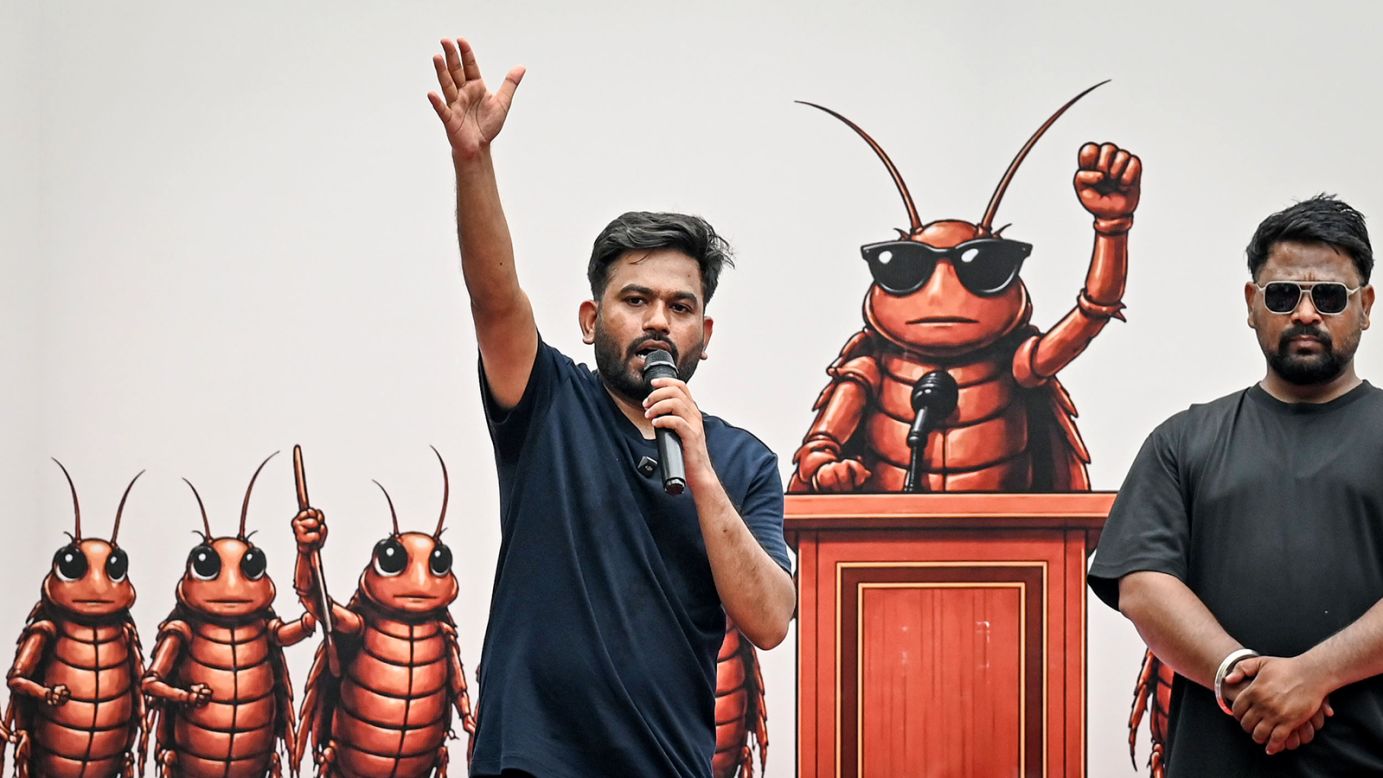
Abhijeet Dipke, a former Boston University student, responded on X with a question: what if all the cockroaches came together?
The joke found its audience immediately. Within days Dipke had built a website inviting people to sign in, and his Instagram following climbed into the millions.
Last month he arrived in New Delhi from the United States, attempting to convert a viral moment into an actual movement on the ground.
Why Exams Became the Flashpoint
The Cockroach Janta Party — the satirical people’s party that emerged from all this — launched with a single demand: the removal of Education Minister Dharmendra Pradhan.
The grievance behind it is concrete and long-running. India’s competitive examination system has been repeatedly compromised by paper leaks, technical failures and cancelled tests. Over the past decade, dozens of students have died by suicide in connection with these failures.
For a generation whose entire economic prospects hinge on exam performance, a rigged or broken system is not an administrative problem. It is the difference between a future and no future.
A Regional Pattern
India’s protests do not stand alone. South Asia has become a center of Gen Z political upheaval, with Bangladesh, Sri Lanka and Nepal all seeing mass movements that toppled unpopular governments.
India has the world’s largest Gen Z population, facing a specific combination of pressures since 2014:
- High unemployment
- Record inequality
- Religious tensions
- A steady decline in the country’s democratic rankings
Wangchuk’s Hunger Strike
Sonam Wangchuk, a 59-year-old engineer turned educator from Ladakh, began an indefinite hunger strike on June 28 in solidarity with the movement.
Wangchuk is not new to this. He conducted a similar strike in September demanding special status for Ladakh, the Himalayan region Modi’s government separated from India-administered Kashmir in 2019.
Three doctoral students joined him: Neha Bora, Aameen Amitoj and Manish, all members of the All India Students Association, the student wing of the Communist Party of India (Marxist-Leninist).
Saturday’s Removal
Twenty days into the strike, police moved.
Officers entered the Jantar Mantar protest site in civilian clothes, stormed the stage, and covered it with white curtains before removing Wangchuk.
Images of the operation spread rapidly online and produced exactly the opposite of what authorities presumably intended.
Police cited a court order and Wangchuk’s deteriorating health. His wife, Gitanjali J Angmo, said he was taken to hospital against his will and called it illegal detention disguised as medical care. She has petitioned the court to have him moved from a government hospital to a private facility of the family’s choosing.
Officers also broke into the tents of the AISA students before protesters forced them out.
Delhi police are controlled by the federal government and have repeatedly demanded that the site be vacated.
The Escalation
Dipke’s response was immediate. He broke down on Saturday morning and pledged to continue the hunger strike in Wangchuk’s place.
His statement marked the turning point: until then the demand had been Pradhan’s resignation, but after what he called a despicable act, the movement would now demand Modi’s.
He has faced physical attacks himself — slapped during an event in Jaipur last month and hit with an ink-like substance on Saturday. Both he and Wangchuk have consistently urged protesters to remain peaceful despite provocation.
Why Monday
The march date was chosen deliberately.
Wangchuk announced the plan on July 8, calling on supporters to do more than send messages from comfortable couches and to come to Delhi on July 20. He described the effort as India’s second freedom movement.
Parliament opens its monsoon session — one of three annual legislative sessions — that same day.
Saurav Das, chief spokesman for the CJP, framed the stakes broadly, telling Al Jazeera the march is about reclaiming India and fighting for a better future not only for students but for the country. He added that it will determine whether the nation and society are still alive.
The Government’s Position
Pradhan has refused to resign. He has gone further, describing the protesters as the B team of terrorists.
Modi, who has not held a press conference in over twelve years but remains active on social media, has said nothing about the protests.
Das characterized the action against Wangchuk as dictatorial, arguing it demonstrates a government that rejects dialogue, deliberation and discussion — the three foundations of democracy.
On the Ground
Jantar Mantar filled Saturday evening as thousands arrived following Wangchuk’s removal.
Shreya Kumar, a 19-year-old Delhi University student, described being shaken by how police cheated the protesters. She said her blood was boiling and accused the government of being liars and cheaters.
She spent the night at the site. Her concern is that police and paramilitary forces may simply overpower the march. Her stated position was defiant regardless: they are ready to face whatever comes, and the minister must resign.
What Monday Could Look Like
New Delhi is heavily deployed with police and paramilitary forces. Other activist groups and political parties have declared solidarity and encouraged participation.
The elements are familiar to anyone who has watched movements in the region over the past two years: a young population with economic grievances, a viral organizing mechanism, a government that has chosen confrontation over negotiation, and a single incident that converted a specific demand into a general one.
What separates a protest from a turning point is usually what happens when the crowd meets the security line. Monday will supply that answer.
Author