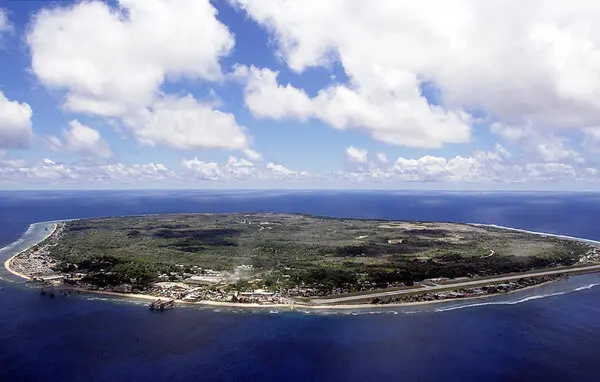
Nauru changes name to Naoero — a shift that looks minor on a map but carries considerable weight for the roughly 12,000 people who live on the remote Pacific island. The country will now be formally known as the Republic of Naoero, aligning its official designation with how the name has always been spelled and spoken in the national language.
What Actually Changes
The adjustment reaches beyond the country’s name alone.
The international code shifts from NRU to NRO. Citizens, previously described as Nauruan, will now be known as dei-Naoero. And the pronunciation moves from the familiar Now-roo to Now-ero.
National aircraft and ships will need to be renamed as well. The government has already begun asking other countries and international bodies to adopt the change.
A Name That Was Never Really Chosen
The reasoning behind the move rests on an uncomfortable piece of history.
According to an earlier government statement, the island became known internationally as Nauru simply because outsiders struggled with the local pronunciation. The foreign version took hold as a matter of convenience rather than through any decision by the people who lived there.
President David Adeang framed the correction in terms of identity when he brought the proposal to Parliament in January, saying the change was meant to more faithfully honour the nation’s heritage, its language and its sense of self.
In his most recent announcement, he described the moment as the start of renewed national pride.
Why No Referendum Was Held
The path to formalising the change took an unexpected turn.
When the government last voted on the matter in May, Adeang announced that a referendum would follow to confirm the decision. That public vote was subsequently dropped.
Lawmakers concluded after extensive discussions that a referendum was unnecessary. The government’s reasoning was distinctive: a referendum exists to establish the will of the people, but Naoero had never actually disappeared — it had simply been waiting to be fully embraced.
The statement noted that the name already functions as the identity of the people, appears on the national coat of arms, is spoken throughout the community, and is permitted under the constitution.
The proposed constitutional amendment cleared the required two rounds of legislative voting, though it was not immediately clear whether the document had been formally amended.
A Very Small Nation With a Turbulent History
Naoero ranks as the world’s third-smallest country by population, trailing only Tuvalu and Vatican City.
The island is a coral limestone atoll with a history shaped repeatedly by outside powers. Germany colonised it, Australia administered it afterward, and independence arrived in 1968.
Economic fortunes since then have swung dramatically:
- The 1970s boom. Phosphate mining generated extraordinary wealth relative to the island’s size, briefly giving residents one of the highest per capita incomes anywhere.
- The collapse. When the phosphate industry failed, the economic foundation vanished with it.
- Near ruin. By the 1990s, the country was on the edge of financial catastrophe.
The mining left another legacy beyond the balance sheet: extensive excavation across the island’s interior, which permanently altered the landscape.
Climate Change and an Unconventional Response
Today the country confronts a threat that dwarfs its earlier economic troubles.
Naoero ranks among the nations most exposed to rising seas. For a low-lying island where habitable land is already scarce, sea level rise is not an abstract projection — it determines whether the place remains livable.
The government’s response has been to pursue overseas investment through a paid citizenship programme, with proceeds intended to fund the relocation of people and infrastructure inland, away from the advancing water.
Such programmes attract criticism internationally, but the underlying calculation is stark. A country of 12,000 people with a collapsed primary industry has few conventional options for financing what amounts to a partial relocation of the nation itself.
Part of a Broader Pattern
Naoero joins a growing list of countries that have shed externally imposed names or sought to standardise how the world refers to them.
Eswatini returned to its historic name in 2018, replacing Swaziland — the designation carried through its colonial period.
Türkiye took a different route in 2022, when Ankara formally asked the United Nations to adopt the spelling the country had long used domestically, effectively closing the gap between internal and external usage.
The motivations vary. Some changes represent a deliberate break with colonial history; others function more as a correction of transliteration. Naoero’s case leans toward the former, since the substitution originated in foreign convenience rather than local choice.
International Recognition Is Already Underway
Adoption has moved faster than might be expected for a country of this size.
The United Nations website now records the nation under its new name, noting that the government submitted the request in June. The foreign ministries of Australia and New Zealand have made the switch, as have the U.S. and Chinese embassies in the region.
That early uptake matters practically. Name changes tend to linger awkwardly when major institutions delay — travel documents, trade paperwork, aviation registries and databases all require updating, and inconsistency creates friction for years.
Why Small Changes Carry Weight
For nations with populations in the thousands rather than the millions, questions of identity operate differently than they do for larger states.
Language, name and cultural continuity represent much of what distinguishes such a country in international forums where economic and military influence offer no leverage at all. When a nation’s population would fit comfortably inside a mid-sized stadium, the name it answers to is not a trivial matter.
Looking Ahead
The Republic of Naoero enters this new chapter facing pressures that far exceed its capacity to address alone. Rising seas will not respond to diplomatic recognition, and the economic model built on selling citizenship carries obvious limitations.
But the name change accomplishes something the government clearly valued: it puts the country’s own word for itself on the official record, in the spelling and pronunciation its people have used all along.
As the government’s statement put it, the name was never lost — it was simply waiting to be taken up in full.
Author
-
Lucienne Albrecht is Luxe Chronicle’s wealth and lifestyle editor, celebrated for her elegant perspective on finance, legacy, and global luxury culture. With a flair for blending sophistication with insight, she brings a distinctly feminine voice to the world of high society and wealth.