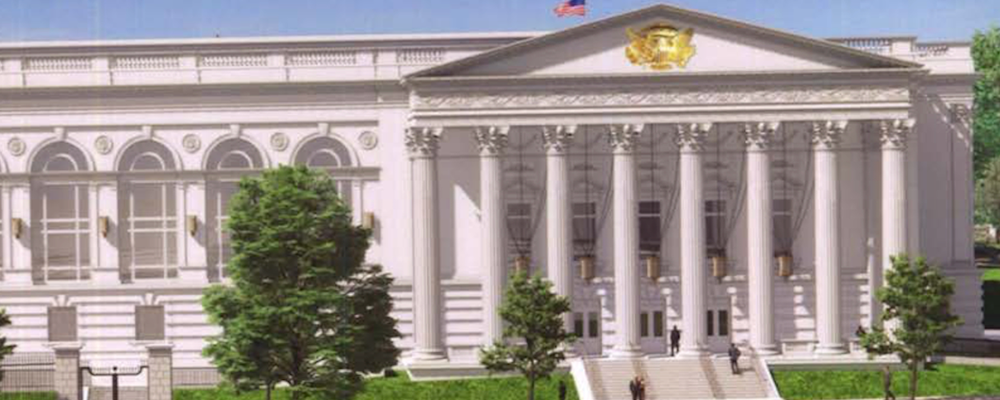
New White House East Wing renderings have surfaced, and the most eye-catching detail is the gold. A large gilded Great Seal of the United States now appears set into one of the building’s pediments, with a smaller gold emblem placed near a run of arched windows.
The images did not arrive through a press release. They emerged inside the Trump administration’s appeal to the Supreme Court, filed in an effort to overturn court rulings that have halted work on the project.
What the Images Show
Beyond the exterior seals, additional renderings depict the interior of the planned ballroom finished extensively in gold-colored trim.
Another element drawing attention is a facility described as a drone port. Renderings for that section show uniformed soldiers positioned around a grouping of military unmanned aerial vehicles.
The Legal Fight
A lower court ruling in August stopped aboveground construction on the grounds that the project lacked congressional approval. The administration is now asking the Supreme Court to reverse that decision.
In the appeal, White House official Joshua Fisher states that construction has reached roughly 65 percent completion, with a target finish date of August 2028.
Fisher also describes what sits beneath the structure. Under the 90,000-square-foot ballroom, he writes, is a security complex engineered to survive bombs, rockets, missiles and even nuclear detonation. He argues that any further delay would put everything already built at risk.
The Money
Cost figures have moved substantially since the project was first announced.
The ballroom is now expected to run around $600 million, with taxpayers covering roughly half of that, according to reporting by the Washington Post.
That represents triple the initial estimate of $200 million — a figure the White House originally said would be financed entirely through private donations.
The shift on both scale and funding source is central to why the project has drawn scrutiny, since the original framing suggested no public expense.
A Design Approval Question
The gold additions may create a fresh procedural problem.
Before signing off on the project in February, the Commission of Fine Arts — the body responsible for aesthetic judgments on historic construction in Washington — successfully pushed the architect to remove a large pediment facing south.
Commission rules require that any modifications to an approved design be resubmitted for review. On its face, adding a substantial gilded seal to a pediment would appear to qualify.
Whether that review produces any real friction is another matter. Every member of the commission was appointed by Trump.
What Lies Beneath Remains Murky
The underground portion of the project is the least clearly documented element.
The National Capital Planning Commission’s official plan indicates a footprint of roughly 22,000 square feet. Trump has publicly described a complex extending six stories underground.
Those two descriptions are difficult to reconcile, and the gap has not been formally explained.
Why This Keeps Generating Conflict
The East Wing project sits at the intersection of several unresolved questions:
- Whether major construction on the White House complex requires congressional authorization
- Who ultimately pays, given that public funding now covers a large share
- How much design authority independent review bodies retain when their members were appointed by the project’s sponsor
- What the actual scope is, particularly below ground
Each of these has produced its own dispute, which is why the project has accumulated an unusually tangled litigation history for a building program.
The Aesthetic Debate
The gold elements will inevitably become the most discussed feature, and reactions tend to divide predictably.
Supporters argue that grandeur is appropriate for the executive residence, that the Great Seal is a legitimate national symbol, and that historic buildings in Washington have long incorporated gilding and ornamental detail.
Critics counter that the White House’s architectural identity rests on neoclassical restraint, and that heavy gilding reads as personal taste imposed on a shared national landmark that outlasts any administration.
That argument is genuinely about values rather than facts, and it will not be settled by a court.
What Happens Next
The immediate decision belongs to the Supreme Court, which must decide whether to lift the construction halt. If it does, work resumes toward the 2028 completion target. If it does not, the administration faces a stalled project at roughly two-thirds completion.
Separately, the Commission of Fine Arts may be asked to review the modified design. Its response will show how much independent scrutiny the project still faces.
For now, the renderings offer the clearest public view yet of what is actually being built — and they arrived, notably, as an exhibit in a lawsuit rather than as an announcement.
Author
-
Lucienne Albrecht is Luxe Chronicle’s wealth and lifestyle editor, celebrated for her elegant perspective on finance, legacy, and global luxury culture. With a flair for blending sophistication with insight, she brings a distinctly feminine voice to the world of high society and wealth.