The Democratic primary results from Tuesday night arrived with one number that overshadowed everything else. In Wisconsin’s race for governor, the winning margin came in at roughly half a percentage point, about 4,000 votes out of more than 750,000 cast.
That razor-thin outcome was one piece of a broader picture stretching across several states this summer, with more progressive contenders repeatedly testing more moderate ones. NPR’s Juana Summers spoke with Amanda Litman, president of Run for Something, an organization that backs young Democrats seeking office, about what the pattern actually shows.
Wisconsin: A Late Collapse, Not a Landslide
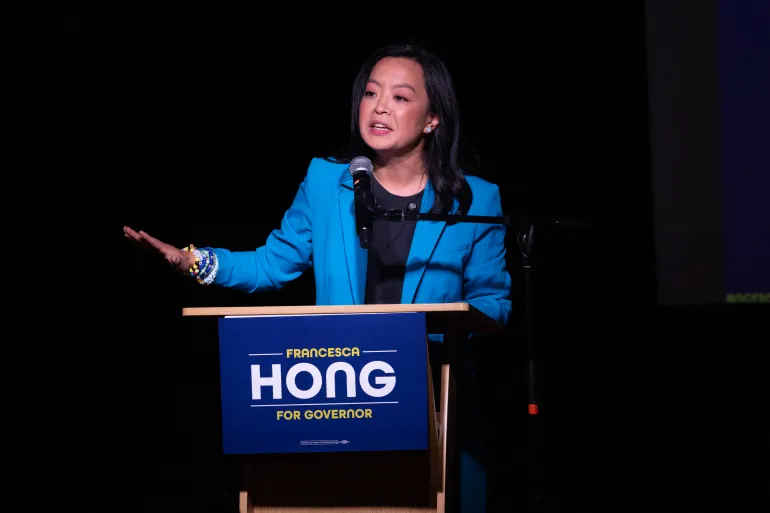
Milwaukee County Executive David Crowley edged past state legislator Francesca Hong, a Democratic socialist who had led comfortably in public polling heading into the final stretch.
Litman offered a straightforward explanation for the reversal. Voters, she said, largely tuned in only during the closing days. A substantial amount of money was deployed on Crowley’s behalf, including heavy television advertising, while the party establishment closed ranks behind him.
Hong’s own trajectory made the outcome more striking. She began the race polling at essentially zero, built an operation with thousands of volunteers, and climbed into contention. Then, in Litman’s assessment, things wobbled in the final week. There were interviews she likely wishes had gone differently, and she struggled to put distance between herself and old social media posts.
Litman’s summary of the polling was blunt: surveys capture a single moment, and repeated experience shows they are not reliable predictors of what happens on election day.
The Electability Argument, Examined
Much of the commentary surrounding Hong focused on whether she could realistically win a general election in a swing state, given past positions including support for defunding police.
Litman pushed back on the certainty behind that framing. Nobody actually knows, she argued, and 2026 has already produced enough unexpected results that ruling out an unconventional candidate seems premature.
She did not dismiss the difficulty. A general election run would have required a substantially different campaign team, significant fundraising, and a plan for handling the opposition research Republicans would have deployed. But difficult and impossible are not the same thing.
She was sharper about how the conversation itself was conducted. One pundit characterized Hong as a kind of faculty lounge curiosity, a description Litman considered both inaccurate and revealing. Hong’s actual background is that of a working chef from an immigrant family who did not complete college, which sits awkwardly with caricatures of detached academic leftism.
The real issue, in Litman’s reading, was communication rather than identity. Hong held strong convictions and expressed them, particularly around 2020, in ways she might phrase quite differently today.
Minnesota: The Race People Are Underrating
Attention shifted north to Minnesota, where Lieutenant Governor Peggy Flanagan defeated Representative Angie Craig for the Senate nomination.
Immigration proved decisive. Craig had voted early in Trump’s second term for the Laken Riley Act, legislation Litman characterized as aggressively anti-immigrant. Roughly eighteen months later, with federal immigration enforcement operating visibly in Minnesota and lethal incidents on state streets, that vote read very differently to primary voters.
Flanagan, meanwhile, assembled a campaign that reached across multiple constituencies and won comfortably.
Litman argued this contest deserves more attention than it has received, and that squeezing it into a simple establishment-versus-insurgent frame misses what actually moved voters.
A Regional Appetite for Something New
Taken together with Abdul El-Sayed’s narrow win in Michigan’s Senate primary, the results point toward something broader across the upper Midwest.
Litman’s read is that Democratic primary voters have run out of patience with the status quo. They are actively looking for people who were not part of creating the current situation to help get out of it. That impulse is producing experimentation with different candidate profiles and different campaign styles.
Her framing of the message problem is worth quoting in spirit if not in words. Opposing Trump is no longer a platform by itself. Voters want to know what a candidate intends to build, not merely what they intend to block.
Even Hong’s defeat fits that reading. She finished near 40 percent from a standing start, in a race the establishment mobilized heavily to win.
Connecticut and the Age Question
The fourth notable result came in Connecticut, where fourteen-term Representative John Larson lost to former Hartford Mayor Luke Bronin, who is 31 years younger.
Litman, whose organization exists specifically to recruit young candidates, did not hedge. She reiterated a position she took publicly last year, calling on Democrats over 75 to treat their current term as their final one.
Her argument is that when veteran incumbents are forced to make an affirmative case for why they specifically are the right person for this moment, many struggle to do it. Larson had faced health difficulties and communication problems, including a widely circulated video from a farmers market in which he appeared unfamiliar with both content creation and boba tea.
She stopped short of a blanket rule. Some older legislators can still connect with their constituents, she acknowledged. Larson, in her view, could not.
The Counterargument
Summers pressed the obvious rebuttal. Long-serving members would argue that experience carries real value, that they understand legislative procedure, and that institutional knowledge translates into effective representation.
Litman’s response was essentially a demand for evidence. Have those advantages produced results over the past several years?
Her contention is that over roughly the last eighteen months, many establishment figures have accommodated rather than resisted, showing less resolve than their own voters have demonstrated. Procedural expertise that is not deployed toward meaningful outcomes, she suggested, offers little justification for keeping the same people in place.
Reading the Results Honestly
Litman represents one perspective, and an interested one. An organization built around electing young Democrats will naturally read generational turnover as the central story.
Others would emphasize that the moderate candidate still won Wisconsin, that establishment consolidation still worked when deployed seriously, and that a 40 percent showing is a loss regardless of momentum.
Both readings can be partly right. What Tuesday demonstrated most clearly is that outcomes are no longer predictable from party positioning alone, and that margins this narrow leave enormous room for interpretation.
Author
-
Lucienne Albrecht is Luxe Chronicle’s wealth and lifestyle editor, celebrated for her elegant perspective on finance, legacy, and global luxury culture. With a flair for blending sophistication with insight, she brings a distinctly feminine voice to the world of high society and wealth.