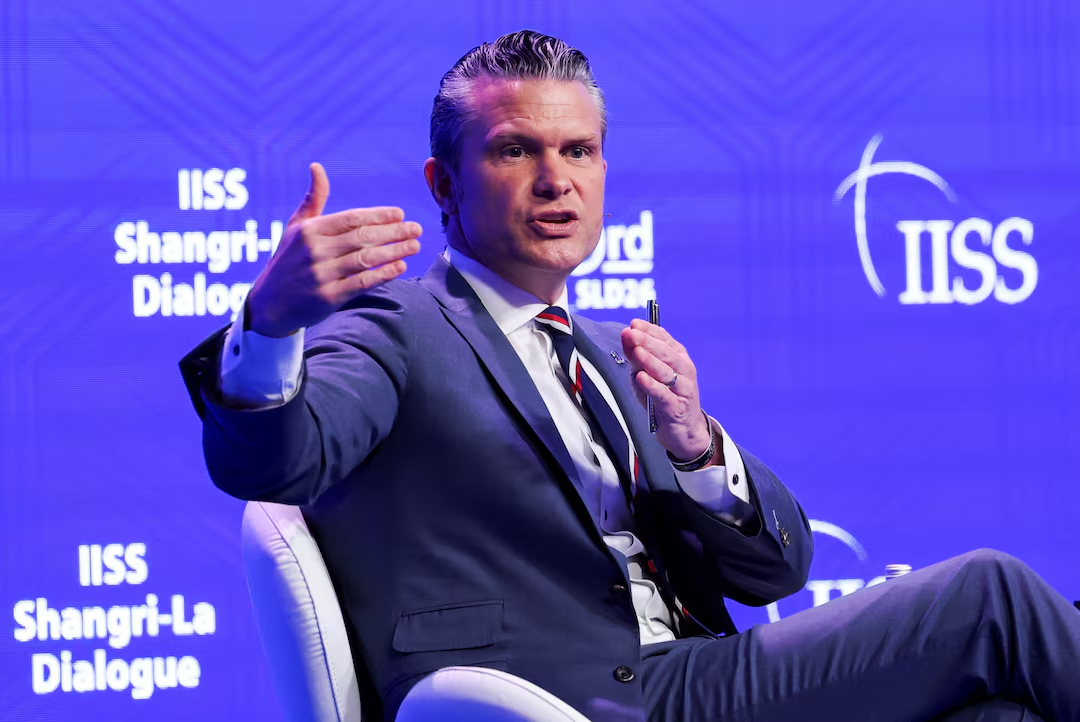
In a closely watched address, the message on Hegseth’s Asia military spending was unmistakable: allies across the region should significantly increase their defense budgets to counter China’s growing power. Yet what the U.S. Defense Secretary left unsaid, most notably any mention of Taiwan, drew nearly as much attention as what he chose to emphasize, leaving many in the region searching for clarity.
A Call to Spend More
Speaking Saturday at the Shangri-La Dialogue, a key annual regional defense summit in Singapore, Defense Secretary Pete Hegseth urged Asian allies to ramp up military spending to confront what he described as China’s historic military buildup.
His appearance carried added weight given the timing. It came just over two weeks after President Donald Trump held a summit with Chinese leader Xi Jinping in Beijing, a meeting both sides praised as a success. Against that backdrop, Hegseth struck a notably balanced tone on the bilateral relationship.
He acknowledged that U.S.-China relations are better than they have been in many years, while simultaneously warning that there is rightful alarm about China’s military activities in the region and beyond. Addressing a room filled with military officials, defense leaders, and diplomats, Hegseth cautioned that a Pacific dominated by any single hegemon would unravel the regional balance of power and undermine the equilibrium that nations are seeking to preserve.
A Shift in Tone From a Year Earlier
This marked the defense secretary’s second appearance at the forum, and the contrast with his previous address was striking. A year earlier, Hegseth had adopted a more confrontational posture toward Beijing.
In his 2025 speech, he asserted that China sought to be a hegemonic power in Asia, one hoping to dominate and control too many parts of the region. He was especially pointed on Taiwan at the time, declaring that China’s military harasses the self-governing island, which Beijing claims as its own, on a daily basis.
This year’s omission of Taiwan therefore stood out sharply, suggesting a deliberate softening or a strategic recalibration in the wake of the Trump-Xi summit.
The Taiwan Question Looms Large
The silence on Taiwan was particularly conspicuous given recent developments that had unsettled the region. Following Trump’s trip to Beijing, the president sparked concern that the United States might pull back its support for the island.
Several developments fueled the unease:
- Trump commented that arms sales to Taiwan represent a “very good negotiating chip” with China.
- Days later, a senior U.S. official said that arms sales to Taiwan had been paused due to the war in Iran.
These signals left many in the region eager for reassurance. According to Ankit Panda, a senior fellow in the nuclear policy program at the Carnegie Endowment for International Peace who was in the audience, people wanted clarity on both Taiwan and Iran, but he found Hegseth’s speech to be light on substance.
When pressed by the audience to address Taiwan directly, Hegseth sought to downplay concerns. He said the United States had sufficient weapons in stock and that decisions on future arms sales to Taiwan rest solely with President Trump, while insisting that there had been no change in the U.S. status on the matter.
Reaffirming a Hard Line on Iran
On the Middle East, Hegseth echoed Trump’s earlier position. He reiterated that the United States would not agree to a deal unless it was a good one that ensures Iran does not obtain a nuclear weapon.
He also signaled continued resolve, stating that the United States stands ready to resume strikes on Iran if no agreement is reached. He noted that some U.S. strikes had already taken place the previous week, underscoring that the option of force remained very much on the table.
The Bigger Strategic Picture
Even as Hegseth highlighted improved U.S.-China relations, he acknowledged the deeper reality that the two nations remain strategic competitors over the long term. That tension places many regional players, especially smaller Southeast Asian nations, in an uncomfortable position, caught between the two great powers.
That anxiety was voiced clearly at the forum. In a keynote speech on Friday, Vietnam’s President To Lam warned that one of the biggest risks is unchecked competition, a dynamic in which might makes right.
Critics argued that Hegseth offered little to ease these concerns. Panda observed that the pathway to avoiding conflict between the United States and China remained entirely unclear, particularly given how much of the secretary’s speech leaned into themes like lethality and dominance. He noted that Hegseth did not lay out a clear vision for how the United States expects to reach what he has called a decent peace with China.
A View From Beijing
China once again declined to send its defense minister, opting for a second consecutive year to dispatch a lower-level delegation of military experts and scholars instead.
Even so, observers connected to Beijing detected meaningful nuance in Hegseth’s remarks. Zhou Bo, a retired senior colonel of the Chinese air force and senior fellow at Tsinghua University, characterized the speech as more moderate on U.S.-China relations than the secretary’s first address at last year’s forum.
Zhou placed particular significance on Hegseth’s reaffirmation of what Trump and Xi had agreed to at their recent summit, namely to build a constructive, strategic partnership. In Zhou’s assessment, this represented the first time the United States had officially recognized the equal strengths of China as a peer power, a development he clearly viewed as notable.
The Bottom Line
Hegseth’s Asia military spending message put the burden squarely on allies to invest more in their own defense, framed against the backdrop of China’s expanding military might. Yet his careful, more moderate tone, combined with his silence on Taiwan and the absence of a concrete roadmap for managing competition with Beijing, left significant questions unanswered.
For a region wedged between two superpowers and anxious about its own security, the speech offered both reassurance and uncertainty in roughly equal measure. As nations weigh how much to spend and which way to lean, the lack of clarity on flashpoints like Taiwan ensures that the strategic anxieties on display in Singapore are unlikely to fade anytime soon.
Author