Grand Canyon flash flooding that tore through the Inner Canyon last weekend did not come down to rainfall alone, officials say. The event was the product of several factors stacking together, and one of them dates back more than a year.
The Fire That Changed the Ground
The Dragon Bravo wildfire burned across the North Rim in 2025 and destroyed the Grand Canyon Lodge. Its perimeter sat directly above several canyons, including the drainage feeding Bright Angel Trail, the route hikers take down toward the Colorado River.
That is precisely where the flooding occurred.
Burn scars behave very differently from unburned terrain. Fire strips away vegetation that would normally slow and absorb water, and intense heat can leave soil water-repellent. Rain that would once have soaked in instead sheets off the surface almost immediately.
When that runoff funnels into narrow slot canyons, it accelerates and gathers debris on the way down.
The Rainfall Totals
Rain gauges operating from Saturday morning through 3 p.m. captured meaningful numbers, though several stopped reporting during the event.
- A gauge below the North Rim, upstream from Bright Angel Canyon: an inch and a quarter
- A gauge nearer Phantom Ranch: just over an inch
- Additional gauges upstream from Bright Angel Canyon: just over half an inch before failing
Those totals may sound modest. Over a burn scar draining into confined canyons, they are not.
The rate matters more than the total. Radar imagery from that morning showed storms repeatedly training over the same section of burn scar for several hours. By 2:30 p.m., the estimated rainfall rate had reached five inches per hour.
Water arriving that quickly has nowhere to go on scorched ground.
The Timeline of Warnings
The sequence shows how little margin existed once the system organised.
- 12:02 p.m. — first flash flood warning issued for Supai, west of the canyon, with storms tracking northeast
- 2:42 p.m. — first flood warning issued for Bright Angel Canyon
- 2:51 p.m. — report from the Grand Canyon of a wash flooding a trail and rendering it impassable
- 2:53 p.m. — report from Havasu Gardens of the campground flooding with a foot of water
- 2:55 p.m. — a further flash flooding report
Roughly 11 minutes separated the warning for Bright Angel Canyon and confirmed flooding on the ground.
Eleven minutes is not much time for someone deep in the canyon, where cell service is largely absent and the only escape from a drainage is upward.
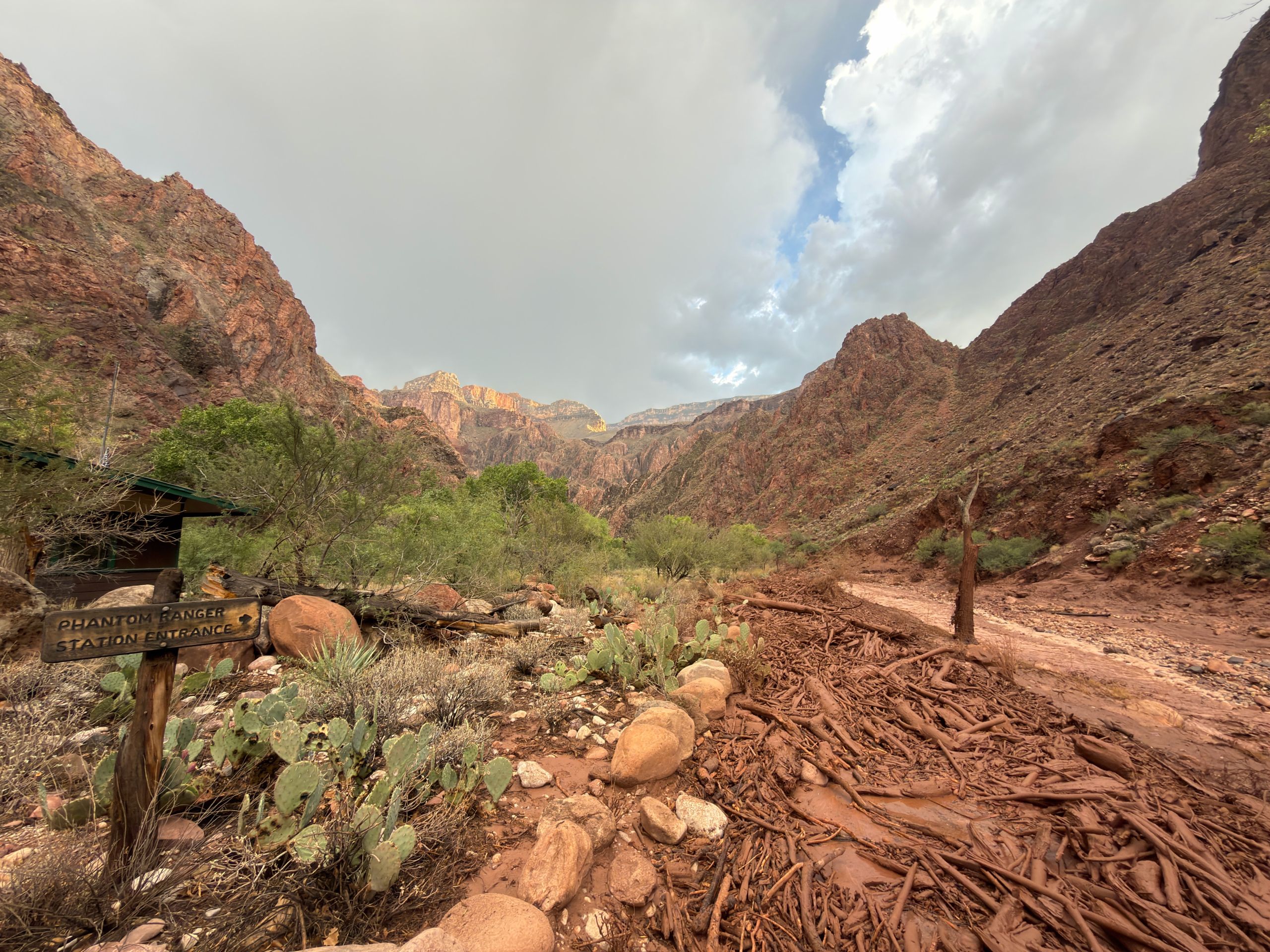
Debris from the burn scar moved downslope with the water, reaching the campgrounds below.
Why This Combination Is So Dangerous
Three factors compounded one another.
First, the burn scar removed the landscape’s capacity to absorb water. Second, the storm parked over the same area rather than moving through, delivering repeated bursts to an already saturated surface. Third, the terrain itself funnels everything into narrow channels that concentrate flow and speed.
Hikers in the Inner Canyon could have been under clear skies while the rain fell thousands of feet above them. That is the recurring hazard in canyon country: the danger is generated upstream and arrives without visual warning.
Investigators Are Asking for Help
The National Park Service is seeking information about anyone who was in the Inner Canyon along the Bright Angel Creek corridor on Saturday.
They want to hear from or about:
- Hikers and backpackers who were in that corridor
- Anyone holding a campground reservation in the area
- People who had permits, and people who did not
That last point is deliberate. Investigators are making clear they are trying to account for everyone present, not enforce permit rules.
Anyone who has not been able to reach someone who may have been in the area is asked to call the NPS tip line at 888-653-0009.
What This Means Going Forward
Burn scars remain hazardous for years after a fire is contained. Vegetation takes time to return, and soil recovery is slower still. The Dragon Bravo fire reached full containment in 2025, but the drainage above Bright Angel Canyon has clearly not returned to its pre-fire behaviour.
For anyone planning to hike below a recently burned area, a few things are worth carrying into the trip:
- Check whether your route sits downstream of a burn scar
- Watch forecasts for the area above you, not just your location
- Treat any rain over a burn scar as a serious signal
- Identify high ground before you need it
- Understand that warning lead times in this terrain may be measured in minutes
The Grand Canyon has always produced flash floods. What the Dragon Bravo scar changed was how quickly rainfall becomes a wall of water, and how little warning anyone below gets.
Author