“I Can Never Repay Him”: A Father Speaks About the Teenager Who Pulled His Son From the Surf
The Seabright Beach rescue that has been watched millions of times online looks, from the outside, like a two-minute drama with a happy ending. For Sumit Rai, it began with a phone call in Dallas and has not really finished yet.
His 10-year-old son Nathaniel was standing in ankle-deep water at the Santa Cruz beach on Saturday when a powerful set of swells came ashore. He lost his footing and was pulled out.
Rai, more than 1,500 miles away, learned about it that evening when he spoke to his children.
The Call
His son’s account was blunt in the way children’s accounts often are.
Rai said Nathaniel told him he had drowned, and that he had gone unconscious. The boy was subdued, still in shock. Rai filled in more details from his eight-year-old daughter.
By the following morning, he had seen the video.
What He Saw in It
Rai’s gratitude is specific rather than general, and it centres on a judgment the lifeguard made in a fraction of a second.
He described conditions that were, in his words, deadly — waves reaching ten feet, rip currents pulling outward. Entering that water was not safe, he said, and the lifeguard did it anyway, risking his own life.
Rai has also spoken about the physical demands of what followed. His son weighs around 100 pounds and was unconscious — dead weight in moving water. Letting go, he pointed out, would have been easy, and it would have ended differently.
The Lifeguard’s Version
Ryder Williams, 16, has described the sequence in flat, procedural language.
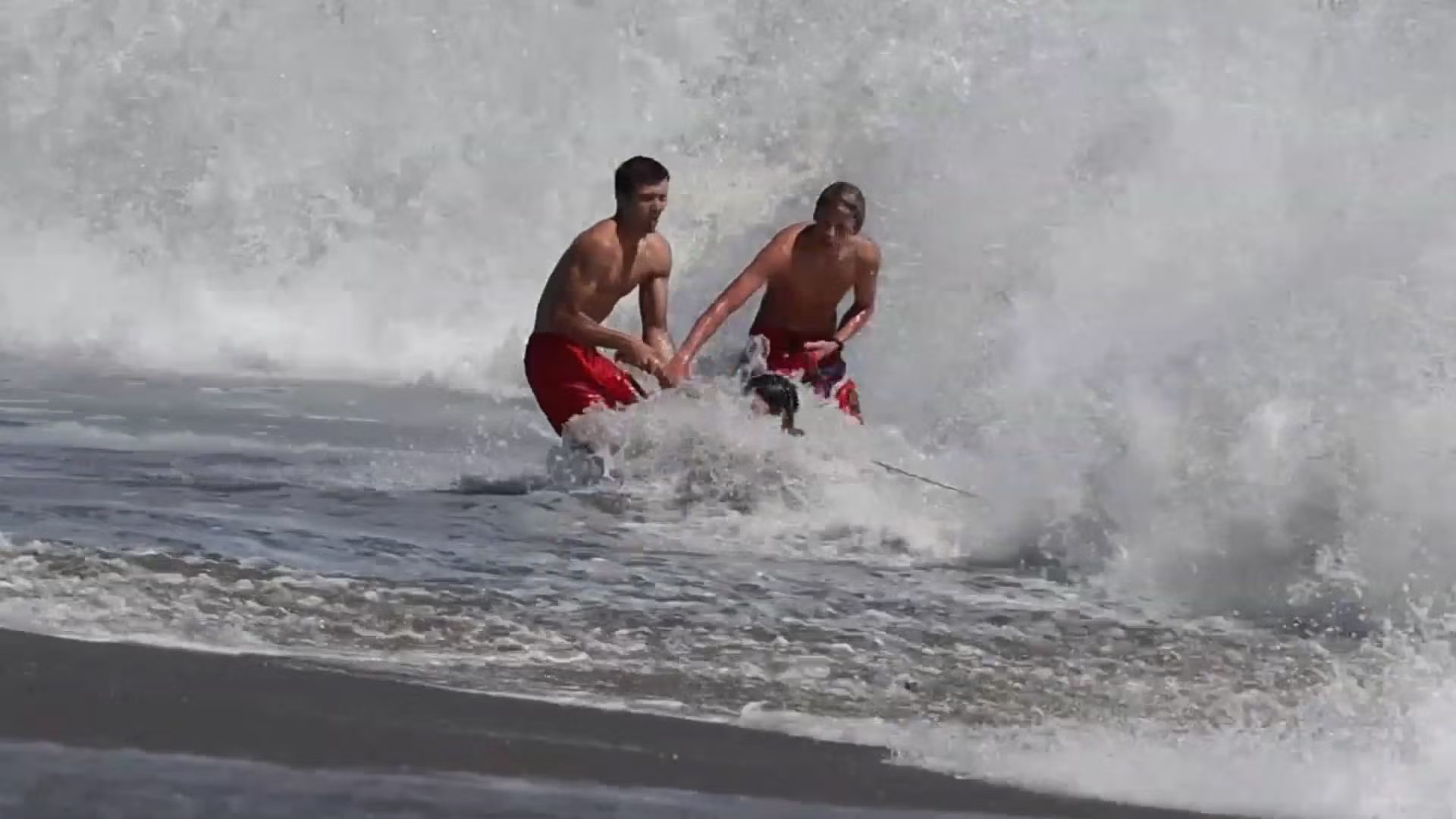
He saw the boy lose his footing in shallow water, radioed it in and ran. He deployed his rescue buoy and went in. After the first wave, he could not pull the child clear because the boy was limp and the surf was pushing too hard.
California State Parks, which employs lifeguards at the beach, said Nathaniel had been swept roughly 15 yards out before Williams reached him. In the footage, Williams can be seen diving into an oncoming wave while keeping hold of the boy.
A second lifeguard, Aaron Bohnen, entered the water to help. Bystanders also went in, and Williams says he shouted at them to get back to shore — the correct instruction, and one that likely prevented additional casualties.
Afterward, Williams returned to his tower and finished his shift.
His own account ends with credit deflected: he said he was grateful to have returned the child safely to his family, that this is his job and he loves it, and that his colleagues perform rescues like this every day.
Nathaniel’s Recovery
Physically, the outcome was good. State Parks said the boy had no serious injuries and was released to his family after a medical evaluation.
Rai said his son described getting sand in his lungs and coughing it out once he was ashore.
The harder part is what came after. Nathaniel is due back from California in a few days, and his father says the experience is still very much with him — on his mind during the day and disturbing his sleep. Rai described it plainly as traumatising.
That is an ordinary reaction rather than a worrying one. Children who survive near-drowning frequently experience intrusive memories, sleep disruption and fear of water in the weeks afterward. Most of it resolves, particularly with patient adults who let the child talk about it on their own schedule and do not rush them back into the water. Where symptoms persist beyond a month or so, therapies specifically designed for childhood trauma are effective, and a paediatrician is the usual starting point.
The White House Question
The video’s reach brought attention Williams’s family did not seek.
President Donald Trump posted about awarding him a high civilian honour and invited him and his family to the White House. Asked whether they intended to accept, Williams’s father Shane said they had not yet heard from the administration officially.
The family has described the attention as overwhelming, with Shane Williams noting that he has been trying to shield his son from it and that, whatever the footage shows, Ryder is still a kid.
The Wider Context
Saturday was a difficult day along the entire California coast. A beach hazard statement was in effect, with swells producing consistent four-to-six-foot waves and sets occasionally reaching ten. Warm weather had drawn heavy crowds into those conditions.
Santa Cruz district lifeguards performed 34 rescues over the weekend. Williams himself is reported to have made several more that same day, some of which relatives describe as harder than the one that was filmed.
Rai has emphasised what makes rip currents so dangerous for anyone who has not encountered one: they pull outward, they are exhausting to fight directly, and someone who is unconscious cannot help themselves at all.
The standing advice remains the same in most conditions — swim near a lifeguard, watch the ocean before entering it, keep small children within arm’s reach at the waterline, and if someone is in trouble, call for help and keep them in sight rather than swimming out yourself.
What Comes Next
Rai has reached out to Williams and hopes to thank him in person.
His summing up was short and unqualified: what the teenager did is something he can never repay, and he will be grateful for the rest of his life.
Whether the White House visit happens is, in the scheme of this story, a footnote. The part that mattered was decided on Saturday afternoon by a 16-year-old standing 20 yards away who ran toward the water instead of away from it, and then refused to let go.
Author