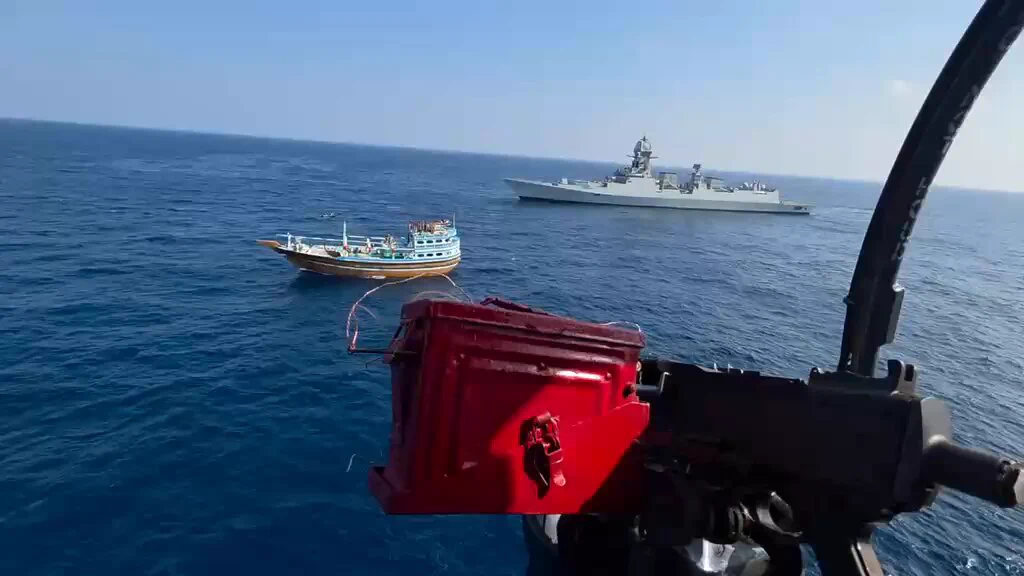
Indian Navy rescue teams have freed all 20 crew members of a hijacked fishing vessel after a tightly coordinated operation lasting two full days in the Arabian Sea. The vessel, named Azini, was recovered from heavily armed pirates more than 3,000 kilometres from Mumbai on November 2, Defence Minister Rajnath Singh confirmed.
A Mission Far From Home Waters
The distance involved underscores the scale of the undertaking. Operating thousands of kilometres from India’s western coast, naval forces first had to pinpoint the location of the hijacked boat across a vast expanse of open ocean. Once found, the vessel had to be intercepted and the crew extracted without loss of life, all while facing pirates described by the defence minister as significantly armed.
According to Singh, the sequence unfolded in stages: rapid localisation of the Azini, interception by naval assets and finally the safe release of both the crew and the boat. The entire effort was wrapped up within 48 hours.
Air Force Lends Support
The operation was not a navy-only affair. Singh noted that the Indian Air Force provided timely assistance, likely in the form of long-range surveillance and reconnaissance to help track the vessel’s movements. Coordination between the two services allowed the Navy to close in quickly and decisively.
Such joint operations have become a hallmark of India’s approach to maritime security, combining aerial reach with naval presence to cover the enormous distances involved in patrolling the Indian Ocean.
The Defence Minister’s Praise
Singh took to X to congratulate the Navy, describing the mission as meticulously planned and executed. He said the speed and precision of the rescue reflected the force’s high state of readiness and its capacity to respond with authority to threats at sea.
The minister went further, framing the operation as proof of India’s broader commitment to protecting lives and maintaining order across the Indian Ocean Region. He reiterated that the country remains firm in its pursuit of what he called SAFE SEAS and a free, open and secure maritime domain.
India’s Growing Role as a Maritime Security Provider
The rescue of the Azini fits a pattern that has emerged over recent years. The Indian Navy has increasingly positioned itself as a first responder to piracy, hijackings and other maritime emergencies in the western Indian Ocean, including in waters far from its own shores.
Previous operations have seen Indian warships intercept pirate-controlled vessels, free hostages of multiple nationalities and detain suspected pirates for prosecution. These missions have earned the Navy a reputation for reliability among shipping companies and regional governments alike.
The Arabian Sea and the wider Indian Ocean carry a significant share of global trade, including energy shipments vital to India’s own economy. Keeping these routes safe is both a strategic priority and a point of national pride.
Why Fishing Vessels Are Targeted
While large commercial ships often draw the most attention, smaller fishing boats are frequent victims of piracy. They typically lack the security measures and speed of bigger vessels, making them easier to board. Pirates sometimes seize such boats to use as mother ships for launching attacks further out to sea, or hold crews for ransom.
The 20 crew members aboard the Azini would have faced considerable danger during their captivity. The Navy’s ability to secure their release without reported casualties is a notable outcome.
Questions That Remain
Official statements have so far focused on the success of the rescue rather than the details of how it was carried out. It has not been disclosed what happened to the pirates following the interception, whether they were detained, or how many were involved. The nationalities of the rescued crew have also not been specified.
The precise contribution of the Air Force, beyond general support, has likewise not been detailed. These aspects may be clarified in subsequent briefings as the Navy completes its post-operation assessment.
A Message to Would-Be Pirates
Beyond the immediate relief for the crew and their families, the operation sends a clear signal. India has demonstrated that it is willing and able to project force across great distances to protect those in peril at sea. For pirate groups operating in the region, the prospect of a swift and well-coordinated response from the Indian Navy serves as a deterrent.
The Bigger Picture
The Indian Ocean has seen a resurgence of piracy concerns in recent years, with instability in parts of the Horn of Africa and the Gulf region creating conditions that criminal networks can exploit. Against this backdrop, the Navy’s growing operational tempo reflects a recognition that maritime threats cannot be left unchecked.
The Azini rescue adds to a record of successful interventions that have cemented India’s standing as a key security actor in the region. For the 20 crew members now safely freed, the mission was a lifeline. For the Navy, it was another demonstration of capability in a domain where India intends to remain a dominant presence.
As Singh put it, the operation reflected the country’s resolve to safeguard lives and uphold stability at sea, a commitment that will be tested again as long as piracy persists in the waters of the Indian Ocean.
Author