Iran Signals Move Toward “Maximum Deterrence” as US Memorandum Lapses With Talks Stalled
The Iran US memorandum expires today, and with negotiations to end the war firmly deadlocked, Tehran has begun signalling a shift in military doctrine that could reshape the conflict’s next phase.
The Memorandum of Understanding, signed between the two governments in June, has now reached its termination point without a successor agreement in place. What follows is uncertain, but the language coming out of Tehran suggests the ambiguity will not last long.
A Warning From Within the Revolutionary Guard
Brigadier General Yadollah Javani, a senior commander in the Islamic Revolutionary Guard Corps, delivered the most consequential statement of the day.
According to Javani, Iran’s military stance is prepared to move from a defensive footing to an offensive one under what he described as a new maximum deterrence policy.
The phrasing is deliberate. Deterrence framed as maximum implies a posture that does not simply absorb and respond, but one that seeks to impose costs preemptively or at least to make the threat of doing so unmistakable. Coming from the IRGC rather than the diplomatic corps, the message carries a different weight.
Tehran Rejects the Mediation Narrative
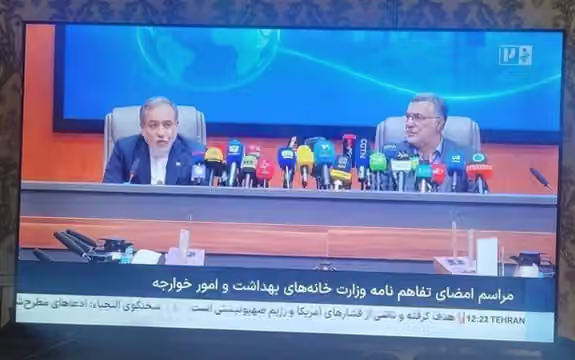
While military voices spoke of escalation, the Foreign Ministry addressed a separate question: whether the diplomatic impasse reflects a shortage of suitable intermediaries.
Ministry spokesman Esmail Baghaei rejected that framing outright.
He acknowledged that several countries are already engaged. Pakistan and Qatar, he said, are actively making efforts and playing a role in the relationship between Tehran and Washington.
He also allowed that European governments expressing willingness to offer their good offices in bilateral contacts is entirely natural behaviour. But he cautioned against reading those overtures as the emergence of a new accepted mediator in the process.
Where Tehran Places the Blame
Baghaei’s central argument was that mediation is not the bottleneck at all.
The fundamental challenge, in his account, stems from the outlook and miscalculations of the American administration, along with its insistence on methods and approaches he characterized as having failed hundreds of times over.
That position effectively forecloses the possibility that a new intermediary or diplomatic format could break the deadlock. If the obstacle is the substance of the American approach rather than the channel through which it is communicated, then adding channels changes nothing.
The Strait of Hormuz Problem
Baghaei also provided an update on a parallel track of diplomacy involving Oman, one focused on establishing a secure maritime transit route.
The stakes there are difficult to overstate. Roughly one fifth of the world’s oil and gas passes through the Strait of Hormuz, making it among the most consequential chokepoints in global commerce.
Baghaei described the process of drawing up the transit route plan as time-consuming, attributing the delay to several factors:
Security complexities arising from actions taken by the United States and Israel
The sheer number of actors operating in the waterway
Obstruction by what he termed disruptive elements
He characterized the issue as inherently complex and argued that the insecurity now affecting the strait, the wider region and global shipping resulted from illegal military action by Washington and Israel.
An Unprecedented Mechanism
Despite the difficulties, Baghaei presented the Iran-Oman effort as something genuinely new.
The proposed framework would attempt to serve two purposes simultaneously: protecting the interests of both countries while keeping commercial shipping moving. He described it as the first occasion on which a mechanism has been developed to safeguard the sovereign rights of two littoral states and ensure safe passage for commercial vessels at the same time.
He added that intensive discussions with Oman to finalize a joint statement and establish that secure mechanism are continuing in earnest, notwithstanding what he described as previous American failures to honour commitments.
Reading the Two Messages Together
The day produced two signals that pull in different directions, and both appear to be intentional.
From the military establishment comes the language of escalation and offensive readiness. From the diplomatic establishment comes talk of ongoing negotiations with a neighbouring state to keep a vital waterway functioning.
That combination is not necessarily contradictory. A government preparing for a harder military phase has strong reasons to simultaneously secure arrangements protecting its own commercial access and to frame regional insecurity as an imposed condition rather than a chosen one.
What the Expiry Actually Changes
The lapsing of the June memorandum removes whatever constraints or understandings it contained, though the document’s specific provisions have not been detailed publicly in this account.
What is clear is that its expiry arrives without a replacement framework, without agreement on mediators, and alongside explicit talk from Iranian military leadership about transitioning to an offensive posture.
For shipping operators, energy markets and regional governments, the immediate question is whether the Hormuz talks with Oman advance quickly enough to establish some measure of predictability before the military posture Javani described begins translating into action.
Author
-
Lucienne Albrecht is Luxe Chronicle’s wealth and lifestyle editor, celebrated for her elegant perspective on finance, legacy, and global luxury culture. With a flair for blending sophistication with insight, she brings a distinctly feminine voice to the world of high society and wealth.