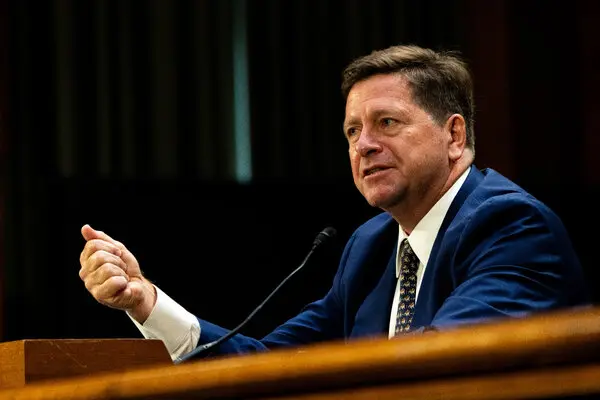
Jay Clayton is now the director of national intelligence, sworn into one of the most sensitive jobs in Washington after a Senate vote that split almost perfectly along party lines. The 51-47 tally on Tuesday closed out a nomination fight that began with rare bipartisan goodwill and ended with every Democrat in the chamber voting no.
The confirmation also ends the brief and turbulent stint of acting DNI Bill Pulte, whose installation had infuriated Democrats and unsettled more than a few Republicans.
A Bipartisan Start That Quickly Fell Apart
When President Donald Trump named Clayton for the post in June, the choice initially landed well on both sides of the aisle. Senators from each party seemed willing to move quickly, partly because the alternative sitting in the chair worried them.
Sen. Mark Warner of Virginia and Sen. Tom Cotton of Arkansas worked out an arrangement to accelerate the process. For Democrats, the appeal was simple: confirm Clayton fast enough and Pulte would never spend a single working day running the intelligence community. For Republicans, the trade offered the votes needed to renew Section 702 of the Foreign Intelligence Surveillance Act, the statute underpinning much of America’s foreign surveillance work.
That agreement collapsed before it could be executed. On the morning Clayton was scheduled to appear before senators, Trump stepped in and pulled the plug, arguing that a rushed confirmation would hand Democrats leverage in the surveillance negotiations. He also brushed aside the criticism of Pulte as exaggerated.
The consequences were immediate. Section 702 lapsed on June 12. Pulte moved into the acting role once Tulsi Gabbard stepped down later that month. And Democrats gained weeks of extra time to dig into Clayton’s record.
Why Democrats Soured on the Nominee
The extra scrutiny did not work in Clayton’s favor.
During his confirmation hearing this month, he declined again and again to state plainly that Joe Biden legitimately won the 2020 presidential election. For Democrats already anxious about how intelligence agencies might be used heading into the midterms, that refusal became the defining moment of the hearing.
He also stumbled when pressed on Gabbard’s decision to show up at an FBI raid on an election facility outside Atlanta. Asked whether he would do anything similar as spy chief, he would not commit either way.
Two days later, Trump made those answers impossible for Democrats to shrug off. In a prime time address, the president claimed the intelligence community had buried evidence of a sweeping Chinese interference campaign in the 2020 vote and instructed his intelligence leadership to investigate. The declassified material he pointed to did not appear to substantiate the accusation, but the directive stands, and Clayton may soon be the official responsible for carrying it out.
There was one more sore spot. Clayton’s name appeared on subpoenas the Justice Department served on New York Times journalists over their reporting on security risks tied to the Qatari-donated Air Force One. He told senators every proper procedure had been followed. The department later pulled the subpoenas after a federal judge applied pressure.
Not a single Democrat voted to advance his nomination on Monday, and none supported him on final passage.
Pulte’s Short, Contentious Tenure
The backlash against Pulte was what set the whole sequence in motion. As head of the federal government’s mortgage regulator, he had publicly pushed for investigations into Trump’s political opponents. He also arrived with no national security experience, a gap that made Republicans uneasy as well.
Even so, when the choice narrowed to Clayton or Pulte, Democratic preference was never really in question. They simply refused to reward the process that produced it.
Clayton’s Résumé Gave Republicans Cover
At 58, Clayton is a lawyer rather than a career intelligence officer, but he carries a level of institutional respect that neither of his immediate predecessors enjoyed.
He ran the Securities and Exchange Commission during Trump’s first term without a major scandal. Since the start of the second term he has led the U.S. attorney’s office in Manhattan, arguably the most prestigious federal prosecutor’s post in the country. There he drew praise for handling the case against ousted Venezuelan leader Nicolás Maduro and a series of prosecutions involving prediction markets.
He also had an influential sponsor. CIA Director John Ratcliffe, one of Trump’s most trusted national security advisers, recommended him. Ratcliffe’s agency had clashed repeatedly with Gabbard, whose resistance to aggressive foreign policy alienated much of the Senate GOP.
A Difficult Job Waiting for Him
The Office of the Director of National Intelligence coordinates information across the 17 other agencies in the intelligence community and controls their budgets. It runs no operations of its own. Its leader is meant to be the president’s chief intelligence adviser.
Living up to that description will be hard.
Trump and several Senate Republicans have been pressing for deep cuts at ODNI, describing it as oversized and ineffective. Gabbard and Pulte together eliminated close to half the office’s workforce since the beginning of Trump’s first term, and lawmakers such as Cotton want further reductions. Pulte publicized a 30 percent staffing cut just hours before Clayton was confirmed.
There is also the question of access. Trump largely sidelined Gabbard during sensitive military operations overseas, and he openly praised Pulte as being “less shackled” when it came to slashing personnel.
Clayton inherits all of this while the administration faces mounting pressure to wind down the war in Iran before November. The conflict has grown unpopular even with parts of Trump’s base, Tehran continues to threaten a critical shipping corridor for global energy, and it has not abandoned its nuclear program.
Meanwhile, with the House away for August recess, there is no clear timeline for another vote on Section 702. The administration can keep operating under the authority through March.
Author
-
Lucienne Albrecht is Luxe Chronicle’s wealth and lifestyle editor, celebrated for her elegant perspective on finance, legacy, and global luxury culture. With a flair for blending sophistication with insight, she brings a distinctly feminine voice to the world of high society and wealth.