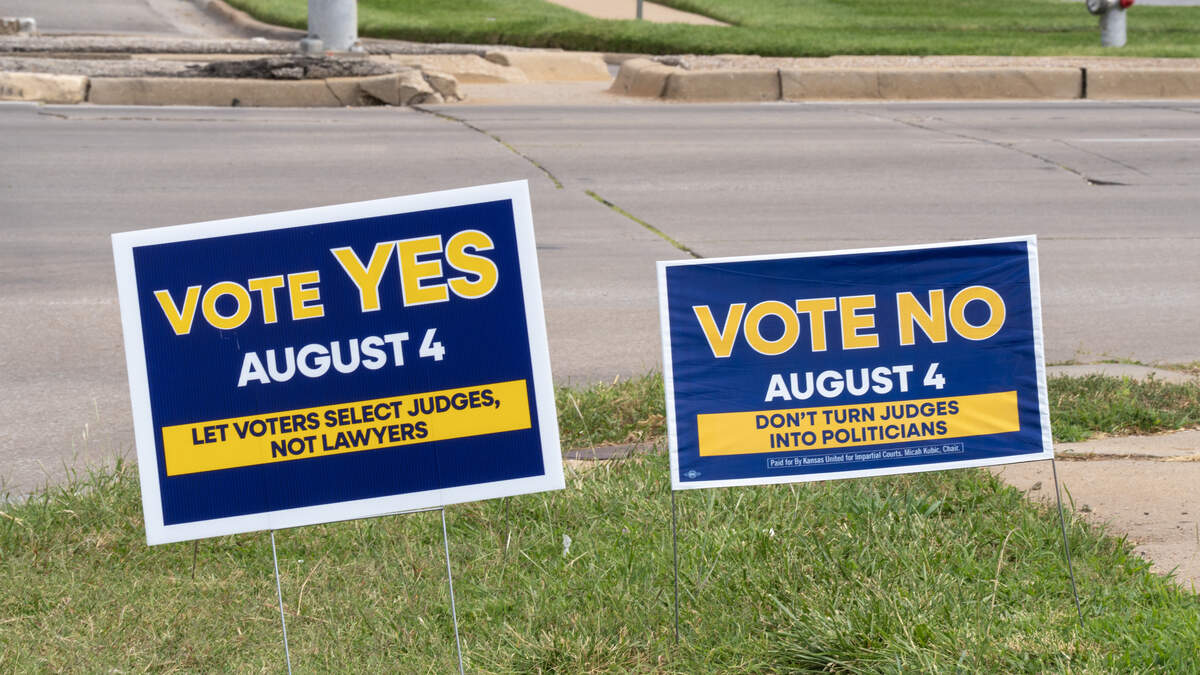
The Kansas judicial selection amendment went down Tuesday, and it did not go down quietly. Voters rejected the proposal by a margin that surpassed even the celebrated 2022 abortion vote, delivering a second consecutive rebuke to Republican leaders who have spent years trying to bring the state Supreme Court under political control.
Note: the following reflects commentary and argument advanced by supporters of the outcome, alongside the factual results.
The Numbers Tell the Story
Four years ago, Kansans defeated an attempt to strip abortion rights from the state constitution by 18 percentage points. That result was described at the time as an unexpected landslide.
Tuesday’s margin was larger. As of 10:30 p.m., “no” led by 24 points. At several stages during the evening, the gap exceeded 40 points before settling.
For a state that reliably elects Republicans to statewide office, the repetition of this pattern is remarkable. It suggests something about ballot questions specifically: strip away party labels, and Kansas voters behave differently than their partisan registration would predict.
What the Amendment Would Have Changed
On its surface, the proposal offered something that sounds democratic. It would have moved Kansas from its current nominating commission system to direct election of Supreme Court justices.
Opponents argued the surface reading missed the point entirely. Their case was that electing justices would open the bench to the same forces that dominate legislative races: large donations, ideological screening, and organized pressure campaigns. The practical result, they contended, would be a court willing to ban abortion and reduce funding for public schools.
The current system has operated for seven decades. Its defenders argue it has consistently protected people with the least power to protect themselves.
A Campaign Fought Uphill
Amendment opponents faced a genuinely difficult task, and not only because of the political terrain.
They had to explain a procedural question to voters who do not typically think about judicial selection mechanics. That is a harder message than a simple yes-or-no on a familiar issue, and it required conversations rather than slogans.
They also faced a heavily funded opposition campaign. Reporting ahead of the vote described a flood of dark money and misleading claims saturating the state. Opponents additionally described experiencing intimidation and what they characterized as gaslighting throughout the campaign.
They responded by dispersing across Kansas and doing the work in person.
What Advocates Said After the Result
Micah Kubic, executive director of the ACLU of Kansas, framed the stakes broadly, listing abortion rights, voting rights, public education, workers’ rights, and the fundamental freedoms guaranteed to Kansans as everything riding on the outcome.
He argued the politicians behind the measure wanted a court that would follow their instructions rather than the law and constitution. Kansans from across the political spectrum and every region, he said, stood against the money and the falsehoods. His central claim was simple: the courts are not for sale, and rights will not be surrendered to politicians who believe they know better than the public.
Logan Stenseng of Kansas Appleseed, another group that campaigned against the amendment, emphasized participation. He described the outcome as evidence that individual voices matter and thanked volunteers and voters who engaged with the process, adding that democracy functions best when citizens are both informed and involved.
A Caution Worth Considering
There is a complication in this victory that supporters would be wise to acknowledge.
The current nominating commission has been shaped substantially by successive Democratic governors, as have the justices selected through it. That arrangement has produced a court whose rulings progressives generally favor.
Nothing guarantees that continues. A sequence of Republican governors could populate the commission with different appointees and elevate justices with different judicial philosophies.
Consider a plausible scenario. If Sen. Ty Masterson, who won the Republican gubernatorial primary Tuesday, serves two terms and is followed by another Republican, the composition of the commission and the court could look very different by the mid-2030s. At that point, Democrats might find themselves wishing for the ability to elect justices directly.
That is not an argument the amendment’s opponents needed to make this week. But it is one worth remembering, because institutional rules cut both ways depending on who holds power.
Why the Result Landed So Hard
Two consecutive statewide votes have now produced the same answer on closely related questions. That consistency makes it harder to dismiss either result as a fluke driven by unusual turnout or momentary anger.
What appears to be happening is that Kansas voters distinguish between electing representatives and altering constitutional structures. They have been willing to send Republicans to Topeka while simultaneously refusing to hand those same officials expanded control over the judiciary.
The lesson for anyone drafting future ballot measures in Kansas seems clear enough. Voters here will read past the framing, ask what a change actually accomplishes, and vote accordingly.
For now, the amendment’s opponents have earned their moment. They were outspent, pressured, and given a complicated argument to explain in a short window. They made it anyway, and the margin suggests they made it convincingly.
Author
-
Lucienne Albrecht is Luxe Chronicle’s wealth and lifestyle editor, celebrated for her elegant perspective on finance, legacy, and global luxury culture. With a flair for blending sophistication with insight, she brings a distinctly feminine voice to the world of high society and wealth.