The Williamson Street encampment in Madison is gone, and what remains of it now sits in a parking lot several miles north. Personal belongings gathered from the site have been relocated to Demetral Park, where former residents and their supporters have a narrow window to reclaim what belongs to them.
Volunteers from the encampment worked alongside City of Madison employees and demonstrators to sort through the material. The items span the basic necessities of daily life outdoors: toiletries, blankets, coolers, and similar possessions carried over from the demonstration site.
The Timeline for Recovery
City staff planned to remain at Demetral Park until noon on August 5.
After that cutoff, anyone still looking for their possessions must contact the Parks Division directly and arrange retrieval from a different storage location.
The city has set a 45-day holding period. Once that window closes, whatever remains unclaimed will be discarded.
That schedule places real pressure on people who may not have reliable transportation, phone access, or awareness that their belongings were moved at all, which is a recurring difficulty in encampment clearances generally.
How the Removal Unfolded
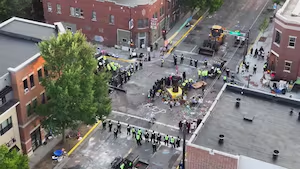
Law enforcement agencies from across the Madison area dismantled the encampment at Williamson Street and Baldwin on Tuesday morning.
The operation did not proceed quietly. Several individuals were handcuffed during the clearance, and officers were confronted with shouting from those present as the removal proceeded.
The encampment had grown out of demonstrations following the death of Corey Ruiz, becoming both a protest site and a place where unhoused residents stayed.
A Family Friend Says the Purpose Shifted
Larry Ace Williams, a family friend of Ruiz, spoke with 27 News on Tuesday and offered a candid assessment of how the encampment evolved.
His view is that the demonstration lost its original meaning after Ruiz’s death became the backdrop rather than the focus. He said he spoke with the organizers and the people who assembled the tents, and that by roughly the fourth or fifth day after that Sunday, he told them the effort was no longer about Corey.
His reasoning centered on process. Williams said the appropriate path forward involved allowing the justice system to work and permitting the courts to handle what they needed to handle.
He indicated that this message was communicated to everyone involved, encouraging them to carry the movement beyond the court case and beyond Ruiz’s memorial, redirecting it toward advocacy for unhoused residents. If that was going to be the fight, he said, it should have been waged in a different manner.
The Family Declined to Comment
27 News had expected to hear from Ruiz’s family regarding the encampment’s removal. Williams said they chose not to issue a statement.
That silence is worth noting rather than interpreting. Families navigating a death that has become a public flashpoint often face pressure from multiple directions, and declining to comment is itself a decision that deserves to be respected without speculation attached.
What Williams Hopes Comes Next
Despite his criticism of how the encampment developed, Williams framed a constructive outcome he would like to see emerge from it.
He said he hopes the encampment served as a reminder to city officials about the number of people experiencing homelessness in the Madison area, and about the need to identify a more sustainable place for them to stay.
That points toward the harder question sitting underneath the entire episode. The camp is cleared and the belongings have been moved, but the people who were living there still need somewhere to go.
The Broader Context
Encampment removals tend to follow a familiar sequence. A site forms, tensions build with neighbors or city officials, an enforcement action clears it, and belongings enter a temporary storage system with a deadline attached.
What varies is whether anything changes afterward.
Several open questions remain in Madison’s case:
Where the displaced residents will relocate now that the Williamson Street site is unavailable
Whether the city will pursue expanded shelter capacity or designated sanctioned sites
How many people will successfully reclaim their possessions before the deadlines pass
Whether the arrests made during Tuesday’s clearance result in charges
For those affected most directly, the immediate concern is considerably simpler than policy. It is finding their belongings in a parking lot before the window closes, and figuring out where to sleep tonight.
Author
-
Lucienne Albrecht is Luxe Chronicle’s wealth and lifestyle editor, celebrated for her elegant perspective on finance, legacy, and global luxury culture. With a flair for blending sophistication with insight, she brings a distinctly feminine voice to the world of high society and wealth.