A Kushner Jeffries meeting held privately in New York has surfaced as one of the clearer signs yet that the White House is preparing for the possibility of losing the House majority this November.
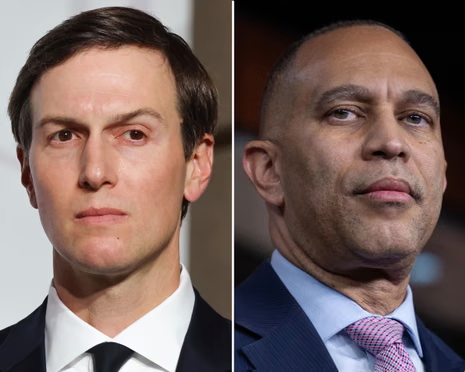
House Democratic leader Hakeem Jeffries sat down with Jared Kushner, President Trump’s son-in-law and informal adviser, in a conversation first reported Sunday by The New York Times. The discussion covered housing costs, immigration and the broader affordability squeeze weighing on American households.
What Was Discussed
Inflation sits at the center of the current political moment, and Democrats have consistently pinned responsibility for rising prices on Republicans and the president himself.
During the meeting, Kushner proposed a follow-up step: a direct conversation between Jeffries and White House chief of staff Susie Wiles. Jeffries is positioned to become House speaker if Democrats win back the chamber in November, which would make him a central figure in any legislative dealings with the administration.
Jeffries Responds Without Confirming Details
In a statement issued Sunday, Jeffries did not directly reference the private meeting. He instead focused on broader criticism of Republican governance, arguing that the party’s rigid, take-it-or-leave-it style has failed ordinary Americans.
He framed Democratic resistance as a response to extremism rather than obstruction for its own sake, stating that his party has made clear such an approach will face forceful opposition. He closed by putting the question back on Republicans, asking whether they are willing to work together.
Why This Meeting Matters
The outreach reflects genuine anxiety inside Republican ranks about the midterm landscape, particularly concerning the House.
Should Democrats retake either chamber, the White House would likely face a much more aggressive oversight posture. Jeffries has previously used pointed language describing certain administration figures, and impeachment remains a tool Democrats could deploy if they control the relevant committees.
Positioning a channel to Jeffries now, before the election even happens, suggests the White House is hedging against that outcome rather than assuming Republican control will continue uninterrupted.
Speaker Johnson Pushes Back
House Speaker Mike Johnson, a close Trump ally, responded dismissively when asked about the meeting during a Sunday appearance on Fox News.
He downplayed Kushner’s influence within the administration, describing him as someone who hedges his bets and suggesting he lacks a substantive day-to-day role in West Wing operations. Johnson expressed confidence that House Republicans would defy expectations and hold their majority.
Neither the White House nor a representative for Kushner responded to requests for comment on the meeting.
A Familiar Line of Communication
Jeffries and Kushner have a working history that predates this moment. During Trump’s first term, the two collaborated on criminal justice legislation that introduced sentencing flexibility for certain drug offenses, an effort aimed at reducing excessively long federal prison terms.
That relationship, while not close, has apparently persisted despite repeated public attacks Trump has directed at Jeffries. In this second term, Kushner has taken on an outsized role despite holding no official White House position, functioning as an outside adviser and envoy, including handling diplomatic outreach as the conflict with Iran continues into its sixth month.
A Tense Relationship at the Top
The dynamic between Trump and Jeffries directly has been considerably more hostile.
The two have met only once since Trump returned to office, an encounter during which the president reportedly placed red “Make America Great Again 2028” caps in front of Jeffries and Senate Democratic leader Chuck Schumer, a jab referencing Trump’s repeated flirtation with pursuing a constitutionally barred third term.
Following that meeting, Trump posted an altered image mocking Schumer and Jeffries that was widely criticized as leaning on racist imagery, timed just before what became the longest federal government shutdown in American history.
How Power Currently Flows
Under the current arrangement, Trump has been able to bypass Congress when convenient, relying heavily on executive authority to advance his agenda, while applying pressure on House and Senate Republicans when their votes are needed, particularly for contested Cabinet confirmations.
That balance would shift considerably if Democrats gained control of either chamber. Lawmakers in the minority have signaled eagerness to reassert Congress’s role as a coequal branch, more willing to check executive action rather than simply ratify it.
The Battle for the House
Republicans are leaning heavily on Trump’s standing with core voters as they try to defend a narrow House majority. Johnson has expressed confidence that the GOP can break the historical pattern in which the party out of power typically gains ground in midterm elections.
With Republicans holding only a slim edge, control will likely come down to a handful of competitive districts. Democrats are hoping for something resembling their 2018 performance, when a wave of voter frustration during Trump’s first term delivered them the House.
The Senate, though currently more narrowly divided in Republicans’ favor, is increasingly viewed as competitive as well. GOP strategists have voiced concern about an enthusiasm gap, with Democratic voters appearing more motivated to turn out than their Republican counterparts.
A Shifting Democratic Coalition
Adding another layer of unpredictability, Democrats in several races are nominating candidates from outside the party establishment, including some aligned with socialist positions, over more conventional, establishment-backed alternatives.
That trend reflects broader voter dissatisfaction with the status quo on both sides of the aisle, and it raises questions about how a Democratic majority, if it materializes, would actually govern given the ideological range within its own ranks.
What to Watch Next
Whether the Kushner-Jeffries channel develops into anything substantive likely depends on the November results. If Republicans hold the House, the outreach may prove to have been a low-cost hedge that goes nowhere. If Democrats win, it could become the foundation for whatever limited cooperation the White House pursues with a chamber it no longer controls.
Either way, the mere fact that this conversation happened, and that it leaked publicly, signals that both sides are already positioning for a very different Washington come January.
Author