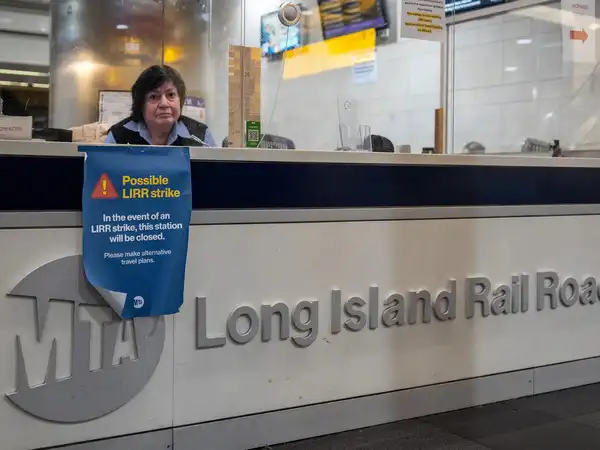
The Long Island Rail Road has come to a complete stop, leaving roughly 275,000 daily riders scrambling for alternatives. The LIRR strike began at 12:01 a.m. Saturday after five unions and the Metropolitan Transportation Authority failed to settle a new contract before a midnight deadline — and it marks the first shutdown of the country’s busiest commuter railroad in more than three decades.
With no fresh talks scheduled and both sides describing the gap between them as wide, commuters now face real uncertainty about how they’ll get around in the days ahead.
Why the Trains Stopped Running
The walkout came after the MTA and five unions representing most of the LIRR’s workforce couldn’t bridge their differences over pay raises and changes to work rules. As negotiations ran into the midnight deadline, the unions chose to strike.
Kevin Sexton, national vice president of the Brotherhood of Locomotive Engineers and Trainmen, told reporters in a late-night press conference that no new round of negotiations had been arranged. He said the two sides remained far apart and felt further talks were unnecessary because the bargaining process had already run its course. A union spokesperson added that they did not expect anyone to return to the table on Saturday.
The sticking points, according to both sides, came down to a few specific issues:
- The MTA said it had reached agreement with the unions on pay increases for the first three years of a proposed four-year contract, but the two sides deadlocked over wages for the final year.
- Union officials said the MTA tried to introduce healthcare benefit negotiations late in the process, though they declined to discuss specifics.
- MTA Chair Janno Lieber said the agency had floated the idea of new LIRR hires contributing a “reasonable portion” of their healthcare costs — slightly more than current employees pay, but still roughly half of what the average New York State worker contributes.
How Commuters Are Coping
For the hundreds of thousands of people who rely on the LIRR every day, the shutdown is more than an inconvenience — it’s a scramble.
At Atlantic Terminal in Downtown Brooklyn early Saturday, MTA staff handed out information cards about backup options while a few dozen picketers gathered outside. Many riders learned of the strike only that morning.
Feiona Harris, who needed to travel to Shirley in Suffolk County, said she wasn’t sure what she would do. A ride-hail trip, she noted, would be far too expensive for her to afford.
Shanique Grant, a nurse heading home after an overnight shift, faced a similar dilemma — pay for a costly Uber or accept a much longer trip on alternative transit. While frustrated, she expressed sympathy for the workers. She said she understood there had to be a serious reason for the unions to take such a drastic step, even as the disruption rippled out to everyone who depends on the railroad.
The MTA’s Backup Plan
If the strike stretches into Monday, the MTA plans to roll out limited shuttle bus service connecting LIRR stations to the city’s subway system. Officials estimated this alternative could cost as much as $550,000 a day.
The shuttle routes are designed to funnel riders toward key subway connections:
- From the Bay Shore, Hicksville, and Mineola stations, shuttles will run to the Howard Beach–JFK A train station.
- From the Huntington and Ronkonkoma stations, shuttles will head to the Jamaica–179th St. F train station.
- Nassau County commuters can also use NICE bus service to reach the Flushing–Main St. station for the 7 train, or the Jamaica Bus Terminal near the 169th St. F train.
LIRR President Rob Free acknowledged last month that buses alone could never absorb the railroad’s full ridership, but said the agency had to do everything it could. Meanwhile, the New York State Department of Transportation has prepared for heavier traffic on Long Island, deploying electronic highway message signs, extra tow trucks, maintenance crews, and traffic signal technicians. The MTA and Gov. Kathy Hochul are also urging businesses to let employees work from home where possible.
Both Sides Dig In
The MTA has framed its position as a matter of fiscal responsibility. In a statement, Lieber said the outcome was not what the agency wanted, but insisted the MTA could not agree to a deal that would “implode” its budget.
He argued the agency would not put the cost of “outsized wage increases” onto riders and taxpayers, particularly for workers he described as already the highest-paid railroad employees in the country. According to Lieber, the average LIRR salary sits around $136,000. At an April board meeting, MTA officials warned that meeting the union’s pay demands could force an 8% fare hike and job cuts to avoid a deficit.
The unions see it very differently. The Brotherhood of Locomotive Engineers and Trainmen, affiliated with the Teamsters, argued the strike could have been avoided entirely. They pointed to recommendations from federally appointed review panels that called for higher pay than the MTA had put on the table.
BLET President Mark Wallace, who also leads the Teamsters Rail Conference, said the walkout would not have happened if the MTA had offered the terms the federal panels repeatedly recommended. He urged the agency to “get serious” to prevent further disruption, saying management knew where to find the union — “on the streets.”
What’s at Stake
The economic toll could be steep. New York State Comptroller Thomas P. DiNapoli estimated that a strike could drain up to $61 million in lost economic activity each day it continues.
How long the standoff lasts remains anyone’s guess. For context, last year’s NJ Transit strike ran three days, while the most recent LIRR strike, back in 1994, lasted just two. But with the busiest commuter rail line in the nation offline and no talks on the calendar, the real test will come Monday — when the start of the work week collides head-on with a railroad that isn’t running.
Author