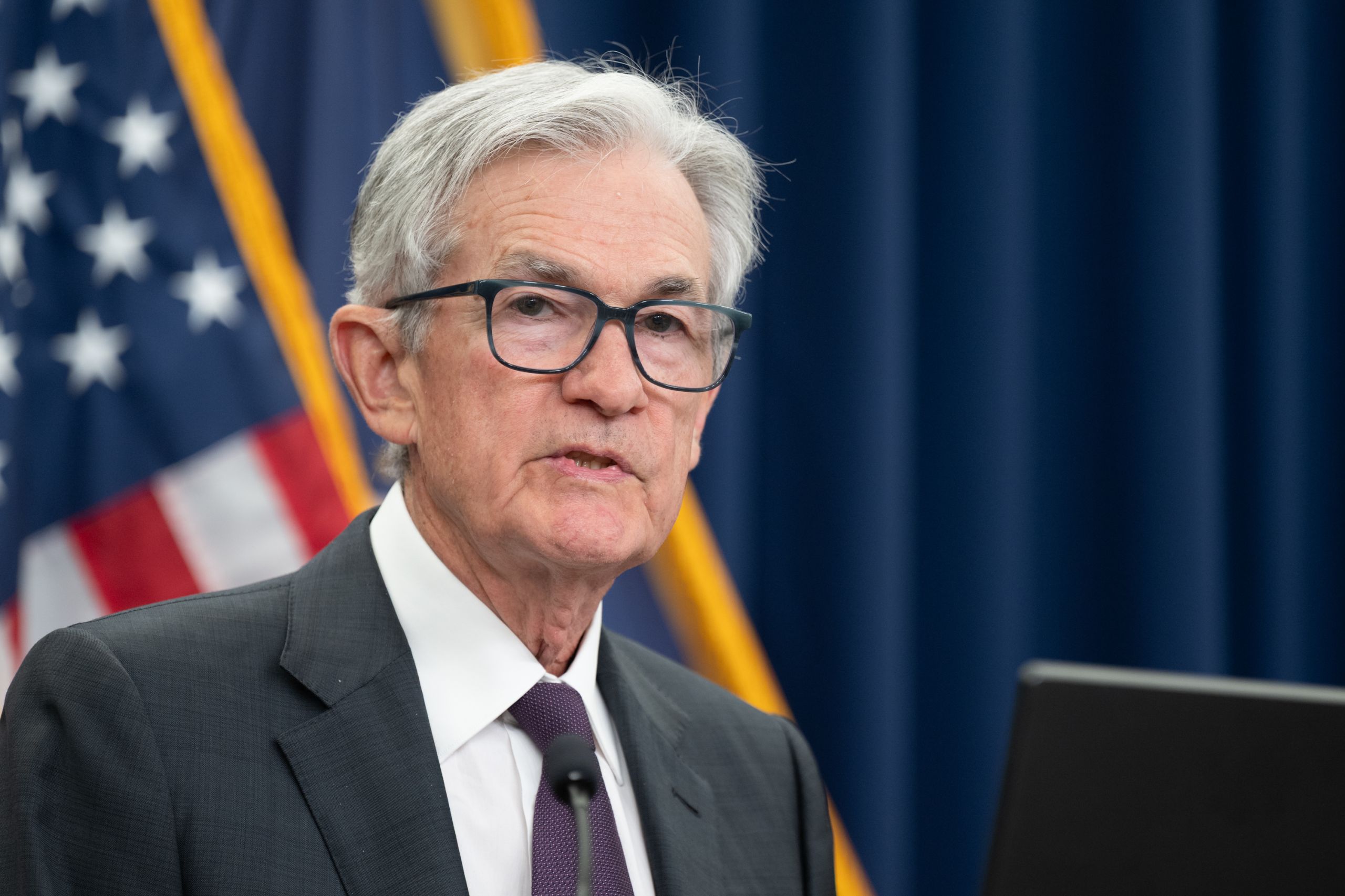
A Jerome Powell warning to Wall Street may turn out to be one of the most consequential things the outgoing Fed chair said during his entire tenure — and it had nothing to do with interest rates. Investors who tune it out could be making a costly mistake.
May 15 marked the close of Powell’s two-term run as chair of the Federal Reserve and the start of Kevin Warsh’s first term in the role. It’s a genuinely historic moment: in more than 110 years, only 17 people have ever held the position. But while Powell has stepped down as chair, he’s chosen to stay on the Fed’s Board of Governors to finish out his 14-year term — and his words and decisions are likely to shape market sentiment well beyond his departure.
The Warning Most Investors Overlooked
Ask people what they’ll remember about Powell’s final stretch as Fed chair, and many will point to his very public clash with President Donald Trump over interest rates.
Trump repeatedly criticized Powell and the Federal Open Market Committee — the 12-member panel responsible for setting U.S. monetary policy — for refusing to slash rates to 1% or lower. Powell, in turn, cited persistent inflation tied to Trump’s tariffs and the conflict involving Iran as reasons the committee couldn’t justify deeper rate cuts. The back-and-forth between the two became a regular feature of the news cycle.
Yet that feud probably isn’t what will define Powell’s legacy on Wall Street. Something far quieter and far rarer is more likely to linger: a brief comment he made about stock valuations back in September.
Why a Fed Chair Talking About Stocks Is a Big Deal
Sitting Fed chairs almost never weigh in on the stock market. The committee’s job is to pursue its dual mandate — stable prices and maximum employment — and to leave the valuation of stocks to investors and the market itself.
So when a Fed chair does break that unwritten rule, history suggests it’s worth paying attention.
The most famous example came in December 1996, when then-Chair Alan Greenspan delivered his “irrational exuberance” speech, warning about how quickly stock valuations were climbing in the early days of the internet boom. A little over three years later, the dot-com bubble collapsed.
Fast forward to September 2025. While speaking in Rhode Island, Powell was asked how the committee factors equity valuations into its policy decisions. His response was strikingly direct. For arguably the first time in nearly 30 years, a sitting Fed chair pointed straight at soaring stock prices and stated plainly that equity prices were fairly highly valued.
It’s those six words — equity prices are fairly highly valued — that could reverberate across Wall Street for a long time to come.
What the Numbers Say About Today’s Market
Over the long run, stocks have been an outstanding place to put money. The Dow Jones Industrial Average, S&P 500, and Nasdaq Composite have all climbed to record highs again and again over the decades, rewarding patient investors despite plenty of turbulence along the way.
But the short-term picture is far less reassuring — and one particular tool helps explain why.
The Shiller Price-to-Earnings Ratio, often called the Cyclically Adjusted P/E (or CAPE) Ratio, is widely regarded as a more reliable gauge of valuation than the traditional P/E ratio. Here’s the key difference:
- A standard P/E ratio looks at earnings from just the trailing 12 months.
- The Shiller P/E uses average inflation-adjusted earnings from the previous 10 years.
By drawing on a full decade of earnings, the Shiller P/E smooths out the distortions that recessions and short-term shocks can create, offering a cleaner, apples-to-apples comparison across different eras.
And what it shows right now is striking. Going back to January 1871, the CAPE Ratio has averaged 17.36. But as of the close on May 13 — the day Kevin Warsh was confirmed as Powell’s successor — the reading stood at 42.32. That’s the highest level of the current bull market and the second-most-expensive valuation in recorded history, surpassed only by the dot-com peak of 44.19 in December 1999.
History’s Uncomfortable Pattern
Expensive markets have a troubling track record, and the data here is hard to wave away.
The Shiller P/E can’t tell investors when a downturn will arrive — no tool can. But there has been a clear negative relationship between elevated CAPE readings and major declines in the broad indexes.
Over the past 155 years, the CAPE Ratio has climbed above 30 on just six occasions, including the present one. In every single one of the previous five instances, the move was eventually followed by a drop of somewhere between 20% and 89% in one or more of the major stock indexes.
Put simply, each prior time the market reached this level of stretched valuation, a steep decline followed. That doesn’t guarantee history will rhyme again — but it’s a pattern with an unbroken record so far.
The Takeaway for Investors
It’s worth keeping context in mind. Powell wasn’t issuing a market forecast or telling anyone to sell. He was discussing valuations strictly through the lens of monetary policy, answering a question about how the committee thinks about its job.
Still, the rarity of the comment is exactly what gives it weight. A sitting Fed chair almost never says the stock market looks expensive — and when one does, it tends to be remembered.
None of this means a crash is imminent or that long-term investors should abandon stocks. Markets have always recovered and gone on to new highs given enough time. But Powell’s six words, combined with a valuation measure flashing one of its most extreme readings ever, are a reminder that prudence and a long time horizon matter more than ever.
His brief remark may well echo through Wall Street for years — or, as the historical record suggests, until the pattern repeats itself once again.
Author