A Shocking Allegation
In a startling case that has captured attention across Mexico, a mayor faked kidnapping in an alleged scheme to embezzle millions in government funds. Local authorities announced Thursday that the mayor staged her own abduction, disguising the stolen money as ransom payments.
The accusations paint a picture of an elaborate plot that ultimately unraveled, leaving the official at the center of a growing scandal.
The Mayor at the Center
The official accused is Nancy Napoles, the municipal president of Tenancingo, a town located several hours outside Mexico City. According to prosecutors, she orchestrated a fake kidnapping to siphon off $2 million worth of public money.
Napoles has firmly denied any wrongdoing. In a video posted to social media, she proclaimed her innocence and dismissed the accusations as politically motivated.
Her response set the stage for what promises to be a contentious legal and political battle.
Political Connections
The case carries added significance due to Napoles’s political affiliations. She belongs to the ruling Morena party of President Claudia Sheinbaum.
This connection is particularly notable because Sheinbaum has made combating corruption one of the central pillars of her administration. The allegations against a member of her own party place the scandal in an especially sensitive political context.
The situation underscores the challenges facing the government’s anti-corruption efforts.
The Legal Proceedings
Prosecutors have outlined their next steps in the case. They announced that they requested Napoles provide testimony on July 9 regarding what they described as the simulation of a kidnapping.
Notably, no arrest warrants have been issued against Napoles herself. This stands in contrast to her husband and brother-in-law, who are reportedly on the run from authorities.
The differing legal status of those involved hints at the complex web of relationships behind the alleged scheme.
How the Plot Allegedly Unfolded
According to the prosecutor’s office, the kidnapping appeared real on the surface. Armed men forced Napoles out of her car at gunpoint, an account based on the testimony of three individuals who have since been arrested as supposed kidnappers.
Authorities described how the captors allegedly threatened to kill Napoles and her family unless a ransom was paid. The demanded sum was 40 million pesos in exchange for her freedom.
Crucially, prosecutors said the captors advised her that if the ransom could not be paid, equivalent to roughly $2.3 million, she would need to take resources from the local government. This detail forms the heart of the embezzlement allegation.
An Unexpected Witness
The alleged plan reportedly fell apart due to an unforeseen complication. An unsuspecting witness happened to see the mayor being forced into a car.
This witness tipped off the police, who promptly launched a search. The unexpected intervention forced the mayor to abandon the mission, according to authorities.
The chance sighting proved pivotal in exposing what prosecutors describe as a staged event.
Evidence Released
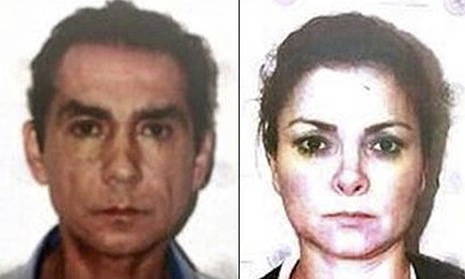
To support their case, prosecutors released images that they say document the fake kidnapping. The visual evidence was presented as part of their effort to demonstrate that the abduction was not genuine.
A subsequent investigation reportedly revealed inconsistencies in Napoles’s account. These discrepancies suggested that her husband and brother-in-law had planned the false kidnapping.
According to prosecutors, the scheme was designed to claim public money that had already been embezzled, creating a justification for the missing funds.
The Mayor’s Defense
Napoles has continued to push back against the allegations. She denied the accusation outright and expressed a willingness to cooperate with authorities.
She stated that she wanted to help clarify what happened so that the guilty actors could be punished. By framing herself as cooperative, Napoles sought to distance herself from the alleged conspiracy.
Her insistence on her innocence adds another layer of intrigue to the unfolding case.
Part of a Broader Pattern
The Napoles case does not stand alone. Other top Mexican officials have faced accusations of criminal activity in recent months, reflecting ongoing concerns about corruption.
In April, the United States charged the governor of Sinaloa along with nine other current and former Mexican officials with drug trafficking and weapons offenses. The case highlighted the international dimensions of corruption involving Mexican authorities.
These high-profile cases have kept the spotlight firmly on issues of governance and accountability.
A Troubling Trend
The pattern of allegations extends further back as well. Last year, a mayor from a western Mexico town was arrested as part of an investigation into a suspected drug cartel training camp.
That disturbing case involved the discovery of human bones and clothing at the site. The grim details underscored the serious nature of the criminal activity that has touched some local officials.
Together, these cases illustrate the broader challenges Mexico faces in rooting out corruption and crime within its political ranks.
What Comes Next
As the investigation continues, attention will turn to Napoles’s scheduled testimony on July 9. Her account, along with any further evidence prosecutors present, could prove decisive in determining the outcome of the case.
The fate of her husband and brother-in-law also remains uncertain, given that both are currently evading authorities. Their eventual capture could shed additional light on how the alleged plot was conceived and carried out.
For now, the case stands as a striking example of the corruption scandals that have plagued Mexican politics.
A Test for Anti-Corruption Efforts
Beyond the specifics of the case, the allegations against Napoles represent a test for President Sheinbaum’s anti-corruption agenda. With a member of her own party implicated, the government faces pressure to demonstrate its commitment to accountability.
How authorities handle the investigation and any subsequent prosecution will be closely watched. The outcome could influence public perception of the administration’s willingness to confront corruption, even when it involves its own ranks.
As the story develops, it serves as a reminder of the persistent challenges surrounding governance and integrity in Mexican public life. The coming weeks will likely reveal whether justice is served and whether those responsible, whoever they may be, are held accountable.
Author