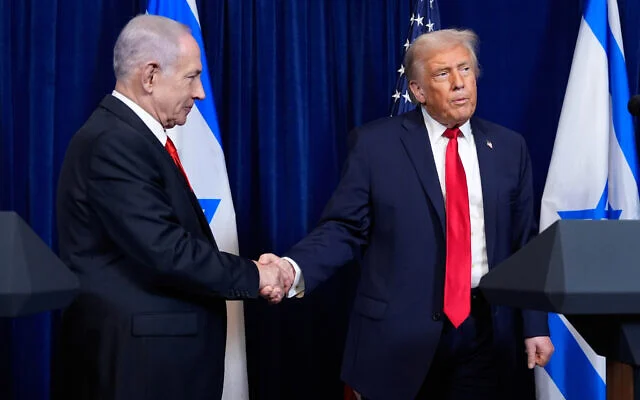
The Iran US war reopened with a jolt on Tuesday evening, hours after President Donald Trump wrapped up a private session with Israeli Prime Minister Benjamin Netanyahu at the White House. American commanders say Tehran attempted to catch them off guard, and the timing has not gone unnoticed in either capital.
According to US Central Command, forces belonging to the Islamic Revolutionary Guard Corps fired a salvo of ballistic missiles out of Iran at 5:45 p.m. Eastern time, aimed at American positions across the Middle East. CENTCOM described it as an attempted surprise attack and said every incoming missile was intercepted before it reached its target.
No casualties were reported in that exchange. But the launch effectively ends the quiet stretch that had settled over the conflict in recent weeks, and it raises the obvious question of whether the pause was ever a de-escalation at all or simply a reload.
What Iran Says It Hit
Tehran’s account differs from Washington’s. Iranian officials claim their forces struck American bases in Jordan and say they hit three tankers moving through the Strait of Hormuz.
That second claim is the one likely to reverberate furthest beyond the battlefield. The Strait is the narrow channel through which a substantial share of the world’s seaborne oil and liquefied natural gas passes every day. Shipping through it has already grown expensive and nervous. Any confirmed strike on commercial vessels tends to move insurance rates before it moves front pages, and the effects reach consumers who have never heard of the waterway.
The US has not corroborated the Iranian version of events, and the two sides’ descriptions of the same evening are, as usual, difficult to reconcile.
A Second Front, Fought With Drones
The missile launch was not the only military activity CENTCOM disclosed on Tuesday.
The command said Saudi Arabian forces joined the United States in a separate operation responding to a wave of drone attacks over the preceding three days. More than thirty such attacks had been launched in seventy-two hours, according to the American account, carried out by groups it described as Iran-aligned.
CENTCOM went further than the usual language, accusing Iran’s paramilitary structure of actively directing those groups against both American troops and Saudi energy infrastructure. The retaliation came in the form of joint US and Saudi air operations against what the command identified as terrorist logistics and weapons sites scattered across eastern Iraq.
The framing matters. Attacks on Saudi energy facilities pull Riyadh deeper into a war it has approached cautiously, and strikes inside Iraq widen the geography of a conflict that already spans several borders. Each of those expansions makes the fighting harder to contain and harder to end.
The Meeting That Preceded It
Netanyahu’s appearance at the White House was his first since the United States and Israel began joint operations against Iran, and both governments went out of their way to describe it warmly.
The prime minister called it one of the best conversations he has had with Trump. The White House characterized the meeting as positive and productive. Neither side offered much beyond that, and the session itself was held out of view of the press.
The brevity of those readouts is itself a signal. When a meeting produces a concrete deliverable, governments generally say so. When it produces alignment on tone but not on next steps, the statements tend to sound exactly like these did.
Whether Iran timed its launch to coincide with the meeting is unknown, and Tehran has not framed it that way. But the sequence lands as a message regardless of intent: talks in Washington do not slow the pace of the fighting.
Why This Escalation Is Different
Several elements make Tuesday’s exchange more consequential than the tit-for-tat rounds that preceded it.
The attack was a direct, acknowledged launch from Iranian territory rather than an operation routed through proxies. That distinction removes the ambiguity both sides have sometimes used to avoid full confrontation.
It struck at more than one theater simultaneously, combining ballistic missiles with a drone campaign against Gulf infrastructure.
It drew a NATO-adjacent partner into visible joint action, with Saudi aircraft flying alongside American ones.
And it involved commercial shipping in the Strait of Hormuz, where the consequences of a mistake are measured in global energy prices rather than local damage assessments.
Taken together, these amount to a wider war being fought at a higher tempo, even as diplomats on all sides continue to describe a resolution as achievable.
The Pressure Building at Home
Trump faces this moment with limited domestic room to maneuver. The war has grown steadily less popular with the American public, including within parts of his own coalition, and the November midterms sit just over the horizon.
Iran, for its part, has absorbed heavy losses and shows no sign of surrendering the leverage it holds over the Strait. Tehran’s calculation appears to be that time and patience favor it more than any settlement currently on offer.
That leaves both governments in a familiar and dangerous position: each convinced the other will tire first, each unwilling to be the one who blinks, and each able to escalate faster than either can negotiate.
For now, the interceptors held. The next question is how many more nights that will remain true, and what happens on the one it does not.
Author
-
Lucienne Albrecht is Luxe Chronicle’s wealth and lifestyle editor, celebrated for her elegant perspective on finance, legacy, and global luxury culture. With a flair for blending sophistication with insight, she brings a distinctly feminine voice to the world of high society and wealth.