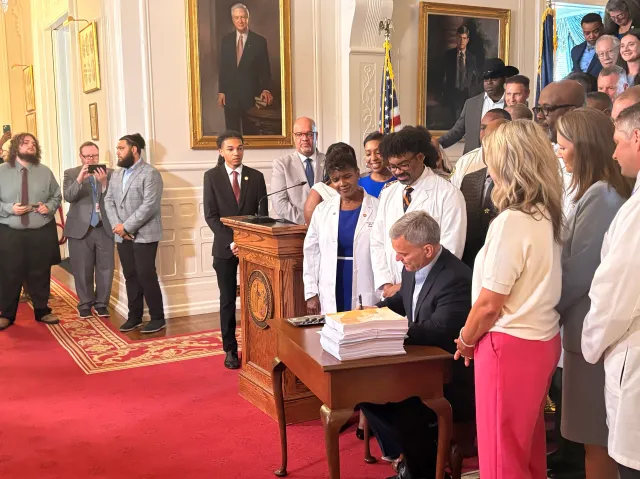
The North Carolina budget saga has finally come to an end. After more than 1,000 days without a comprehensive spending plan, Democratic Governor Josh Stein signed a $34 billion budget on Tuesday, unlocking pay raises for state employees and rolling out tax cuts for residents across the state.
A Deal Long in the Making
The plan was crafted by Republican legislative leaders who reached an agreement only last week, following roughly a year of drawn-out negotiations. Those talks stalled repeatedly over contentious issues ranging from the state’s income tax rate to funding for major capital projects, including a proposed children’s hospital in Apex.
Because of the prolonged deadlock, state agencies had been forced to operate under budgets originally approved back in 2023. For a state government running on years-old numbers, the new plan represents a significant reset.
While Stein voiced clear objections to several provisions, he ultimately concluded that state workers had waited long enough. In his view, delaying their raises any further simply wasn’t an option.
What the Budget Delivers
Republicans have championed the plan as a win-win, boosting worker pay while simultaneously easing the tax burden on North Carolinians. Some of the headline features include:
- A 3% raise for all state employees.
- Raises averaging around 8% for teachers.
- Increases of up to 17% for certain law enforcement officials.
- A reduction in the personal income tax rate from 3.99% this year to 3.49% next year.
Together, these measures form the backbone of a budget that both parties, however reluctantly, found reasons to support.
The Governor’s Mixed Verdict
Stein made it clear that his signature came with reservations. While he celebrated parts of the plan, he refused to gloss over what he saw as its shortcomings.
On the positive side, he praised the budget for making meaningful investments in community colleges, the DMV, childcare, and summer food programs for children. These, he said, were genuine victories worth celebrating and worthy of his approval.
But he did not hold back on his criticisms. Stein pointed out that the legislature was eliminating more than 1,000 state government positions, which he warned would make it harder to meet the public’s health and safety needs. He also noted that many of the raises fail to keep pace with inflation, and that even the more substantial increases still leave North Carolina trailing neighboring states in salary competitiveness.
Democratic Concerns Run Deeper
Beyond the governor, other Democrats raised pointed objections to portions of the sprawling 600-page document. Senate Minority Leader Sydney Batch singled out a provision tucked deep within the budget that would bar the North Carolina State Bar from funding civil legal groups.
In practice, that measure would slash the budgets of organizations that assist low-income residents facing eviction, domestic violence, and other legal challenges, a change critics view as deeply harmful to vulnerable communities.
Anderson Clayton, chair of the state Democratic Party, offered a more measured take. She credited Stein for approving a plan that addresses some urgent needs while acknowledging its imperfections. Going forward, she argued, the state must keep investing in public education, reverse the cuts affecting state employees, and focus tax relief on working families rather than large corporations and their shareholders.
Why Stein Didn’t Veto
Stein technically had the option to veto the legislation, but doing so would have created an awkward situation for his own party. Many Democrats had voted for the budget, even if grudgingly.
The numbers tell the story. The proposal cleared the state House by a vote of 88-21 and passed the Senate 35-10, margins comfortably large enough to override a gubernatorial veto had Stein chosen to issue one. Faced with those realities, signing the bill was the more practical path.
Big Projects, Notable Omissions
The budget sets aside hundreds of millions of dollars for several major initiatives, including the new children’s hospital in Apex, UNC-Chapel Hill’s Carolina North campus, and Poe Hall at N.C. State University.
Not everything made the cut, however. Notably, the plan does not include a funding mechanism for a potential Major League Baseball stadium in Raleigh, sidelining hopes tied to a possible expansion bid.
Beyond the marquee items, the budget carries a wide range of other provisions. Among them, it:
- Directs more than $700 million toward Hurricane Helene recovery and $10.7 million toward Tropical Storm Chantal recovery.
- Leaves Wake County with the most understaffed prosecutor’s office in the state.
- Raises taxes on sports betting companies while, for the first time, allowing UNC and N.C. State athletics to share in that revenue, and separately authorizes prediction market betting firms to operate at a much lower tax rate.
- Introduces dozens of policy changes and adjustments affecting K-12 education.
- Provides $15 million to the North Carolina Collaboratory at UNC-Chapel Hill for research and cleanup of PFAS chemicals near fire stations.
Cutting Costs Through Vacant Jobs
Alongside the spending, the plan includes cost-saving measures, most prominently the elimination of hundreds of state jobs. Supporters argue that by focusing largely on positions that have sat vacant for a long time, the state can achieve real savings without disrupting current operations, though critics remain wary of the broader reductions.
A First for Stein and a Turning Point for Leaders
This marks the first comprehensive budget Stein has signed since taking office last year. It stands in contrast to his predecessor, Democrat Roy Cooper, who vetoed Republican spending plans in both 2017 and 2019.
The road to this agreement was rocky. Lawmakers had been expected to pass a full budget last summer but failed, largely because House Speaker Destin Hall and Senate leader Phil Berger clashed over tax rates and capital spending.
The negotiations also brought together two leaders at very different points in their careers. Hall, 39, became House speaker last year after Tim Moore left the chamber for Congress. Berger, 73, has led the Senate for 15 years but recently lost his district’s Republican primary to Rockingham County Sheriff Sam Page. Some Democrats speculated that his reelection fight distracted him from budget talks, a suggestion Berger has firmly denied.
Praise From Republican Leaders
Republican leaders were quick to celebrate the outcome. Berger took credit for fiscal policies he said have fueled a remarkable decade of economic growth, arguing that the new budget continues that trajectory by cutting tax rates and prioritizing citizens over bureaucrats.
Hall went even further, calling it the best budget in decades. He highlighted the historic raises for teachers and law enforcement, along with tax relief for working residents, and claimed the plan offers something for every North Carolinian while delivering investments designed to strengthen communities and improve lives across the state.
The Bottom Line
For a state that spent nearly three years without an updated spending plan, the signing of this $34 billion budget closes a long chapter of gridlock. It delivers tangible gains, raises, tax cuts, and major investments, while leaving behind lingering disputes over job cuts, legal aid funding, and long-term priorities. Whether celebrated or criticized, the plan finally moves North Carolina forward after an unusually prolonged standstill.
Author