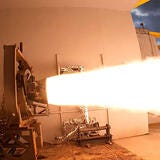
A Bottleneck With a Possible Fix
The Pentagon has warned that shortages of solid rocket motors could limit its plans to sharply increase missile production. But one of the industry’s largest suppliers argues the real challenge may lie less in manufacturing capacity and more in how the government actually buys them. The future of solid rocket motor production, according to Northrop Grumman, hinges on longer-term commitments rather than capacity alone.
In short, the company says the industry is ready to scale up — it just needs the right signals to justify the investment.
The Heart of Northrop’s Argument
Northrop Grumman, one of just two dominant US producers of large and medium-sized solid rocket motors, contends that the industry has substantial room to expand. The catch is that manufacturers need longer-term procurement commitments to justify investments throughout the supply chain.
James Kalberer, vice president of Northrop Grumman’s propulsion systems business unit, said manufacturers are responding to demand concerns and are prepared to boost output. However, he pointed to a key obstacle: annual appropriations and shorter-duration contracts make it difficult to commit to the long-term investments needed for sustained growth.
In an interview with SpaceNews, Kalberer noted that while government demand signals are being heard, suppliers need greater confidence that procurement plans will last beyond annual budget cycles.
Why Annual Budgets Create Uncertainty
The timing of this debate is significant, as the Defense Department prepares for a major increase in missile procurement. A recent report by the Center for Strategic and International Studies concluded that solid rocket motors remain a bottleneck across the US missile industrial base — precisely as the Pentagon seeks to rapidly expand production of air and missile-defense interceptors.
The Pentagon has taken steps to help, embracing multiyear authority for munitions contracts and making direct investments in suppliers. Yet several structural problems persist:
- Multiyear procurement programs ultimately depend on annual congressional appropriations, which Congress can change, terminate, or reprioritize
- The Pentagon’s multiyear authorities are program-specific rather than supply-chain-wide
- A prime contractor may feel confident about a missile program, but a second- or third-tier supplier making propellant chemicals may not see enough certainty to justify a major factory expansion
Kalberer said the government’s efforts are helping, noting that longer demand signals allow companies to work with their supply chains to ensure readiness at all levels. With commitments to multiyear procurements, he explained, every part of the ecosystem could respond more quickly than under traditional year-to-year requirements.
Investment Across the Entire Chain
Expanding rocket-motor production requires investment that reaches far beyond the prime contractor. Kalberer emphasized that it involves raw-material suppliers, nozzle manufacturers, insulation producers, propellant ingredient suppliers, workforce development, and facility expansion.
In other words, scaling up isn’t a single decision — it’s a coordinated effort across a sprawling network of vendors and specialists.
Billions Already Committed
Northrop has put serious money behind its position. Kalberer said the company has committed more than $2 billion across its munitions and solid rocket motor businesses over the past several years, including more than $1 billion dedicated specifically to solid rocket motors.
“Capacity is online to support the need,” he said.
In his view, the industry’s remaining challenges can largely be solved through procurement reforms. Suppliers have shown they’re willing to make their own investments when demand signals are clear, he said, adding that the next step is for the government to ensure multiyear confidence in how it procures these systems over time.
A Unique Position in the Market
Northrop occupies a distinctive spot in the solid rocket motor industry. The company’s propulsion business traces its lineage through Hercules Aerospace, Alliant Techsystems, and Orbital ATK, which Northrop acquired in 2018. That acquisition gave the company one of the two major domestic solid rocket motor franchises, with the other being the former Aerojet Rocketdyne business, now part of L3Harris Technologies.
The company’s work extends well beyond missiles. Northrop also manufactures the twin solid rocket boosters for NASA’s Space Launch System, the heavy-lift rocket built for the Artemis moon program.
Capacity and Growth Targets
Northrop’s production numbers underscore both its scale and its ambitions. Kalberer said the company delivered roughly 13,000 rocket motors in 2024 and expects production to reach about 25,000 annually by 2029.
The company also points to existing capacity that remains underutilized. Kalberer explained that propellant production requires very heavy infrastructure, noting that Northrop currently produces 30 million pounds of propellant but has available capacity today for 50 million pounds.
Speeding Up Qualification
Part of Northrop’s strategy for increasing output involves accelerating how quickly new technologies and suppliers can be qualified — a longstanding pain point in the industry, where qualifying new products and vendors can take years even as military needs shift rapidly.
To address this, the company is now in the fifth year of an internally funded initiative called SMART Demo, short for Solid Motor Annual Rocket Technology Demonstrator. The program tests new manufacturing methods, materials, and suppliers before introducing them into production.
According to Kalberer, SMART has helped cut the time from design to qualification testing from as much as three years down to between 12 and 18 months, while also bringing new suppliers into the ecosystem.
The Broader Push for Capacity
The Pentagon has pursued multiple avenues to expand capacity beyond Northrop’s efforts. Several new entrant startups have won contracts to develop solid rocket motors, and in April, the Pentagon completed a $1 billion investment in L3Harris’s missile propulsion business to accelerate expansion.
When asked whether Northrop would welcome a similar investment, Kalberer declined to speculate. He said he couldn’t speak to the government’s plans regarding Northrop or its strategy on other investments, emphasizing instead that the company works directly with customers to understand where critical needs exist.
Scrutiny on Another Front
The conversation about capacity comes as Northrop’s rocket-motor business faces scrutiny elsewhere. Earlier this year, the Space Force paused national security launches on United Launch Alliance’s Vulcan rocket after a second anomaly involving a Northrop-built solid rocket booster in less than two years. Investigations into the most recent incident remain ongoing.
Kalberer said Northrop continues to support ULA’s Atlas launch operations and is working closely with the company on Vulcan’s return to flight, noting that Northrop is “very much aligned with their manifest and their needs.”
The Bottom Line
Northrop Grumman’s message is clear: the capacity to meet the Pentagon’s growing missile needs largely exists, and the industry stands ready to invest further. What’s missing, the company argues, is the predictable, long-term demand that would give suppliers across the entire chain the confidence to commit.
As the Pentagon ramps up its missile ambitions, the question may ultimately come down not to whether the industry can build more rocket motors, but whether the government can buy them in a way that makes scaling up worthwhile.
Author