DHS surveillance of anti-ICE protesters extended far deeper than previously known, according to internal government documents now sitting in a federal court file. The records describe undercover agents attending community meetings, activists’ encrypted group chats being penetrated, and the banking records of major American labour unions and progressive non-profits being pulled through subpoenas that required no judge’s signature.
How the Documents Surfaced
Roughly 30 internal law enforcement reports were released Thursday in connection with a Justice Department prosecution of 15 Minneapolis protesters. The defendants stand accused of conspiring to obstruct immigration officers during the administration’s enforcement surge in the region.
The Department of Homeland Security produced the reports through discovery, and a defence attorney for one of the accused filed them with the court. Neither DHS nor the Justice Department offered comment.
The Operation and Its Origins
The files show that in January, DHS opened an inquiry it labelled Operation Puppet Master, aimed at mapping what it described as a network of conspirators organising against Immigration and Customs Enforcement.
The timing matters. The operation began as community mobilisation against ICE was surging in the Twin Cities following the killings of Renee Good and Alex Pretti.
By February, an internal report framed the target as individuals allegedly supplying material support to violent opportunists and agitators. The documents trace the effort back to an executive order issued last year that designated antifa a domestic terrorist organisation and blamed it for riots directed at ICE.
That designation appears to have unlocked the investigative posture. What followed was described by one defence lawyer as a mass spying campaign.
Organisations Named but Never Charged
The government’s theory swept in a striking list of established institutions. According to the documents, investigators linked the alleged conspiracy to:
- The AFL-CIO and the Service Employees International Union
- The Minneapolis Federation of Educators and the Minnesota Association of Professional Employees
- The Democratic Socialists of America
- Showing Up for Racial Justice
None of these organisations faces criminal charges.
The prosecution itself centres on Direct Action Minnesota, characterised in the indictment as a loose coalition of organisers.
Following the Money
Part of the inquiry proceeded under the banner of domestic terrorist financing, and it reached directly into financial institutions.
One record shows DHS using administrative subpoenas — instruments that require no judicial authorisation — to collect wire transfer data flowing to and from SEIU, among the largest unions in the country. Investigators also asked the Federal Reserve Bank of New York to hand over financial information concerning the Communications Workers of America.
The Sunrise Movement, a national climate organisation, had its financial records obtained as well.
Inside the Undercover Work
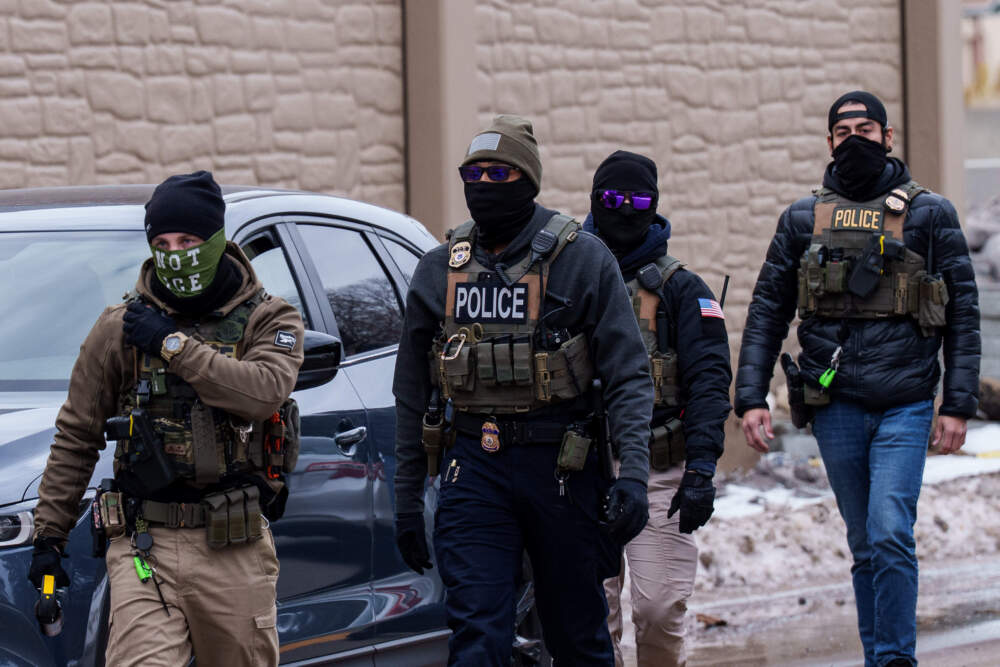
The most detailed passages describe agents posing as activists and embedding themselves in ordinary community life.
On 31 January, an agent attended a Sunrise Movement resistance skills training held at a Minneapolis public library. The resulting report described participants discussing recruitment and de-escalation, with speakers recommending that events include a police liaison and a safety marshal. The agent’s own summary conceded the point: the organisation was clearly oriented toward peaceful protest.
The agent did not merely observe. According to the report, he told an attendee that he worked in construction and could build items useful to groups pursuing more direct-action tactics. He added that going to jail did not trouble him, and handed over his phone number.
A separate agent gained access to activists’ Signal groups.
Other documented surveillance included:
- A virtual Hunter College meeting in New York on ICE brutality and responding to state violence
- A gathering at a Minneapolis labour centre covering a range of political topics
- A discussion of protest tactics held in a public park
- A Direct Action Minnesota meeting inside a church
Agents made audio recordings at these events. One report recounts an agent attending a training session in a church gymnasium and taking part in boxing and sparring practice, while secretly recording. The recorder, the report notes, fell to the floor, forcing the agent to return and retrieve it.
At another church event, agents logged the licence plates of people attending. When a man approached two agents and asked whether they were ICE, one denied it.
The Defence Response
Attorney Kevin Riach, who filed the tranche in federal court, said he was taken aback by the breadth of the operation and by what he saw as an absence of investigative discipline — though he added he was not entirely surprised.
In his motion seeking additional records, Riach argued the government was advancing conspiracy allegations rooted in fantasies of political retribution. He further alleged that undercover personnel did not simply watch but helped organise and steer the groups they targeted, at moments attempting to draw people into discussing or carrying out crimes.
The scale mismatch is notable. The indictment runs 94 pages and alleges a sprawling conspiracy, yet contains no claim that any defendant injured a specific ICE officer and no charges of serious violence.
A Community’s View
Emilia Gonzalez Avalos, executive director of the Minneapolis non-profit Unidos MN, whose activities appear in the files, described the campaign as an attempt to intimidate and to politically punish disagreement. That, she said, is not the country built over centuries, nor the one her organisation is working toward.
She noted that trainers routinely asked attendees not to record. But organisers also made a point of telling any immigration officers present that they were welcome to remain, since the work was grounded entirely in the Constitution and there was nothing to conceal.
An Ex-Agent’s Assessment
Mike German, a former FBI agent turned civil liberties advocate, flagged several irregularities.
He found it unusual that DHS rather than the FBI was driving investigations into supposed terrorist activity. He also highlighted the reliance on administrative subpoenas, which bypass judicial review entirely.
More fundamentally, German said the government appeared to be operating on guilt by association rather than building narrow cases around specific alleged crimes.
Having worked undercover himself, he was dismissive of the premise. These were public meetings actively recruiting members and openly inviting people to protests — hardly a difficult environment to penetrate, and precisely the signal that no criminal enterprise was present. Criminals, he observed, rarely advertise their plans.
He placed the episode in a longer American pattern of surveilling left-wing activism and labour organising, powers that expanded substantially after 9/11. Nobody, he said, should be startled to see those authorities aimed at political opponents rather than at criminals.
Author
-
Lucienne Albrecht is Luxe Chronicle’s wealth and lifestyle editor, celebrated for her elegant perspective on finance, legacy, and global luxury culture. With a flair for blending sophistication with insight, she brings a distinctly feminine voice to the world of high society and wealth.