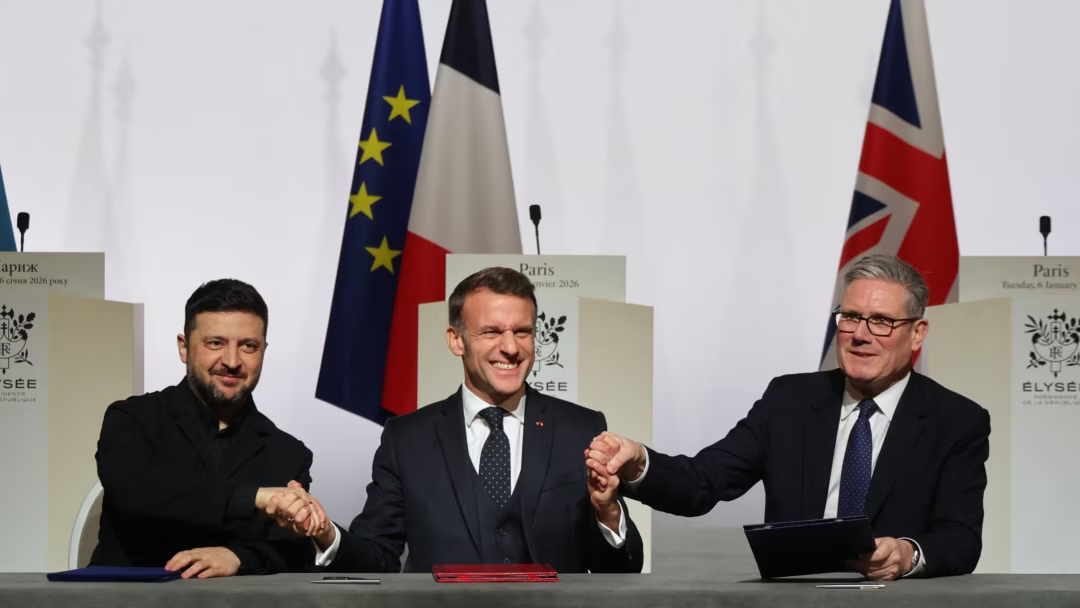
Volodymyr Zelenskyy arrived in Paris on Monday to meet roughly two dozen European leaders — and he came with something he has not always had: momentum.
The Zelenskyy Paris talks come as Ukraine claims to have struck 105 Russian vessels in eight days, as its drones reach deep into the Moscow region, and as Kyiv’s technological edge has begun to visibly slow Russia’s advance.
The war is in its fifth year. For the first time in a while, the trajectory looks negotiable.
The Coalition Assembles
The Paris gathering brought together the so-called Coalition of the Willing — more than 30 countries supporting Ukraine — with around 25 heads of state and government attending in person.
That attendance figure is itself the message.
Sending a foreign minister is support. Sending a head of state is commitment. Twenty-five of them arriving simultaneously is a signal aimed squarely at Moscow, which has spent months probing Europe’s resilience.
European foreign ministers met separately in Brussels to address Ukraine’s needs and Russia’s broader threats to the continent.
Moscow’s Response
The Kremlin dismissed the entire exercise.
“This is a coalition of warmongers,” said spokesman Dmitry Peskov. “They are driven by the profound delusion that it’s possible to inflict a strategic defeat on our country, so this is a coalition of the deluded, a coalition of those who incite the war.”
Despite a year-long peace effort by the Trump administration, Moscow has shown no willingness to compromise.
What Zelenskyy Wants
His priority is air defence — specifically, jointly developing anti-ballistic systems with European partners capable of stopping Russia’s devastating strikes on Ukraine’s power grid.
Trump’s pledge last week to license Ukraine to produce Patriot systems could be transformative. But experts and Ukrainian officials caution that converting that promise into actual weapons would likely take years.
Ukraine needs interceptors now. It is being offered a factory later.
The Sea of Azov Campaign
The most striking Ukrainian claim came from Robert Brovdi, commander of Ukraine’s Unmanned Systems Forces.
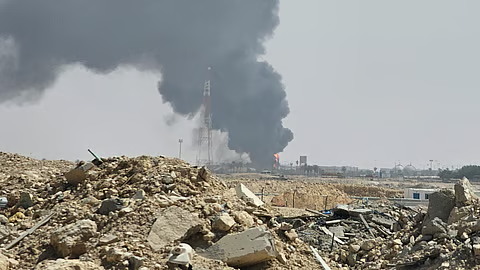
Between July 6 and 13, he said, Ukrainian forces struck 105 Russian vessels in the Sea of Azov, adjacent to Crimea.
The targets included tankers, dry cargo ships, a ferry and tugboats.
The strategic purpose is clear: isolate the Crimean Peninsula, which serves as the key rear base for Russian forces occupying southern Ukraine.
It appears to be working. Crimea is now enduring its worst fuel crisis since Russia illegally annexed it in 2014.
The claims could not be independently verified. Russian officials offered no immediate comment.
Drones Over Moscow
Ukraine’s long-range strike capability has reached a scale that now rivals Russia’s own aerial campaign.
Moscow Mayor Sergei Sobyanin said Russian air defences downed 350 Ukrainian drones heading toward the capital since late Sunday, including 50 near Moscow itself.
Andrei Vorobyov, head of the Moscow region, reported 81 drones downed overnight. Three people were killed and three injured in the Pionersky settlement near Istra.
Meanwhile, Ukraine’s air force said Russia launched 134 long-range strike drones and three guided aviation missiles.
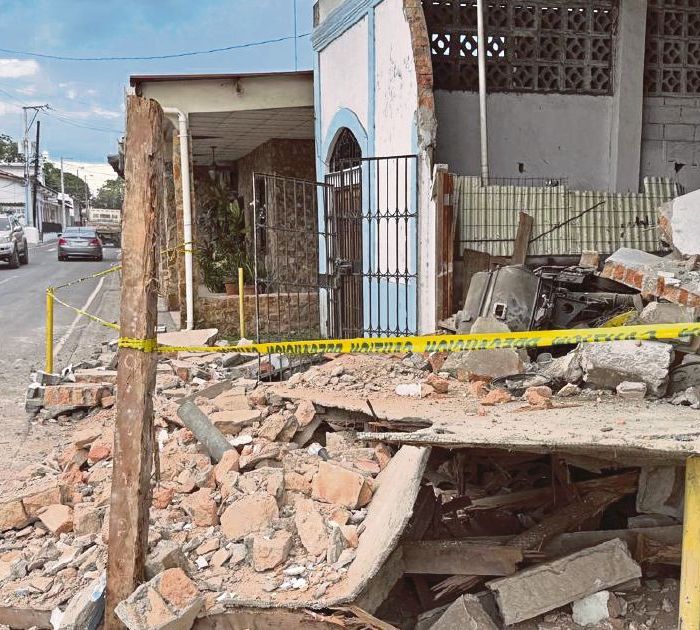
In Zaporizhzhia, more than 70 people were hospitalised after recent Russian strikes damaged 11 apartment blocks, according to military administration head Ivan Fedorov.
The Foiled Plot
Russia’s Federal Security Service announced it had thwarted an elaborate Ukrainian drone operation targeting two air bases — Ukrainka in the far eastern Amur region and Shagol in the Chelyabinsk region.
The method described is remarkable.
According to the FSB, small drones were smuggled into Bryansk region using air balloons and larger transport drones, then transported by car close to the air bases by Ukrainian agents.
The agency said it arrested agents and accomplices and seized 24 drones, describing the plot as “unprecedented in its scale and the level of threat.”
The claim is credible in light of history. Just over a year ago, Ukraine’s Operation Spiderweb destroyed or damaged nearly a third of Russia’s strategic bomber fleet using drones smuggled into Russian territory.
The War Spills Outward
Russia’s campaign is no longer confined to Ukraine.
French Foreign Minister Jean-Noël Barrot announced Monday that he would summon the Russian ambassador and impose sanctions on Russian hackers.
He described “a vast cyber campaign aimed at sabotage and espionage, carried out by Russia in about 10 European countries.”
Separately, a drone launched during Russian overnight attacks on Ukraine’s Odesa region crashed and exploded inside Moldova. The country’s foreign ministry called the incident “serious and unacceptable.”
Why This Moment Matters
Analysts and Western officials credit Ukraine’s advances in drone technology with delivering a genuine edge.
Strikes on supply routes behind the front line have stripped the Russian army of momentum, making its progress slow and expensive.
That is the leverage Kyiv and its backers are attempting to convert into negotiations.
The theory is straightforward: Putin will only talk when continuing becomes more costly than stopping.
Twenty-five leaders in Paris, 105 ships in the Azov, and 350 drones over Moscow are all arguments toward the same conclusion.
Whether Putin is listening is another question entirely.
Author