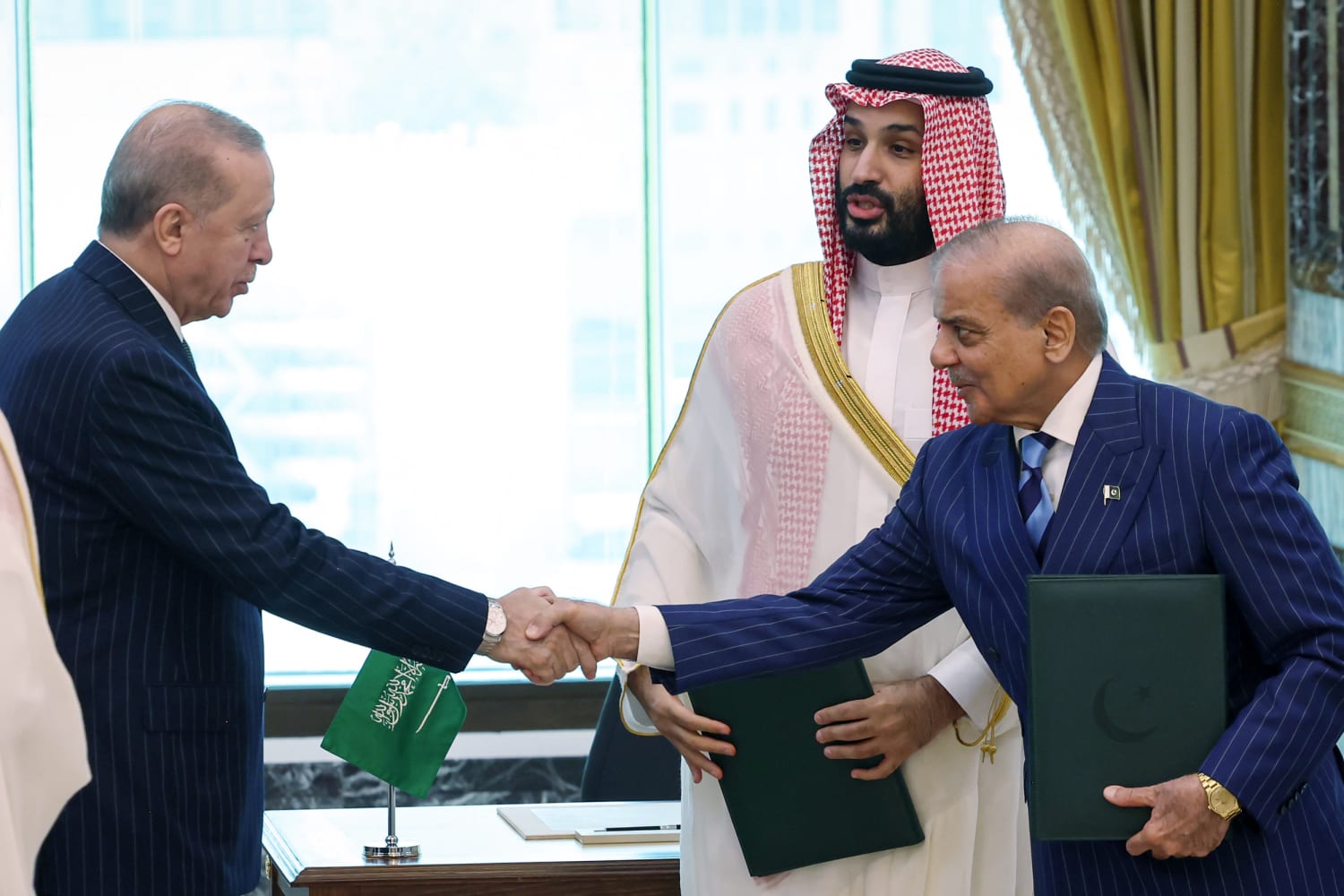
The Mecca Joint Defence Agreement, signed Friday by Saudi Arabia, Turkiye and Pakistan, has prompted a round of questions about whether the security architecture of the Middle East is being quietly rewritten in the aftermath of the US and Israeli war on Iran.
The pact was concluded in the Saudi city of Mecca, and its central provision borrows the language of collective defence familiar from NATO.
What the Agreement Says
According to a statement issued after the meeting, the arrangement is meant to strengthen collective deterrence against acts of aggression. It specifies that an armed attack on any one of the three signatories will be treated as an attack on all of them.
The document also commits the parties to expanding defence cooperation across its various dimensions, though it does not spell out what that entails in practice.
That vagueness is itself notable. The agreement establishes a principle without yet establishing the machinery to enforce it.
A Response to Eroding Confidence
Analysts consulted about the pact largely converged on a single reading: this is less about building something new than about hedging against something old becoming unreliable.
Kristian Coates Ulrichsen, a Middle East fellow at Rice University’s Baker Institute for Public Policy, said regional states have questioned the dependability of the American security partnership for over a decade.
In his assessment, recent events sharpened those doubts considerably. The decision to open military operations against Iran, the way the war has been prosecuted, and the intermittent efforts to resolve it have all pushed regional governments toward diversifying their defence relationships.
He was careful about what that means, however. The purpose, he said, is not to replace or displace the United States but to create additional strategic and policy options.
The First Visible Shift
Sina Toossi of the Center for International Policy framed the pact as an early marker of something larger.
He described it as among the first significant geopolitical indications that the regional order is being reshaped by the war. What matters, in his view, is not whether a formal military alliance functions as advertised, but what its existence reveals about how governments in the region are recalculating their security.
The Saudi position illustrates the point. Riyadh and Washington have maintained a close partnership for decades, built around overlapping security interests. Toossi argued that rather than continuing to rely primarily on the United States, Saudi Arabia now appears to be widening its network of partners and building the foundation for security arrangements among regional states themselves.
That, he suggested, is the most consequential element of the agreement.
The Costs That Prompted the Rethink
The frustrations behind this shift are concrete rather than abstract.
Reports have indicated that American partners in the region were unhappy that the Trump administration initiated February’s war with apparently little consideration of the consequences for allies nearby.
Those consequences arrived quickly:
- Iranian missile and drone strikes on US military facilities across the region, producing bystander casualties
- Attacks on civilian infrastructure including energy and desalination facilities
- Closure of the Strait of Hormuz, a critical route for regional energy exports
The strait has been particularly damaging. Despite heavy strikes by American and Israeli forces, Iran has largely retained its capacity to disrupt traffic through the waterway, imposing serious economic costs on neighbouring economies.
Compounding the problem, Washington has struggled to supply partners with adequate air defence munitions, with a substantial share of available interceptors directed to Israel.
An Open Field
Brett McGurk, who helped design Middle East policy under former President Joe Biden, characterised the current moment as fluid and open, describing it as a tabula rasa era for the region.
That phrasing captures the uncertainty. Assumptions that governed regional planning for decades are being reexamined simultaneously by multiple governments.
Why This Is Not an Anti-Iran Bloc
Yasmine Farouk of the International Crisis Group cautioned against two common misreadings.
The first is that the pact represents a move away from the United States. All three signatories are American partners, she noted, and each recognises that no existing framework can substitute for Washington’s role.
The second is that the agreement signals preparation for confrontation with Tehran. Farouk pointed out that since the US and Israel began attacking Iran in late February, all three countries have consistently advocated mediation and de-escalation.
What unites them, she said, is that none is seeking regional escalation.
Normative Deterrence
Farouk offered a framing that captures the pact’s likely function: something closer to normative deterrence than operational alliance.
The logic is that Iran has emerged from the war hardened and more confident in its willingness to use force to pursue its objectives. Against that backdrop, a declared mutual defence commitment raises the anticipated cost of aggression without requiring any party to mobilise.
She also emphasised the timeframe involved. The agreement reflects a long-term view of strategic cooperation rather than a short-term deterrent gesture.
What to Watch
The meaningful test will be implementation. Collective defence clauses are only as credible as the planning, exercises and command arrangements behind them, and none of that has been announced.
The Trump administration has not yet commented publicly on the pact.
For now, three American partners have formalised a commitment to one another that did not exist before the war. Whether that becomes a functioning security structure or remains a statement of intent will say a great deal about how far the region’s realignment actually goes.
Author
-
Lucienne Albrecht is Luxe Chronicle’s wealth and lifestyle editor, celebrated for her elegant perspective on finance, legacy, and global luxury culture. With a flair for blending sophistication with insight, she brings a distinctly feminine voice to the world of high society and wealth.