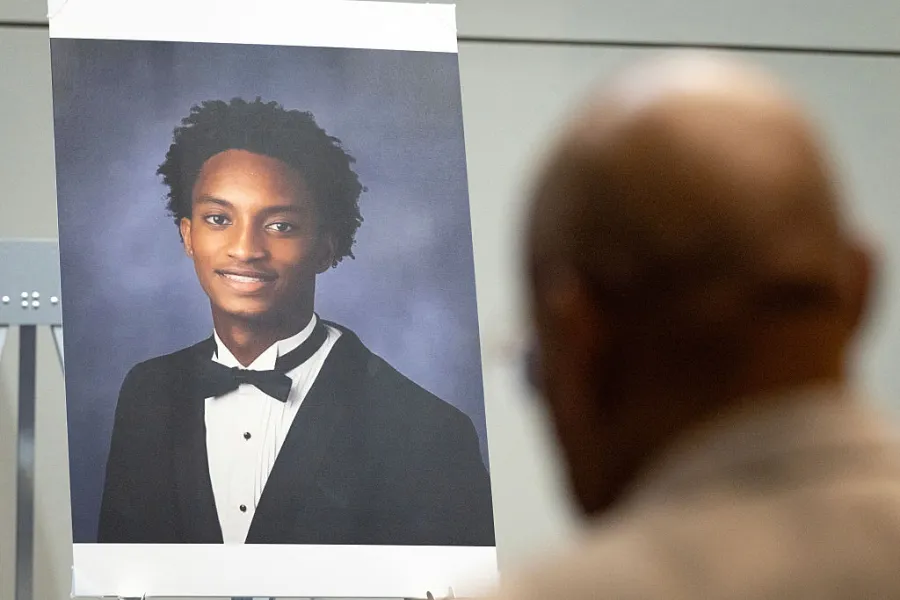
The Nolan Wells independent autopsy released Wednesday did not close the case. If anything, it widened it.
Commissioned by the family and performed on July 10 by forensic pathologist Dr. Roger Mitchell, the preliminary examination stopped short of assigning either a cause or a manner of death for the Black teenager, who was found dead after disappearing on a Mississippi island on the Fourth of July. Instead of resolution, the report delivered a list of things that still need answering.
Attorney Ben Crump, representing the Wells family, put it plainly while reading from the findings at a news conference: the pathologist could not exclude the possibility that non-accidental factors played a role in the death.
More questions than answers, as Crump summarized it.
An Unexplained Finding
One detail from the examination stands out.
Mitchell documented red discoloration in the soft tissue at the back of Wells’ head. He noted that the source of that discoloration remained unclear, and Crump emphasized that the finding warrants deeper scrutiny rather than dismissal.
A mark like that is not automatically evidence of anything. But it is also not automatically nothing — and in an examination this constrained, unexplained findings carry weight.
The Missing Neck Structures
The most consequential gap in the second autopsy involved material Mitchell never received.
The internal structures of Wells’ neck, including the trachea, were not turned over to him. Mitchell wrote that he did not know why the initial pathologist retained them, though he acknowledged the practice is not unusual when there are concerns about fracture or compression requiring additional testing.
The consequence, however, is significant: without those tissues, Mitchell stated he cannot rule out neck injury as a contributing factor or the cause of death.
That is a substantial category of possibility left open — not because evidence pointed toward it, but because the evidence needed to close the question was unavailable.
Why Second Autopsies Are Inherently Limited
Understanding this report requires understanding what a second examination can and cannot do.
The first autopsy proceeded normally, which means organs were removed and dissected as standard practice requires. By the time a second pathologist examines a body, much of the original condition no longer exists in an observable state.
Mitchell identified the specific handicap this created:
- He could not directly examine the airway for the presence of water
- He could not directly examine the lungs for the same
- He could not directly observe stomach contents
For a death involving water, those three observations are close to foundational. Their absence removes the most direct route to determining whether drowning actually occurred.
The examination was funded by civil rights activist Colin Kaepernick.
Seven Questions Still Open
Mitchell concluded his report with a list of seven matters requiring further investigation. Among them:
- What circumstances led Wells to enter the water in the first place
- Whether water was present in his airway
- Whether he suffered a brain bleed
Crump identified the first of these as the central issue. Wells’ physical condition before he entered the water, he argued, is the crux of the entire matter — and determining it is essential to establishing both cause and manner of death.
The distinction matters. Whether someone drowned and why they were in the water are separate questions, and answering only the first tells you very little.
What Local Authorities Have Not Released
The family’s frustration centers heavily on information that remains unavailable.
The Jackson County Sheriff’s Department has not made its autopsy or toxicology results public. Crump has called on the Mississippi medical examiner’s office to share its photographs and observations with Mitchell, arguing that transparency is the minimum requirement for public confidence.
He also relayed Mitchell’s view that toxicology findings should properly be interpreted before a grand jury, and urged the district attorney to have Mitchell testify in that setting so all relevant material reaches jurors.
Mitchell did not attend the news conference, which was held at the 117th NAACP National Convention in Chicago. He serves as president of the National Medical Association and previously held the position of chief medical examiner for the District of Columbia.
A Family Left Waiting
Christine Wells-Wonsley, Wells’ mother, described the silence from local authorities as both heartbreaking and concerning. Her last contact with the sheriff’s office came a day or two after her son’s body was recovered on July 6.
Her explanation for why the family has pursued an independent path is direct. Local officials concluded Wells had drowned and indicated they did not suspect foul play within an hour of his body being removed.
An hour is not much time to consider alternatives.
Contradictions in the Account
At a July 10 news conference, Crump raised what he characterized as glaring inconsistencies in witness statements about the disappearance.
The disputed points include whether Wells remained on the island or left it, and why he was not carrying his phone. Crump also questioned the drowning conclusion on its own terms, noting that Wells was a young athlete who knew how to swim.
Swimming ability does not make drowning impossible. But it does make it a claim that ought to be demonstrated rather than assumed.
A Growing Public Response
The case has drawn substantial attention beyond Mississippi. The Rev. Al Sharpton, filmmaker Tyler Perry, and former NFL player Terrell Owens have jointly offered a $125,000 reward for information leading to a conviction.
That figure signals something important — the belief among prominent supporters that there may be someone to convict.
Where Things Stand
Nothing about this report establishes wrongdoing. Mitchell did not conclude that Wells was harmed by anyone. What he concluded was narrower and, in its way, more unsettling: he could not determine what happened, and critical evidence needed to make that determination was either unavailable to him or never collected.
The path forward runs through material only local authorities can release — the original autopsy, the toxicology results, the photographs, the neck tissues.
Until those surface, the family is left where they started. As Wells-Wonsley put it, the only thing they want to know is what happened to their son.
Author
-
Lucienne Albrecht is Luxe Chronicle’s wealth and lifestyle editor, celebrated for her elegant perspective on finance, legacy, and global luxury culture. With a flair for blending sophistication with insight, she brings a distinctly feminine voice to the world of high society and wealth.