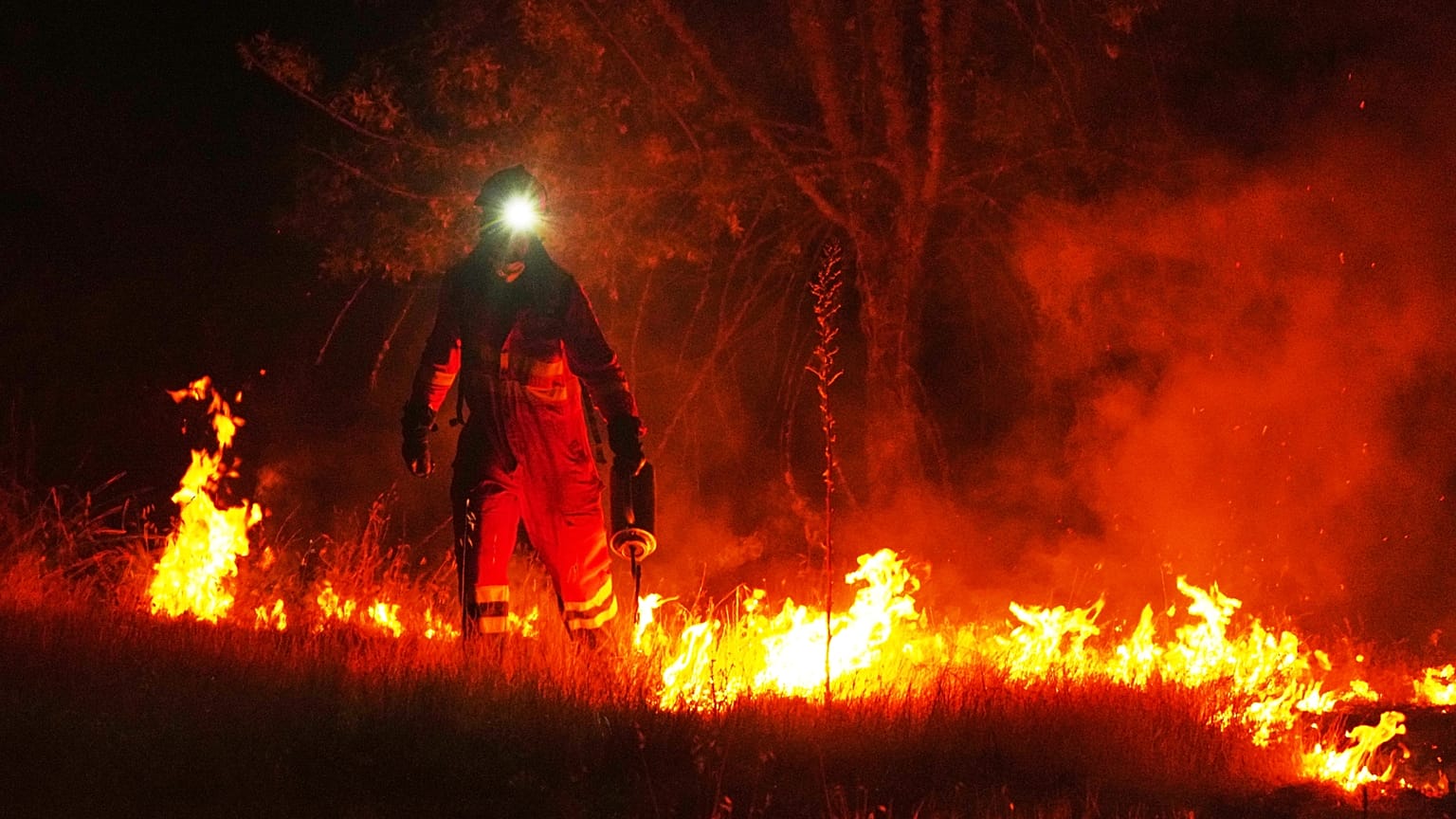
The Spain wildfires evacuees return story took a hopeful turn this week, with thousands of people finally allowed back into their houses across Toledo, Madrid, Ávila and Castellón. In the Madrid region alone, 24,000 residents were cleared to go home, and confinement orders affecting another 20,000 were lifted.
The relief may be short-lived. Spain and France are both bracing for the fourth heatwave of the summer, and several fires are still burning.
The Largest Fire Spain Has Ever Recorded
The blaze at Burgohondo, roughly 150 kilometres west of Madrid in Ávila province, has now consumed more than 43,000 hectares — about 108,000 acres. That makes it the biggest wildfire in Spanish records.
It has driven 40,000 people from their homes.
Francisco Bolaños, part of the team directing the firefighting effort, offered a cautiously encouraging update: the fire had not advanced a single centimetre overnight. But he warned that rising temperatures could reignite it, and crews are now focused on holding a perimeter that stretches 180 kilometres.
Across the country this year, wildfires have burned through more than 207,000 hectares.
Prime Minister Pedro Sánchez described the coming twelve hours as decisive for the fire near the capital. Progress was favourable, he said, though with maximum caution given the combination of higher heat, falling humidity and the threat of wind gusts.
Coming Home to Very Little
Not everyone is returning to an intact life.
About 1,000 residents of Navas del Rey and Chapinería, west of Madrid, had been sheltering in Leganés on the capital’s south-western edge before being allowed back.
Lucía Moya, the mayor of Chapinería, was blunt about what awaits them. The consequences for her town have been severe. Many residents lost homes and jobs in the same week, and rebuilding, she said, will be an arduous process.
In the nearby Tiétar Valley, roughly 2,000 people fled and were taken in by volunteers in Talavera de la Reina, well to the south. Around 300 of them were still there on Wednesday morning. Mayor José Julián Gregorio said they would continue receiving the same standard of care they got on day one.
A Death From an Earlier Fire
No deaths have been reported in the fires around Madrid or in Castellón on the east coast.
But authorities in Seville confirmed that a woman severely burned in the Los Gallardos fire in Almería earlier this month has died in hospital of her injuries.
That brings the Almería toll to fourteen. The dead include British and Belgian nationals alongside American, French and Spanish citizens — a reminder that these fires strike regions where tourists and foreign residents live and holiday alongside locals.
France Faces Its Own Fight
Across the border in the south-west, the largest fires in the Gironde region are officially described as still stabilised. Officials are careful with that phrasing, because there have been several flare-ups.
The forecast is not helping. Dry winds are expected alongside temperatures reaching 41C. Sixteen departments are under orange heatwave alert, including the Landes area further south.
Blandine Sarrazin, mayor of Le Barp near Bordeaux, said conditions are getting harder after two new fires broke out the previous day. Her instruction to residents was simple: be hyper-vigilant.
Protecting the Dangerous Sites
One detail from Gironde deserves attention. The fire service has deployed special measures specifically to shield a group of industrial facilities tied to France’s defence and aerospace sectors.
These are designated Seveso sites, a European classification for installations handling hazardous materials in quantities significant enough to require heightened oversight. Some of the plants in question manufacture materials used in missiles and rockets.
Fire near that kind of facility changes the calculation entirely. Crews are not simply defending forest and homes; they are working to prevent an industrial incident layered on top of a natural one.
The Fires Are Not Only in Spain and France
Portugal is dealing with active fires in the north-eastern district of Vila Real. Civil protection officials told the national broadcaster that one front extends about a kilometre, and they are watching a water treatment plant and a gas depot near the town of Valpaços with particular concern.
Greece has fires burning on the Aegean island of Paros and in Trifylia in the southern mainland.
Taken together, the map shows something more than a bad week in one country. Four nations are fighting simultaneously during the same heat event.
Why This Keeps Happening
The pattern is not random, and the science behind it is well established.
Rising global temperatures are pushing summer heat higher everywhere, but Europe is warming faster than any other continent — roughly twice the global average, according to the Copernicus Climate Change Service.
That has three practical effects. Heatwaves arrive more often and last longer. Water supplies come under sustained strain, leaving vegetation drier and more combustible. And wildfires, once started, burn hotter and spread faster than firefighting systems were originally designed to handle.
A fourth heatwave in a single summer is not an anomaly in that context. It is the expected outcome of a warming pattern that has been documented for years.
What Happens Next
The immediate question is whether the perimeters hold.
A fire that has not moved overnight is not an extinguished fire. Heat, low humidity and wind can restart a blaze along a line that appeared secure hours earlier, which is why Bolaños and Sánchez both framed their updates with such care.
For the returning evacuees, the timeline is longer. Insurance claims, rebuilt houses and recovered livelihoods take months or years, and towns like Chapinería are starting that process while the region remains under threat.
For everyone else in southern Europe, the coming days are about a familiar set of precautions: avoiding anything that produces a spark outdoors, heeding evacuation orders quickly rather than reluctantly, and accepting that the summer is not finished with them yet.
Author
-
Lucienne Albrecht is Luxe Chronicle’s wealth and lifestyle editor, celebrated for her elegant perspective on finance, legacy, and global luxury culture. With a flair for blending sophistication with insight, she brings a distinctly feminine voice to the world of high society and wealth.