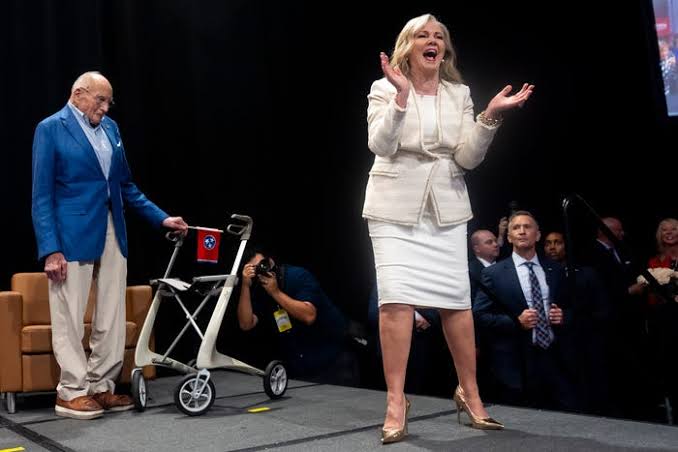
Marsha Blackburn captured Tennessee’s Republican nomination for governor on August 6, defeating two conservative rivals and positioning herself as the strong favorite to win in November. NBC News and the Associated Press both projected the result.
Her general election opponent will be Jerri Green, a Memphis council member who took the Democratic nomination, according to projections from CNN and the AP.
The outcome guarantees a historic result. With women winning both major party nominations, Tennessee will elect its first female governor this fall regardless of which party prevails.
Blackburn Claims the Nomination
Blackburn posted her reaction on X shortly before 9:30 p.m. Eastern, describing a year-long effort built around a single objective: making Tennessee the nation’s conservative leader and demonstrating what bold conservative governance looks like. She said she was humbled and honored by the nomination.
Her victory speech leaned heavily into national politics. She pledged to keep the state the most conservative and best-governed in the country, called it Donald Trump country, and committed herself to his America First agenda.
She promised to work with the Trump administration to ensure every person in the country illegally is deported, and reaffirmed her plan for a state-level government efficiency initiative aimed at eliminating wasteful spending.
Blackburn also drew sharp contrasts with the opposition, saying she would not permit Tennessee to become New York or California and criticizing the growing democratic socialist faction within the Democratic Party. Defeating Democrats in November, she said, would send an unmistakable message that Tennessee is a solidly red conservative state where socialist and communist policies stop at the border.
A Race She Led Throughout
Blackburn, 74, entered the primary as the clear front-runner against U.S. Rep. John Rose and state Rep. Monty Fritts, at one point holding double-digit leads in early polling.
Her standing within the party is well established. She was the first woman elected to the U.S. Senate from Tennessee and is serving her second Senate term after four terms in the House.
Notably, Trump did not endorse anyone in the primary, even though both Blackburn and Rose positioned themselves as strong supporters. Trump carried the state in 2024 by nearly 30 points over Kamala Harris.
Her platform hit familiar Republican themes: economic growth through tax reduction, crime and immigration enforcement, cutting government waste, parental rights and removing what she describes as woke curriculum from schools. Her campaign website lists commitments including keeping men out of girls’ sports, holding big tech accountable, defending life, protecting farmland from Chinese ownership and securing the border.
In her victory remarks, she characterized the past 16 years as a period in which Tennessee became a Christian conservative standard bearer.
The campaign drew national attention in July with a video showing Blackburn seated in a Chinese restaurant crumbling fortune cookies to illustrate how aggressively she intends to confront China. She also faced criticism for declining to debate her primary opponents.
The contest tightened as the primary approached, but she never surrendered the lead.
Rose Concedes and Endorses
Rose built a contrasting campaign around his roots as an eighth-generation Tennessee farmer and his framing as someone who is not a career politician. Like Blackburn, he emphasized loyalty to Trump, describing himself as an unapologetic supporter who would follow the president’s blueprint.
His five priorities were education, infrastructure, healthcare, energy and economic and community development.
Addressing supporters on election night, Rose said he had called Blackburn to congratulate her. He acknowledged the disappointment while urging his backers to support the Republican nominee heading into the general election.
Fritts ran a smaller-government campaign organized around ten pillars, including eliminating the grocery sales tax, defending Second Amendment rights, supporting voter identification requirements and removing incentives he argued attract people to the state illegally.
Green’s Historic but Difficult Path
Green celebrated her own milestone on X at 9:29 p.m. Eastern, noting she is the first woman to win the Democratic nomination for governor in Tennessee.
She reaffirmed her campaign focus on affordability and strong public schools while criticizing what she called out-of-touch extremists in Washington who answer only to the wealthy and well-connected. She closed with a call to make history again.
Her broader platform includes support for working families, strengthening public education, expanding Medicaid in rural areas, common-sense gun legislation and climate preservation. She defeated Carnita Atwater and Tim Cyr in the primary.
The structural challenge is significant. No Democrat has occupied the governor’s office since Phil Bredesen was term-limited out in 2011 following his 2006 reelection. Republicans have dominated statewide contests since.
Republicans Warn Against Complacency
Despite the favorable landscape, some Republicans urged their party not to treat November as settled.
U.S. Rep. Tim Burchett, a Knoxville Republican who ran unopposed for reelection in the 2nd Congressional District, congratulated Blackburn while cautioning that the election is not over. He characterized the opposition in stark terms, accusing members of the other party of disrespecting the American flag, and told supporters to take the general election seriously.
What Comes Next
The general election will test whether Tennessee’s Republican advantage holds in a midterm environment, or whether affordability and healthcare arguments give Green more traction than recent Democratic nominees have found.
Blackburn’s Senate seat will also draw attention. Should she win the governorship, her departure from Washington would create a vacancy with its own political consequences.
Either way, a woman will be sworn in as Tennessee’s governor for the first time in the state’s history.
Author
-
Lucienne Albrecht is Luxe Chronicle’s wealth and lifestyle editor, celebrated for her elegant perspective on finance, legacy, and global luxury culture. With a flair for blending sophistication with insight, she brings a distinctly feminine voice to the world of high society and wealth.