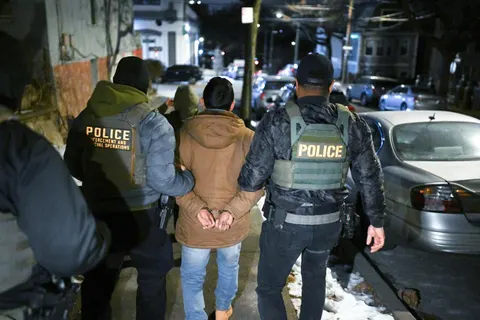
The legal immigration crackdown now taking shape in Washington marks a shift in emphasis. For most of the past year, enforcement energy has been directed at people who crossed the southern border without authorization. That focus has not disappeared, but a second front has opened, and this one targets people who applied, waited, paid fees, and entered through official channels.
Two developments in recent days signal how far the administration intends to go.
Immigrant Visa Processing Comes to a Halt
The State Department has suspended processing of all immigrant visa applications worldwide.
The pause is not permanent, at least as described. It exists so the department can brief consular officers stationed across the globe on a new policy governing how applications should be evaluated going forward.
The substance of that policy concerns financial self-sufficiency. Officers will be instructed to screen out applicants judged likely to become a burden on public resources, effectively raising the economic bar for anyone seeking permanent residence.
Immigrant visas are the pathway to a green card. They cover spouses of American citizens, parents, adult children, siblings, employment-based applicants, and diversity lottery winners. A global pause touches every one of those categories simultaneously.
Who Feels This First
The people caught in the freeze are not abstractions.
They are individuals who have often spent years in a queue, some of them separated from spouses or children by the delay. Many have already completed medical examinations, gathered police certificates from every country they have lived in, and paid substantial fees. Some have interview appointments scheduled.
Medical exams and police clearances carry expiration dates. A pause of any real length means documents lapse and must be redone, which costs money and adds further months.
The Broader Meaning of the Policy
Screening applicants for potential reliance on public assistance is not a new concept in American immigration law, but the reach of such rules has varied enormously depending on how they are drafted and enforced.
A narrow version looks at whether someone is likely to require cash welfare or long-term institutional care. A broad version can sweep in applicants who might use health programs, nutrition assistance, or housing support, or who simply appear to have modest income and limited assets.
Where the new guidance falls on that spectrum will determine how many applications it blocks. Consular officers also have considerable individual discretion, which means outcomes may vary from one embassy to another.
The Largest Visa Revocation Ever Attempted
The second development is larger in scale and more legally fraught.
The administration is preparing to cancel business and tourism visas held by as many as 200,000 foreign nationals who have filed asylum claims. The Associated Press reported the plan this week.
Nothing of comparable size has been attempted before. Individual revocations happen routinely. Mass revocations affecting entire nationalities have occurred in narrow circumstances. A single action stripping visas from 200,000 people would be without precedent in American immigration history.
The Logic and the Contradiction
The reasoning appears to rest on the idea that someone who arrives on a visitor visa and then applies for asylum has undermined the basis on which that visa was granted. Business and tourism visas require applicants to demonstrate they intend to leave when their visit ends.
Critics see a different picture. Applying for asylum is a legal right under both American statute and international agreements the United States has signed. People fleeing danger frequently arrive on whatever visa they can obtain, because there is no dedicated visa for seeking protection.
Punishing someone for exercising a legal right, opponents argue, effectively converts that right into a trap.
Legal Trouble Ahead
Courts will almost certainly be asked to intervene, and the challenges will likely proceed along several lines.
- Whether revoking status from a defined class without individual review satisfies due process requirements
- Whether the action penalizes protected conduct under asylum law
- Whether proper administrative procedure was followed in adopting the policy
- Whether the government has adequately justified the change
Visa revocation has historically enjoyed broad deference from courts, which have been reluctant to second-guess consular and State Department decisions. But the sheer scale here, combined with the connection to asylum claims, gives litigants arguments they would not otherwise have.
Practical Consequences
For the people affected, revocation would carry immediate effects.
A canceled visa can end work authorization, complicate travel, and expose someone to detention or removal proceedings. Asylum applications would presumably continue moving through a separate system, but the applicant’s ability to remain lawfully while waiting becomes far more precarious.
Employers, universities, and family members would feel secondary effects as people they depend on suddenly lose stable status.
What This Signals
Taken together, the two moves suggest a broader recalibration of what legal immigration means in practice.
Supporters argue the government has both the authority and the obligation to ensure newcomers can support themselves and that visa categories are used for their stated purposes. In their view, enforcement that ignores legal channels is enforcement with a large hole in it.
Opponents counter that the message being sent undercuts years of official insistence that people should immigrate the right way. If following the process offers no security, the incentive structure collapses.
Where This Goes
Consular briefings will conclude at some point, and immigrant visa processing will resume under the new standards. How many applications get denied under those standards is the number to watch.
The revocation plan faces a longer road. Announcement, implementation, and litigation will unfold over months, and courts may well pause portions of it before it takes full effect.
For hundreds of thousands of people currently holding valid documents, the uncertainty has already begun.
Author