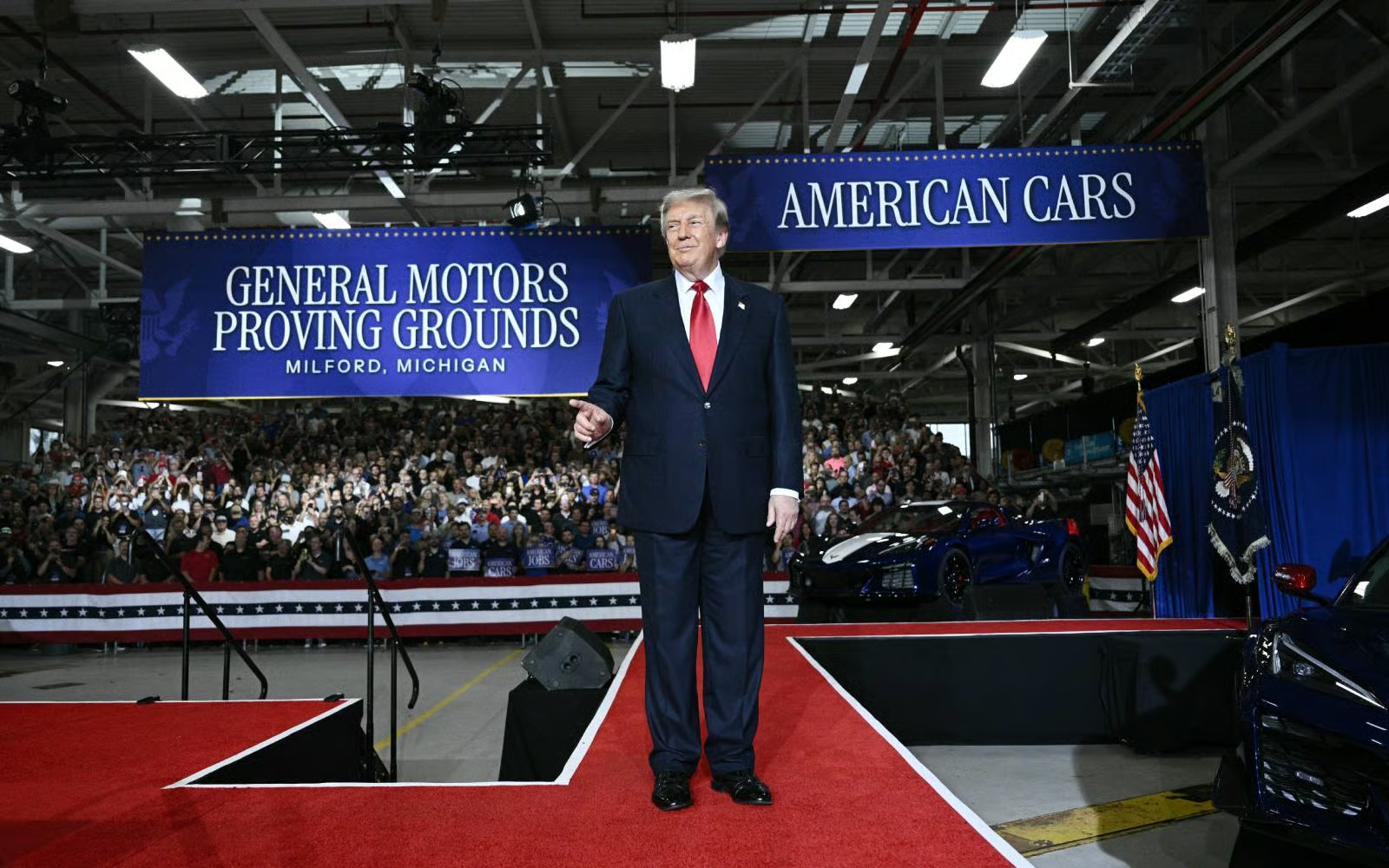
The Trump Michigan speech delivered Monday at a General Motors testing facility was billed as an economic address, but it played more like the opening act of a campaign season. With fewer than 100 days remaining before November’s elections, the president used the venue to celebrate his record on jobs and investment while branding his political opponents communists, drawing loud approval from much of the crowd.
The setting made the moment unusual. Presidents visit auto plants routinely. Converting one into a partisan rally is rarer. General Motors, whose chief executive Mary Barra was in the audience, declined to comment on the political content of the remarks.
The Pitch He Delivered
Trump’s summary of the moment was expansive. He told the audience that employment is rising, inflation is falling, the border is under control, factories are opening at record rates and investment is surging. Michigan, he said, is thriving, and the country is winning as never before.
He did not confine himself to economics. The speech ranged across immigration, the war with Iran, voting restrictions and transgender policy, stitching them into a single argument that the current year has been the best in the country’s history and that his opponents intend to wreck it.
Some of the claims did not hold up. He asserted that Democratic candidates want to push tax rates to 80 percent and eliminate police departments, neither of which reflects any actual party position. He also said the U.S. trade deficit had fallen by 71 percent. The real figure for 2025 was a decline of two-tenths of one percent.
A Term Defined by Economic Shocks
The optimism sits uneasily beside what the past 18 months have actually looked like.
Trump’s second term has produced a sequence of policy-driven disruptions. An aggressive immigration crackdown has reshaped labor availability in several sectors. Higher tariffs have altered costs across supply chains. And the war with Iran has driven oil prices up while creating fresh risks for global shipping and logistics.
Each of those was a deliberate choice rather than an external accident, which makes the resulting economic conditions harder to attribute elsewhere.
Polling consistently shows that the cost of living remains the dominant concern for American voters heading into November, and that holds true in Michigan as much as anywhere.
Michigan Is Not Buying It
The state where Trump chose to make his case is also one where his standing has deteriorated sharply.
Bernie Porn, president and pollster at Epic MRA, which is based in Michigan, reports that voters there have grown considerably more skeptical about the president’s handling of the economy and trade. His approval rating in the state has dropped to 33 percent, with 61 percent disapproving.
The tariff question is especially damaging. Most Michigan voters surveyed say the costs are landing on American consumers rather than on foreign governments, which is the opposite of how the policy has been publicly sold.
Porn’s assessment was blunt: the president faces a serious problem going into the midterms because voters have stopped believing what he tells them.
The White House offered a different read. Spokeswoman Liz Huston credited the America First agenda with prompting automakers to invest, hire and expand at a pace she said the industry has not seen in decades.
Why He Is Making the Argument Anyway
The strategy behind the speech is not difficult to read.
With the Iran conflict compounding financial anxiety at home, Trump has spent recent weeks shifting emphasis away from defending conditions and toward warning about the alternative. Casting Democrats as radicals intent on transforming the country fundamentally gives his base something to mobilize against rather than something to evaluate.
It is a familiar approach when incumbency becomes a liability. If voters are unhappy with how things are going, the argument becomes not that things are fine but that the other side would make them worse.
The Race That Makes Michigan Matter
There is a specific reason the president chose this state, and it sits on the November ballot.
Michigan holds an open Senate seat that has drawn national attention and national money. Trump carried the state over Kamala Harris in 2024 by roughly 1.4 points, reclaiming ground Democrats had held since Joe Biden’s 2020 win. That margin was thin enough to make the state genuinely uncertain again.
Republicans have consolidated behind former Rep. Mike Rogers. Democrats face a contested primary in August between Rep. Haley Stevens and former public health official Abdul El-Sayed, a matchup that pits an establishment-backed moderate against a progressive challenger.
The general election will test something the president cares about beyond any single seat: whether his appeal among working-class voters transfers to Republican candidates when his own name is absent from the ballot. That question has produced mixed answers in past cycles.
The Venue Itself
Trump spoke at GM’s Milford Proving Ground, roughly 40 miles northwest of Detroit. The site sprawls across thousands of acres and includes test tracks, laboratories and facilities built to simulate driving conditions that vehicles will encounter in the real world.
The choice was symbolic as well as convenient. Tariffs have been the administration’s primary instrument for pressuring manufacturers to shift production back onto American soil, and GM offers examples the White House can point to. The company plans to relocate Chevrolet Blazer production from Mexico and to add Equinox output domestically alongside existing capacity.
Whether those decisions represent a broad reshoring trend or a handful of adjustments made under political pressure is the argument that will play out over the coming months.
What the Speech Revealed
Strip away the applause lines and Monday’s event showed a president confronting a gap between the story he wants to tell and the one voters are living.
He described record investment and a booming economy. Michigan voters told pollsters they are paying more and blame his tariffs for it. He promised that the country is winning. His approval in the state hosting him sits at a third.
Closing that gap in under 100 days is the task. Monday suggested the plan is less about persuading skeptics on the economy than about making the alternative sound frightening enough that the economy stops being the deciding factor.
Author
-
Lucienne Albrecht is Luxe Chronicle’s wealth and lifestyle editor, celebrated for her elegant perspective on finance, legacy, and global luxury culture. With a flair for blending sophistication with insight, she brings a distinctly feminine voice to the world of high society and wealth.