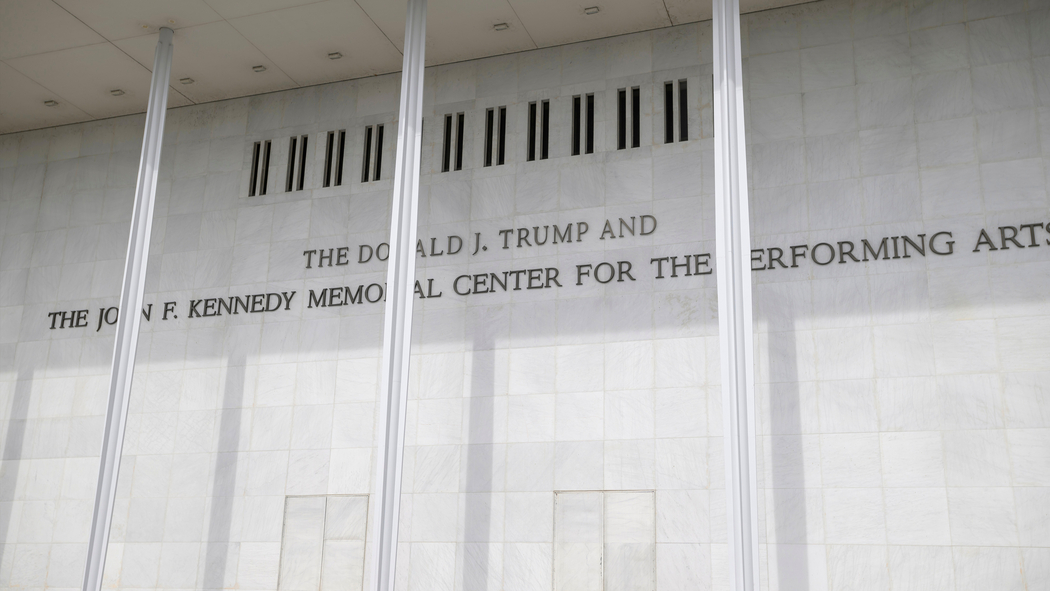
The Kennedy Center Trump name removal saga hit another twist this week when the famed Washington arts institution blew past a court-ordered midnight deadline to strip President Donald Trump’s name from its façade—blaming, of all things, the weather.
Just before the clock struck twelve, the center’s lawyers scrambled to file a request for more time, asking a judge to push the cutoff to noon on Saturday. Their reason? Storms had reportedly slowed the construction crews tasked with peeling the lettering off the building.
A Long Day of Legal Whiplash
The missed deadline capped a chaotic Friday marked by back-to-back courtroom losses. Two separate courts shot down the Kennedy Center’s eleventh-hour attempts to delay the change, even as workers assembled scaffolding alongside the structure.
The first blow came at 1 p.m., when U.S. District Judge Christopher Cooper rejected the center’s argument. He found that its attorneys hadn’t shown they were likely to prevail on appeal, nor had they proven the institution would suffer any “irreparable harm” if Trump’s name disappeared from the building.
The center didn’t give up easily. By late afternoon, Justice Department attorneys had filed an emergency motion with the D.C. Circuit Court of Appeals. That effort collapsed too—the appeals court turned them down shortly after 7 p.m.
When word of the ruling reached a crowd of more than 100 people gathered outside for a “Hands Off the Arts” rally, cheers broke out. “Right now, that name has to come down!” one demonstrator shouted into the celebration.
How We Got Here: A 15-Month Power Struggle
Pulling Trump’s name off the building would mark the most concrete defeat yet in the president’s long campaign to reshape the storied venue.
The takeover began in February 2025, when Trump dismissed the center’s board of trustees and installed political allies in their place. Those new members promptly voted him in as board chair. By December, the same loyalists had voted to rename the institution after him, framing the move as a bipartisan tribute to his support of the arts.
Trump publicly acted surprised by the decision—though he had been joking about a name change for months. His name appeared on the website within hours and on the building itself the following morning. The speed raised eyebrows. In fact, government lawyers later conceded that the signage must have been ordered or made before the board even cast its vote.
The rebranding didn’t stop at the front entrance. The center swapped out:
- Campus signs and shuttle bus branding
- Social media handles
- Official documents and the visitor guide
- Merchandise, including sweatshirts and tote bags
Backlash From the Arts World and the Kennedy Family
The renaming triggered immediate outrage. Members of the arts community and the Kennedy family alike argued that slapping Trump’s name on the building amounted to desecrating a living memorial to a slain president.
Their position has firm historical roots. Congress created the center in 1964, just two months after John F. Kennedy’s assassination, declaring it the only national monument honoring his memory in the Washington area.
The dispute even turned personal inside the boardroom. Rep. Joyce Beatty (D-Ohio), who sits on the board in an ex officio role, sued her fellow trustees in December after she was muted during a virtual meeting while trying to object to the change.
The Judge’s Verdict: Only Congress Can Decide
In May, Judge Cooper delivered a sweeping ruling: all of it had to go. His reasoning was blunt. Congress, he wrote, had been “crystal clear” back in 1964 when it transformed the National Cultural Center into the John F. Kennedy Center for the Performing Arts and enshrined it as a living tribute.
“Congress gave the Kennedy Center its name,” Cooper stated, “and only Congress can change it.”
At first, the center seemed ready to fall in line. An internal memo last week told staff to begin removing the branding, and the website’s title was quietly restored. A spokeswoman said the institution was obeying the court while still weighing its legal options.
But at a special meeting on Thursday, the board reversed course and voted to mount a fresh legal challenge—one aimed at keeping the largest sign in place during the appeal.
A Festival Atmosphere Outside the Venue
While lawyers battled, the scene on the ground felt almost celebratory. Roughly 150 people gathered to watch a 14-person crew assemble the scaffolding needed to pry off the 18 letters.
Spectators brought their dogs, partners, and kids. They gasped as lightning split the sky and marveled at a double rainbow overhead. When a skater glided through the driveway in a rainbow outfit waving a pride flag, the crowd roared. The Foo Fighters’ “My Hero” pumped through the air, and one onlooker shouted a simple request: take the “T” down first.
For some neighbors, the name had felt like an open wound. Grace Terpstra, a nearby resident who helped organize a group called Keep the KC, said the rebranding had left some people unable to even glance at the building. Removing it, she said, brought “a feeling of relief… of completion, of wholeness.”
Rep. Beatty stopped by as the appeals ruling landed. Onlookers thanked her and asked for photos. Calling the victory “humbling” and “rewarding,” she offered a parting thought: you can fight injustice and win.
What Still Hangs in the Balance
Trump himself has sent mixed messages. After Cooper’s ruling, he blasted the judge and hinted he might walk away from the center entirely. Days later, he reversed himself: “I’m the chairman, so we’ll just keep it going,” he told reporters aboard Air Force One.
Bigger questions remain unresolved. Chief among them is the fate of Trump’s surprise February announcement to shut the building for two years of repairs—a plan Cooper paused as too rushed, though he left the door open for trustees to revisit it more carefully.
The center has warned that disrupting its plans could be financially devastating. In a Friday filing, a Justice Department official claimed that some donations were tied directly to Trump’s name staying on the building—potentially forcing the return of “hundreds of millions of dollars.” Beatty’s legal team dismissed that argument as meritless, noting the center had never raised it in the lower court.
For now, the name remains. But the legal clock is still ticking.
Author