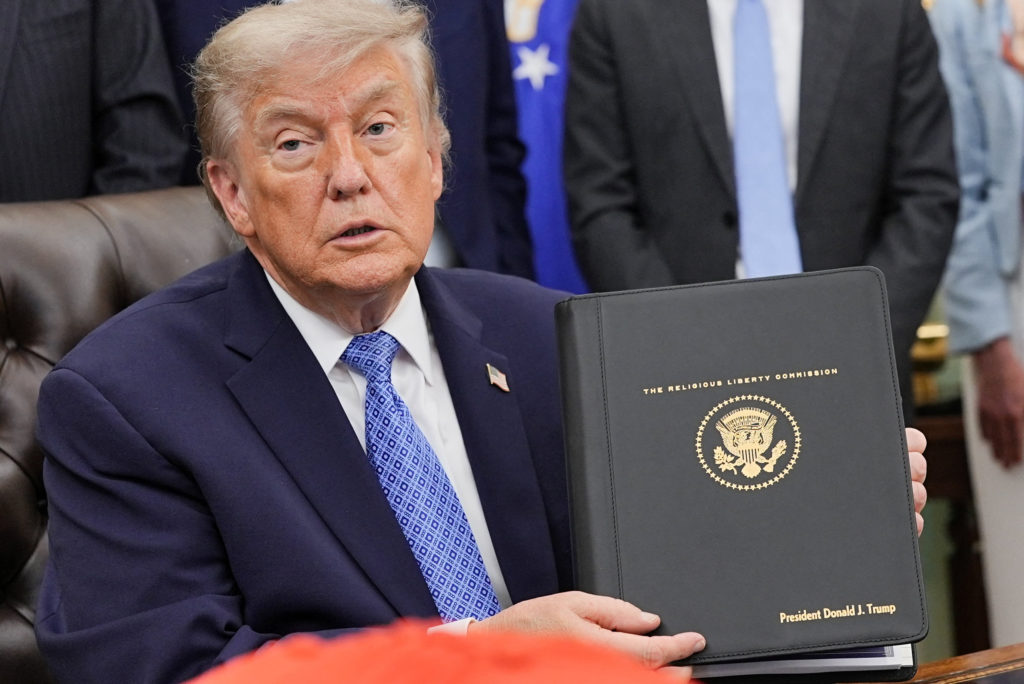
Religious Liberty Commission report released Friday marks a direct challenge to the long-standing principle of separating church and state. Issued in draft form by President Trump’s Religious Liberty Commission, the document argues that the separation concept amounts to a legal error and urges Americans to view religion as an essential pillar of national life.
A Sweeping Reframing of Religion and Government
The 224-page report calls on the Justice Department to issue guidance promoting what it describes as an originalist understanding of how the Constitution treats the relationship between religion and government. While the nation’s founders held a range of views on the subject, recent Supreme Court rulings have leaned toward a narrower reading of the constraints on religious freedom, a direction the commission appears eager to reinforce.
The report lays out a broad set of recommendations, including:
- Faith-based groups working with the government should not be required to follow civil rights laws or any rules that conflict with their religious beliefs.
- Public schools should be allowed to feature religious displays, with the report specifically citing the Ten Commandments.
- Soldiers who refused vaccination and were disciplined should be reinstated and financially compensated.
- The Johnson Amendment, which prohibits nonprofits from making political endorsements, should be eliminated.
Stripping the Phrase of Its Power
At an Oval Office news conference unveiling the report, commission Chairman Dan Patrick, the Republican lieutenant governor of Texas, took aim at the very phrase “separation of church and state.” He said the commission recommends that any official alleging such a violation, whether in government, schools, the military, or hospitals, be required to identify in writing exactly where the Constitution had been breached. His argument was that no such violation exists, and that the phrase should hold no power over people of faith going forward.
The legal reality is more nuanced. While the words “church-state separation” do not appear in the Constitution, the First Amendment does bar any government “establishment of religion.” Americans have debated the precise meaning of that clause since the nation’s founding.
Part of a Broader Push
The report arrives amid an aggressive conservative effort to elevate religion, particularly Christianity, in public life, encouraged by Supreme Court decisions affirming the constitutionality of such expression. Several states have mandated the display of the Ten Commandments in public school classrooms, and many now require schools to release students for Bible classes during the day.
The momentum extends further. The previous month, the White House hosted a day-long evangelical prayer festival on the Mall to mark the country’s 250th birthday, featuring commission members preaching from the stage. On the same Friday the report was released, the Texas education board approved a mandatory reading list for more than 5 million public school students that includes Bible passages.
Questions of Balance and Legitimacy
President Trump’s Religious Liberty Commission, established last year, is composed entirely of conservative Christians along with one Orthodox Jew, groups that experts note represent a minority of Americans. That composition has drawn legal challenges. In February, a coalition representing other religious traditions, as well as nonreligious and interfaith Americans, sued the administration, arguing the commission was assembled without the transparency and diversity required of a federal body.
The Reverend Paul Raushenbush, head of the Interfaith Alliance and one of the plaintiffs, had unsuccessfully applied to join the commission. He condemned the draft report as reflecting a narrow, Christian nationalist worldview, calling it a betrayal of the religious freedom promised in the First Amendment. He argued the commission failed to represent the importance of religious diversity and tolerance for all faiths rather than a chosen few, describing the report as a long-standing wish list of divisive ideas. He also pointed out that while the report raised concerns about anti-Christian bias and antisemitism, it made no mention of rising Islamophobia across the country.
The Legal Battle Ahead
The report remains a draft, with public comments open until July 12. The lawsuit challenging the commission had sought to block the release of any report until a court could rule on whether the body was lawfully constituted. It also requested that any recommendations carry a disclaimer noting they came from a panel that was not fairly balanced.
Responding to concerns about the lack of religious diversity, a Justice Department spokesman framed the commission as a way for Trump to create opportunities for Americans from all backgrounds to share their concerns and recommendations on civil rights and religious freedom. The statement emphasized the department’s mission to uphold the rule of law and ensure impartial justice for all Americans.
Testimony and Strong Words
Those called to testify before the commission included a worker at an Alaska women’s shelter who had turned away a homeless man who later sued for gender discrimination, and foster parents in Vermont who said their faith prevented them from affirming children undergoing gender transitions, despite a state requirement to do so.
Speaking at the White House, commission Vice Chair Ben Carson praised Trump as doing more for religious liberty than anyone else in the country. He emphasized that the nation’s founding document attributes rights to a creator rather than the government, framing the principle as part of the country’s shared heritage as one nation under God. Trump, for his part, noted that he had won the overwhelming majority of evangelical voters in his elections.
Ongoing Litigation
The White House continues to face additional legal challenges over its religion-related actions. Americans United for Separation of Church and State, among other advocacy groups, is pursuing a total of seven lawsuits. Some highlight that Trump’s Justice Department asked federal agencies for examples of what it labeled anti-Christian bias and sought access to related complaints. Others point to the proselytizing of certain agency heads, including the Defense Secretary and the Agriculture Secretary, underscoring how deeply the debate over religion’s role in government has taken hold across the administration.
Author