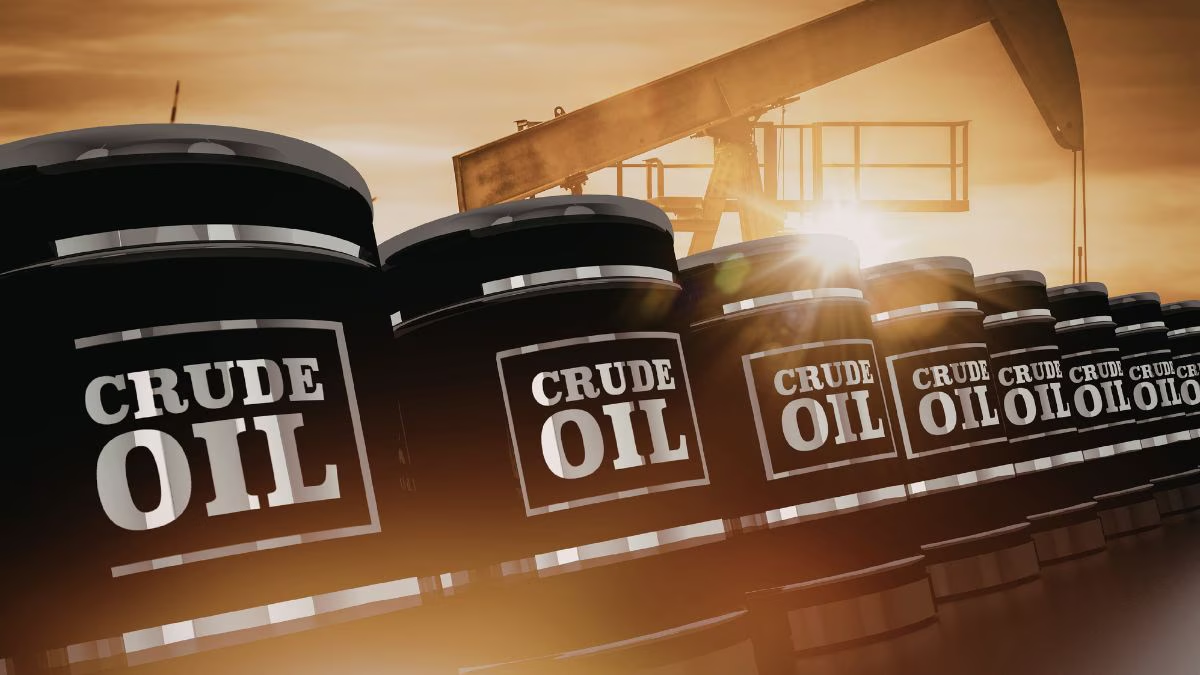
U.S. crude oil dropped below $100 per barrel on Wednesday after President Donald Trump told reporters that negotiations with Iran have entered their “final stages.” The remarks sparked an immediate market reaction, with traders welcoming the possibility of de-escalation after weeks of escalating tensions between Washington and Tehran.
The shift highlights how deeply geopolitics continues to influence global oil prices, and how just a few words from a sitting U.S. president can ripple through energy markets in a matter of minutes.
A Sharp Drop in Crude Prices
The price decline was substantial. According to market data:
- West Texas Intermediate (WTI) futures fell more than 5%, closing at $98.26 per barrel.
- Brent crude, the international benchmark, also lost over 5%, settling at $105.02 per barrel.
The move marks a meaningful correction after weeks of volatility driven by fears of supply disruption, military escalation, and broader instability in the Middle East. Investors interpreted Trump’s optimistic language as a sign that direct conflict could be avoided — at least in the short term.
What Trump Said
According to a pool report from Wednesday, Trump told reporters that talks with Iran are nearing the finish line. Just days earlier, he had said he called off planned U.S. military strikes against Iran at the urging of Gulf Arab allies, who pushed for additional space for diplomacy.
However, Trump’s recent statements deserve cautious interpretation. He has repeatedly expressed optimism about reaching a deal with Iran or quickly ending the war, only for tensions to flare again days later. Markets responded positively this time, but analysts warn that the situation remains highly fluid.
A Stalemate That Has Disrupted Global Energy Flows
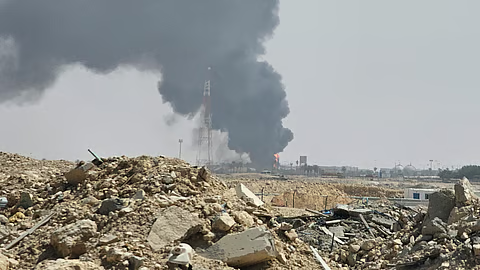
Even as diplomatic hopes rise, the standoff between the U.S. and Iran continues to weigh heavily on global energy markets. The current situation includes:
- Iran blocking shipping routes through the Strait of Hormuz
- The U.S. enforcing a blockade on Iranian ports
- Heightened uncertainty across the Persian Gulf
- Mounting concerns about long-term disruption of energy exports
The Strait of Hormuz, in particular, is critical. It serves as one of the most vital chokepoints in the global oil and gas trade. A prolonged closure could create severe shortages and spike prices worldwide.
Citi Warns the Market May Be Underestimating the Risk
Despite the recent drop, Citibank issued a cautionary note on Tuesday, suggesting that the market may not be fully factoring in the possibility of a sustained Hormuz disruption. The bank’s analysts noted that it appears “increasingly likely” Iran will continue restricting flows through the strait for an extended period.
Citi’s near-term forecast:
- Brent crude could climb to $120 per barrel in the coming weeks
- Continued geopolitical instability could keep prices elevated through the summer
- Any military escalation would amplify the upward pressure
In other words, while Wednesday’s price drop reflects optimism, the underlying risk environment hasn’t materially improved.
Wood Mackenzie’s Worst-Case Scenario: Oil at Nearly $200
The energy consulting firm Wood Mackenzie released its own assessment on Wednesday, presenting a range of scenarios depending on how the Iran-U.S. crisis unfolds.
Their key projections include:
- If Hormuz remains closed through the end of 2026, oil prices could surge toward $200 per barrel.
- In a quick peace scenario, with Hormuz reopened by June, spot Brent prices could ease back to around $80 per barrel by the end of the year.
- Persistent uncertainty could keep prices elevated even without full-blown conflict.
The wide gap between these scenarios — from $80 to nearly $200 — illustrates just how much hangs on the outcome of the current negotiations.
Why Hormuz Matters So Much
For readers less familiar with the energy world, the Strait of Hormuz is one of the most strategically important waterways on the planet. Some key reasons it matters:
- Roughly 20% of the world’s oil supply passes through it.
- Major exporters like Saudi Arabia, the UAE, Kuwait, and Qatar rely on it.
- A prolonged blockade can drive global prices upward and trigger inflation.
- Disruption affects shipping insurance, supply chains, and refinery operations worldwide.
Any sustained closure isn’t just a regional issue — it’s a global economic event.
Market Reaction Reflects Hope, Not Resolution
The 5%+ drop in oil prices doesn’t mean the conflict is resolved. Instead, it reflects investor relief at the suggestion of progress. Markets, however, tend to react quickly to both good and bad news. A single tweet, statement, or military action could erase Wednesday’s gains.
Some traders are also betting that Trump’s framing may be more political than diplomatic — meaning the “final stages” language may not reflect actual progress at the negotiating table. In recent months, similar optimism has been followed by sudden escalations.
What Comes Next
The next several days will be critical. Investors, governments, and energy producers will be watching for:
- Concrete announcements from either Washington or Tehran
- Movement around the Strait of Hormuz
- Statements from Gulf allies
- Updates on U.S. military positioning
- Any breakthroughs (or breakdowns) in talks
If a deal materializes, prices could continue falling. If the negotiations collapse, the market could swing sharply in the opposite direction.
The Bigger Picture
The oil market is once again caught between competing realities: hope for diplomacy on one hand, and the lingering threat of major supply disruption on the other. Wednesday’s price action illustrates how delicate the balance is.
For consumers, the implications are equally significant. Lower oil prices typically translate to relief at the gas pump, reduced shipping costs, and lower inflationary pressure. But if tensions return, the impact could ripple across nearly every corner of the global economy.
For now, the world is watching — and waiting — to see whether Trump’s optimism turns into a genuine breakthrough, or just another temporary lull in a longer, more volatile chapter of U.S.-Iran relations.
Author