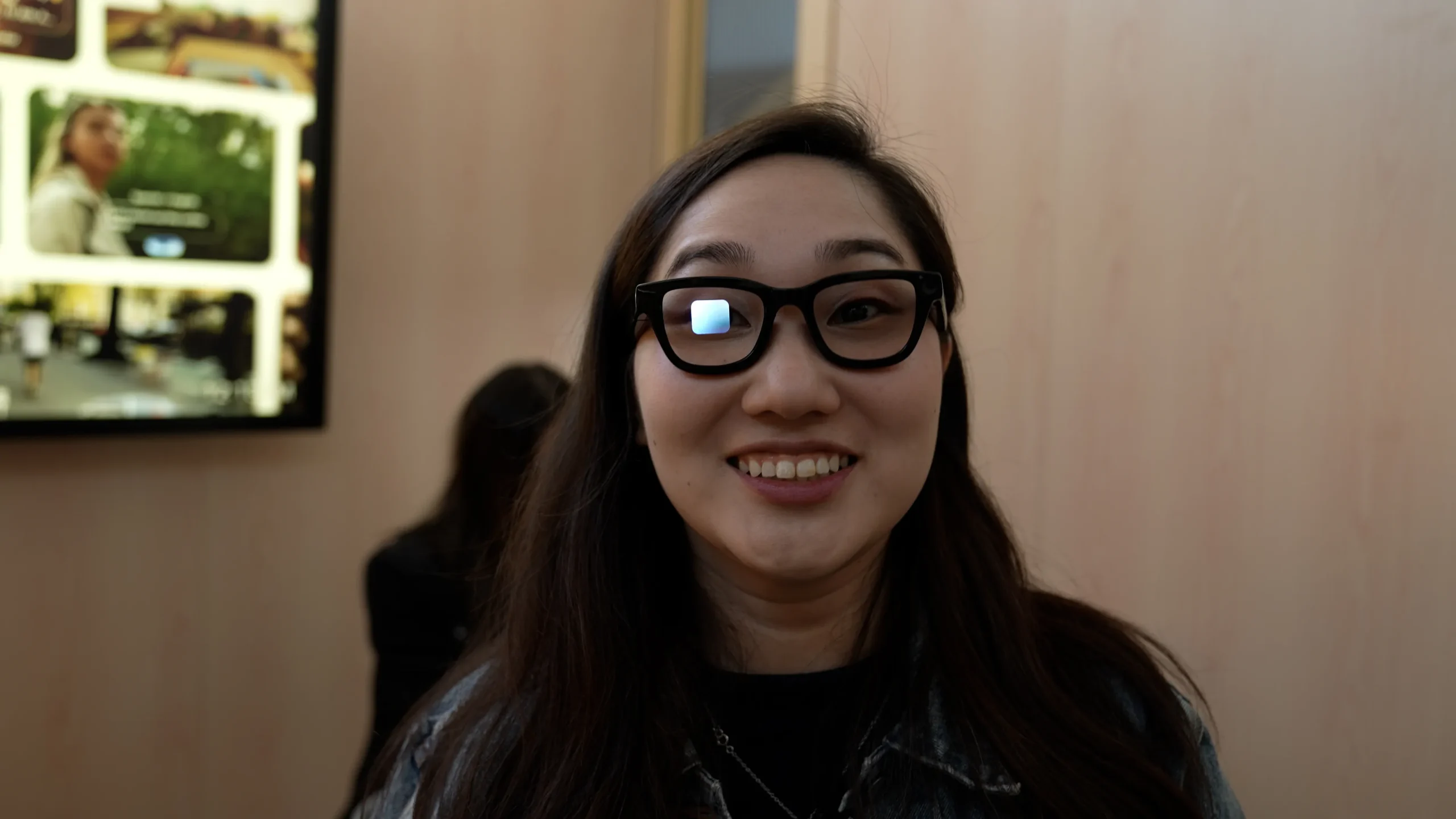
Google’s latest push into smart glasses with a screen left me with more questions than answers. After waiting over an hour at the I/O “AI Sandbox” to try Google’s so-called “intelligent eyewear,” I was finally handed a roughly seven-minute demo — a significant upgrade from the 90 seconds I got last year, but still not nearly enough time to seriously test the device. And the more I think about it, the more it feels like that brevity might be intentional.
The prototype I tried wasn’t the audio-only model developed alongside Samsung, Gentle Monster, or Warby Parker. It was a different beast altogether: a pair of glasses with a tiny screen embedded in the right lens. And while Google’s “Gemini Intelligence” framework genuinely shows promise, the demo experience felt strangely curated — as though Google is going out of its way to keep the screen’s limitations from becoming apparent.
A Quick, Carefully Choreographed Demo
The demo was tightly scripted, almost choreographed, with each interaction designed to highlight a specific capability rather than let me explore freely. Here’s what I was walked through:
- Looked at an Ozzy Osbourne poster and asked Gemini to play one of his songs — it complied instantly.
- Sat at a table with a Go board and asked Gemini about the game — it briefly explained the rules and history.
- Glanced at a corner of the booth where a small widget displayed the weather on the lens screen.
- Experienced real-time translation, but only one-way: Korean to English. I wasn’t allowed to test reverse translation or hold an actual conversation.
- Took a selfie in front of a mirror and asked Gemini to use Google’s Nano Banana image generator to “put me on the moon.”
That last task was, frankly, the most uncomfortable moment. The AI not only placed me on the lunar surface but also seemingly altered my appearance to look more Caucasian — something I never asked for. The result felt off and unsettling, the kind of gimmick that highlights how generative AI can subtly miss the mark on identity and representation. It wasn’t a feature; it was a problem.
Gemini Intelligence Has Real Promise — But Also Real Limits
When stripped of the awkward moments, Gemini Intelligence — the AI’s ability to interpret what the glasses’ cameras see — genuinely has potential. The translation feature could be a game-changer for travelers. Identifying objects, posters, or items on the fly could prove genuinely useful. And the response time was noticeably faster than last year.
Still, the demo left me wondering why Google isn’t doing more to show off the actual screen. The display is the defining feature here, yet it played the smallest role in the entire experience.
Is Google Intentionally Downplaying the Screen?
It’s an honest question. Why would Google offer a screen-equipped device and then guide users away from the screen?
A few possibilities:
- Privacy concerns — A visible display in public could spark renewed worries about recording and data capture.
- Limited utility — The screen might simply not be capable of doing much yet, and Google may not want users to notice.
- Google Glass shadow — The infamous 2013 launch left a deep mark on the company. Anything resembling that experience risks immediate cultural backlash.
- Software immaturity — Without a robust ecosystem of apps, a screen quickly becomes more decorative than functional.
Whatever the reason, Google’s messaging is conspicuously focused on voice interaction rather than on what users can see in front of them.
The Meta Ray-Ban Display Problem
Google isn’t the only company wrestling with this challenge. Meta launched its Ray-Ban Display glasses earlier with a similar single-lens screen, but the device arrived without any third-party apps — a significant flaw for a wearable that starts at $800. While Meta is now rolling out a new SDK to attract developers and build web apps, it remains uncertain whether that approach will be enough.
This entire category — smart glasses with a screen — is stuck in an awkward limbo. The hardware is here. The AI is here. But the software ecosystem that could justify wearing a screen on your face? Not quite.
Why Tiny Screens Set Big Expectations
The catch with smart glasses is psychological. The moment users get a glimpse of a display in their peripheral vision — even a tiny one — they instinctively expect more. They expect:
- Apps
- Maps
- Notifications
- Messaging
- Camera previews
- Productivity tools
If Google can’t deliver these features, users will quickly become disillusioned, no matter how impressive the AI feels. A screen creates an expectation; the device must rise to meet it, or the experience risks feeling unfinished.
Where This Tech Could Be Headed
Right now, Google’s positioning seems to suggest that smart glasses with a small screen will function more like a smartwatch than a smartphone. That is — useful for quick glanceable information, voice-driven assistance, and occasional widgets, but not a replacement for a full mobile interface.
It’s not necessarily a bad direction. Smart glasses don’t need to do everything to be useful. But it does mean consumers should temper their expectations. The dream of full augmented reality glasses replacing your phone is still much further off, despite all the excitement surrounding new prototypes.
For more serious mixed-reality experiences, Google is investing in a separate project — Project Aura, developed with Xreal — designed for productivity, entertainment, and immersive computing. Those XR-style glasses operate on an entirely different level of optics and capability.
What This Means for the Future of Smart Eyewear
Google’s choice to keep the screen experience low-key may be the smartest possible move at this stage. Pushing too hard, too soon, could re-trigger the same skepticism that doomed Google Glass over a decade ago. A slower, more controlled rollout — one focused on voice, AI capability, and a few small visual perks — could give the technology time to mature.
But there’s a risk in playing the long game: competitors are catching up fast. Meta is iterating quickly. Apple is rumored to be working on its own next-gen wearables. Chinese manufacturers are flooding the market with low-cost options. In a category this competitive, hesitation can be just as damaging as overreach.
For now, Google’s screen-equipped smart glasses remain a quietly intriguing experiment — full of promise, but tightly held behind glass demonstrations and short, scripted interactions.
If Google wants to win the next chapter of wearable computing, it’ll eventually have to let users do more than glance at a tiny weather widget and take a selfie that ends up on a fake moon.
Author