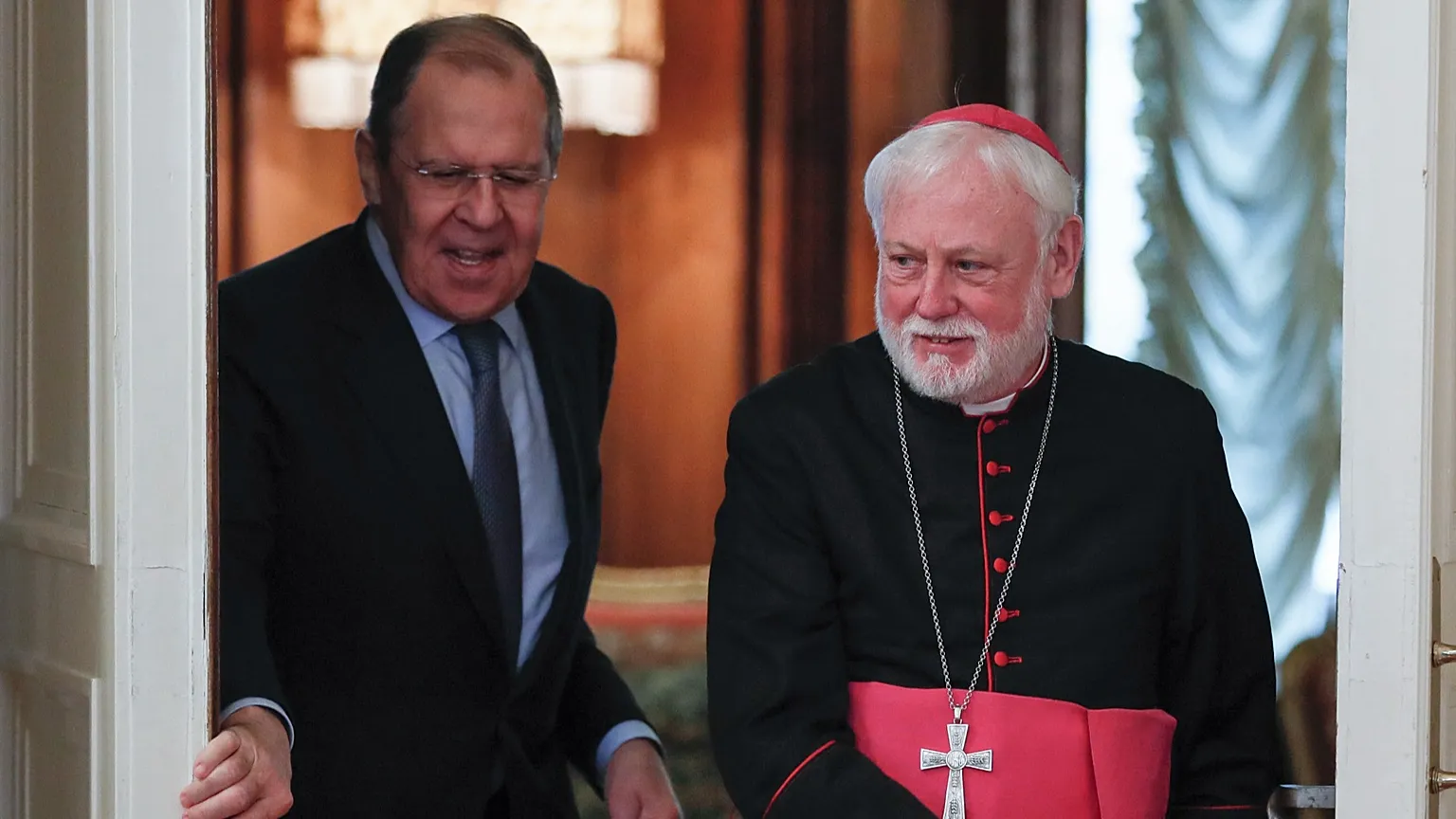
The Archbishop Gallagher Russia visit began this week, bringing the Holy See’s senior diplomat to Moscow for a four-day mission built around dialogue at a moment when few other channels remain open.
Archbishop Paul Richard Gallagher, Secretary for Relations with States and International Organizations, arrived in the Russian capital and is scheduled to return to Rome on 28 August. The programme was announced through a post on X by Terza Loggia, the account of the Secretariat of State.
The Diplomatic Schedule
The itinerary combines political and ecclesiastical engagements, which is characteristic of how the Holy See operates.
On Tuesday 25 August, Gallagher was set to meet Sergey Lavrov, Foreign Minister of the Russian Federation. That meeting was followed by talks with Metropolitan Anthony of Volokolamsk, who chairs the Department for External Church Relations of the Moscow Patriarchate.
On Wednesday 26 August, the archbishop is scheduled to meet Yuri Ushakov, aide to the Russian president for foreign policy.
Ushakov’s inclusion is notable. He works directly within the presidential apparatus rather than the foreign ministry, which places the conversation closer to where decisions are actually made.
Why the Visit Signals Persistence
The schedule reflects a deliberate choice by the Holy See to continue pursuing dialogue during what is arguably one of the most difficult periods in international relations in recent memory.
Vatican diplomacy has historically operated on a different logic from most state diplomacy. It maintains channels regardless of whether they appear productive in the short term, on the reasoning that a closed channel cannot be used when circumstances eventually shift.
That approach draws criticism from those who see engagement as legitimising. It also occasionally produces openings unavailable to governments constrained by public positions and domestic politics.
Meeting the Catholic Community
Thursday 27 August is devoted to the local church rather than to diplomacy.
The day begins with a meeting with clergy and religious men and women, followed by Mass at the Cathedral of the Immaculate Conception of the Blessed Virgin Mary in Moscow.
Gallagher will subsequently meet with the bishops.
The Catholic Church in Russia is small in numbers and scattered across an enormous territory. Its structure consists of the Archdiocese of the Mother of God in Moscow, together with the dioceses of St Clement in Saratov, the Transfiguration in Novosibirsk, and St Joseph in Irkutsk.
Four jurisdictions covering the largest country on earth gives some sense of how dispersed the community is. Pastoral visits of this kind carry weight precisely because they are infrequent.
The Ecumenical Dimension
The meeting with Metropolitan Anthony deserves separate attention.
Relations between the Holy See and the Moscow Patriarchate have been strained by the war, with the Russian Orthodox Church’s public positions creating obvious difficulty for ecumenical engagement.
Maintaining contact through the Department for External Church Relations keeps that relationship functional even where agreement is absent. It also matters practically, since the Orthodox Church’s standing within Russia gives it access that foreign diplomats do not have.
Not the First Trip
Gallagher has made this journey before. His most recent previous visit came in November 2021.
On that occasion he met Prime Minister Mikhail Mishustin, Foreign Minister Sergey Lavrov, and Metropolitan Hilarion, then head of the Department for External Church Relations.
The timing of that earlier visit is difficult to overlook in retrospect. It came three months before the full-scale invasion of Ukraine, during a period when several Western officials were also travelling to Moscow.
What the Mission Can and Cannot Do
Expectations should be calibrated. The Holy See has no army, no sanctions authority and no economic leverage. Its diplomatic instruments are limited to persuasion, moral argument and the maintenance of relationships.
What it does possess is standing as an interlocutor that is not party to the conflict, and a willingness to talk to people others will not.
Whether that produces anything measurable from this particular visit is unlikely to be visible immediately. Vatican diplomacy tends to work on timescales that resist news coverage.
For now, the significance lies in the fact that the meetings are happening at all, and that a senior Vatican official is sitting across from Russian officials at a moment when most such conversations have stopped.
Author