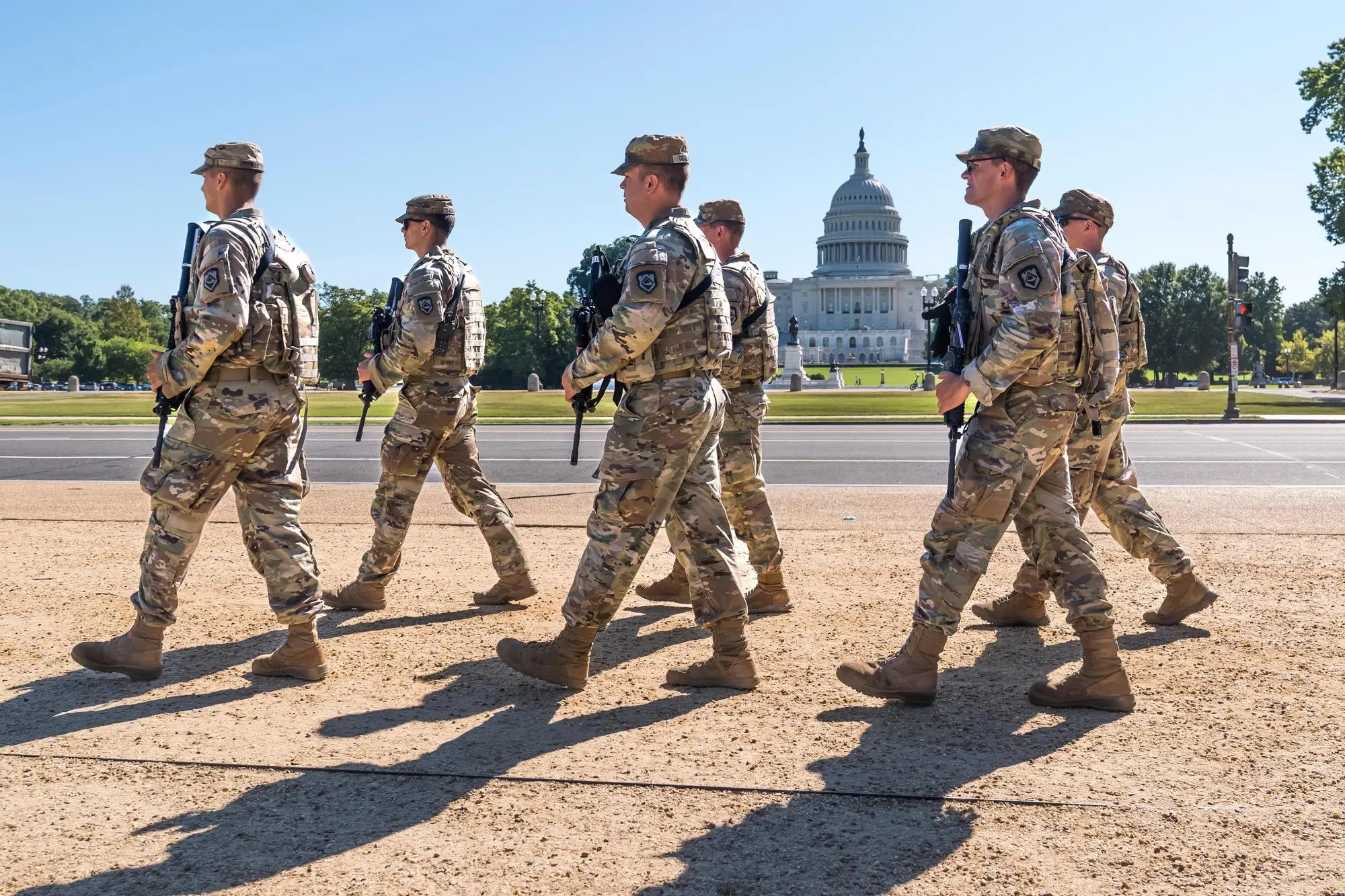
The National Guard in D.C. has reached the point where nobody looks up anymore. On a recent afternoon in a neighborhood park, families spread blankets across the grass, dogs tumbled through the sun, and a father tossed a ball with his child. Four uniformed troops walked single file through the middle of it, each carrying a handgun.
They stopped at a corner, formed a tight circle facing outward, and scanned the crowd in every direction for a minute or two before moving on.
Not one person in the park appeared to notice.
That absence of reaction is precisely what worries the people tracking this deployment most closely.
One Year In, With Nearly Three More Ahead
Thousands of Guard members have now been patrolling the capital for a full year. The mission was quietly extended to run through Inauguration Day in 2029, adding another two and a half years to an operation originally framed as an emergency response.
The troops appear at farmers markets, in Metro stations, along busy commercial streets and around the national monuments. Activists have hung signs across the city reading National Guard Go Home and Troops Out. Meanwhile, daily life has largely adjusted itself around the patrols rather than against them.
This is the longest and largest domestic deployment of its kind under the current administration, which has repeatedly used military forces inside American cities in ways without clear precedent. Every one of those deployments has drawn legal challenges.
The Normalization Problem
Joseph Nunn, counsel at the Brennan Center’s Liberty and National Security program, describes the quiet acceptance as the central danger.
His concern is not a single incident but the slow fading of soldiers into the background until their presence registers as ordinary. Armed military personnel posted on street corners in an American city, he argues, should never become routine.
Nunn points out that the United States effectively invented the modern democratic principle of separating military forces from civilian policing. The Declaration of Independence itself lists among its grievances against King George III the maintenance of standing armies among the population during peacetime.
That principle has held for most of American history. What is happening in Washington tests it directly.
Unusual Powers, Unusual Weapons
Every Guard member serving in the capital has been deputized by the U.S. Marshals Service, temporarily granting limited law enforcement authority.
The specific boundaries matter:
- They cannot make arrests
- They can detain individuals
- They are issued handguns, which is uncommon for domestic deployments
That combination puts armed personnel with detention authority into everyday civilian settings, operating under a different legal framework than police officers and without the same accountability structures.
The consequences are no longer theoretical. A military veteran was detained by Guard members in her own front yard and has since filed suit.
Does It Work?
The stated purpose was crime reduction. Multiple studies examining the deployment have found no measurable effect on violent crime in the city.
The original justification has also drawn scrutiny. Troops were first sent to Washington in August 2025 after a crime emergency was declared and the D.C. Safe and Beautiful Task Force was launched. At that moment, violent crime in the district had fallen to its lowest level in three decades.
Current figures are mixed. Homicides are down this year, while overall violent crime is running higher than 2025 according to city data.
Monica Hopkins, who directs the ACLU of D.C., argues the deployment rests on a false premise, saying there was never a genuine emergency justifying the arrival of these forces.
Warnings From Inside the Military
Some of the sharpest criticism comes from people who spent careers in uniform.
Retired Major General Steven Lepper, part of a group of former military lawyers who submitted a report to Congress, raised concerns about where this progression leads. He specifically named the midterms as a scenario Americans should think carefully about, alongside situations nobody has yet imagined, warning that domestic military deployment can become a mechanism for imposing the will of those commanding the forces onto fellow citizens.
Coming from former judge advocates rather than political activists, that framing carries a particular weight.
A Pattern Beyond Washington
The capital is not an isolated case. In Memphis, a task force introduced as an anti-crime measure gradually shifted into immigration enforcement, a transition that happened without any public announcement of a changed mission.
That evolution illustrates a recurring concern. Once forces are deployed and infrastructure is built, the stated purpose can expand quietly, and the mission that justified the original arrival may bear little resemblance to what the operation eventually becomes.
The Official Response
Asked about these concerns and about why extending the deployment by another two and a half years was considered necessary, the White House did not answer directly. It instead pointed to a press release from the U.S. Marshals Service marking the task force’s first year and describing its work in favourable terms, without supplying supporting evidence.
The gap between that messaging and the available research remains unaddressed.
Why This Deployment Is Legally Possible
Washington’s unusual constitutional status is what allows this. Unlike states, where governors control their own Guard units and federal deployment triggers immediate legal conflict, the district’s arrangement gives the president direct authority.
That distinction explains why the capital became the site of the longest such operation, and why it has proven harder to challenge than deployments elsewhere.
The Question Underneath
Strip away the statistics and the legal filings, and one question remains.
If armed troops become permanent fixtures in a city where crime data does not support the emergency framing, and residents stop noticing them entirely, what standard would ever prompt their removal?
The park tells the story. Blankets on grass, a dog rolling in the sun, a father playing catch, and four armed soldiers scanning the crowd while nobody looks up.
Author
-
Lucienne Albrecht is Luxe Chronicle’s wealth and lifestyle editor, celebrated for her elegant perspective on finance, legacy, and global luxury culture. With a flair for blending sophistication with insight, she brings a distinctly feminine voice to the world of high society and wealth.