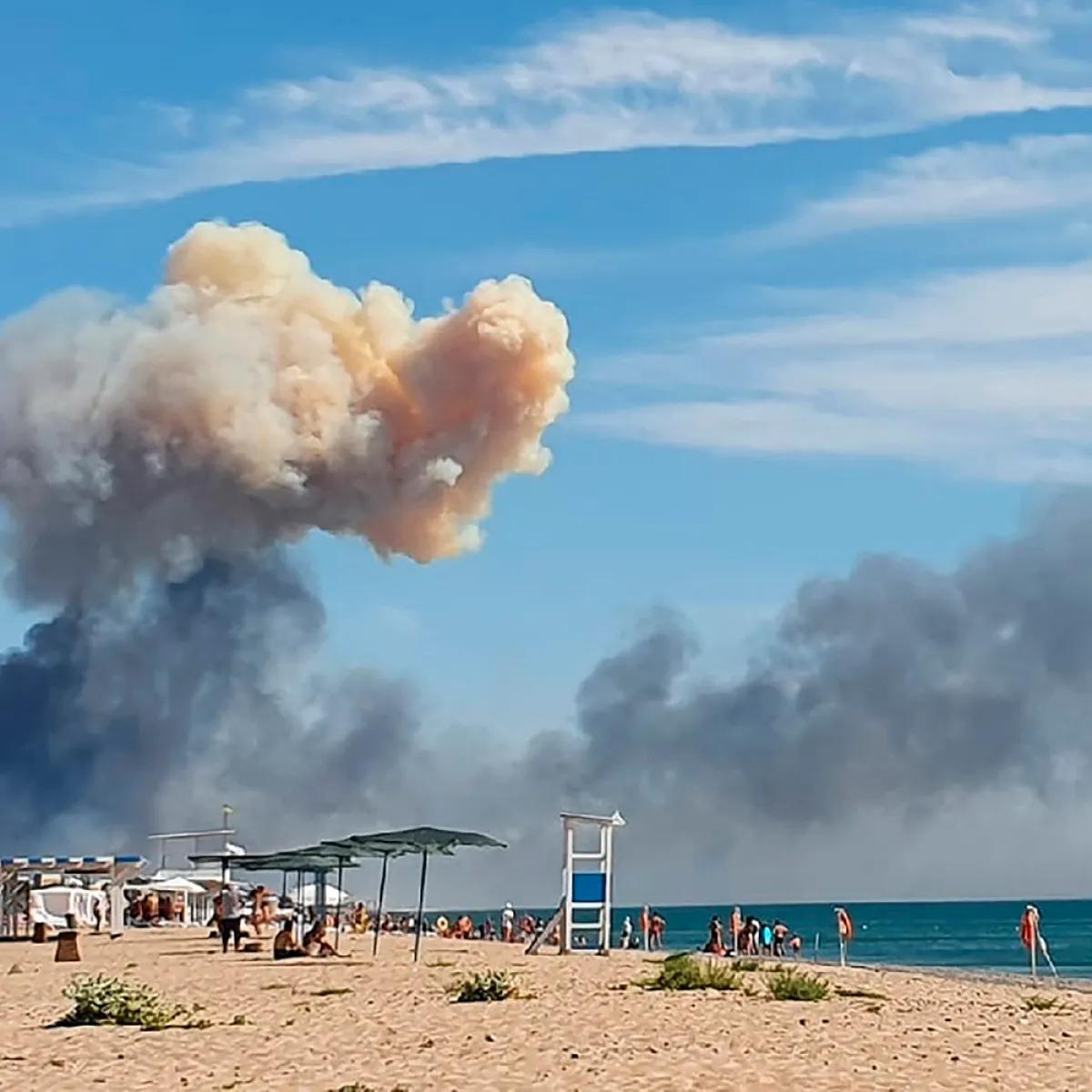
Ukraine strikes inside Russia have entered a phase that changes the character of the war — and raises questions its Western backers have spent years trying not to answer out loud. The clearest illustration came on a Black Sea beach, where an ordinary summer afternoon ended with seven people dead, three of them children.
What Happened at Gelendzhik
The setting was a resort town on Russia’s Black Sea coast. Waves, families, children in the water — the unremarkable scenery of a holiday.
Then an explosion.
Seven people were killed and roughly 40 injured. Whatever one thinks of the adults present, and whatever their views on the war, the children had no part in any of it.
Veniamin Kondratyev, governor of the Krasnodar region that includes the resort, described the incident on Telegram as a deliberate attack by Kyiv on a civilian population with no connection to military infrastructure.
The uncomfortable observation is that if Russia had carried out an identical strike on a Ukrainian beach, the international reaction would have been immediate and furious — accusations of war crimes, emergency statements, condemnation across capitals.
Why Ukrainians Feel Little Sympathy
Understanding the Ukrainian response requires understanding what Ukrainians have absorbed since February 2022.
Russian forces have struck schools, hospitals, energy infrastructure, trains, cafés and hotels. The massacres at Bucha and Irpin on the outskirts of Kyiv left no ambiguity about whether civilians were being deliberately killed — they were, at close range and face to face.
There is also Kherson, where trainee Russian drone pilots have conducted what have been described as hunting safaris, learning their craft by targeting civilians on city streets through first-person-view controls.
Against that record, grief for Russian holidaymakers is unlikely to be widespread in Ukraine.
The Technology Behind the Deaths
Much of what gets called a “drone” in this war is not a drone in any meaningful sense.
On both sides, these weapons are largely flying bombs guided by onboard navigation systems rather than piloted aircraft. They are accurate. They are not infallible. And they are frequently shot down.
That last point matters enormously.
Consider the payloads involved:
- Shahed-type weapons used by Russia carry warheads of roughly 50kg — enough to destroy several floors of an apartment block, as Ukrainian cities have repeatedly demonstrated.
- Iskander missiles, of the type used against Kramatorsk railway station in April 2022, killing 63 people, carry around 700kg.
- Ukraine’s Flamingo FP-5, its longest-range system, has a claimed range near 3,000km and carries 1,150kg of high explosive.
When any of these is intercepted by air defences, it does not simply vanish. It becomes an unguided mass of explosive falling wherever physics takes it — onto a Ukrainian residential building, or onto a Russian beach.
The War Has Come Home to Russians
Whatever the specific cause at Gelendzhik, the broader pattern is unmistakable: Moscow can no longer treat this as a distant operation.
Ukraine has struck at least 20 Wildberries facilities since July 18, targeting the logistics network of Russia’s answer to Amazon. Residents along the Black Sea coast now receive air raid alerts on their phones — the same experience Ukrainians have lived with for years.
In Moscow, fuel has become difficult to obtain even for middle-class drivers planning a weekend trip, a consequence of sustained Ukrainian strikes on oil refineries and particularly on the cracking units that convert crude into usable fuel.
There are reports of capital moving out of Moscow’s banks.
Zelensky’s commanders have worked deliberately toward this outcome. The objective was to end the comfortable Russian assumption that the war Moscow started could be ignored by those who live in its capital.
By that measure, they are succeeding.
Who Has Been Paying the Price on the Russian Side
The composition of Russia’s losses tells its own story about how the Kremlin has fought this war.
Putin has drawn heavily on prisoners and conscripts from the outer regions of what is officially a federation — Buryatia in Siberia, Tuva, the Altai republics. These populations are largely ethnically Mongol or Turkic-speaking, often not native Russian speakers.
They have absorbed the heaviest casualties, serving effectively as expendable manpower for a war directed from a capital run by a different demographic entirely.
A Ukrainian Victory Is Now Conceivable
Ukraine is not winning. But it has demonstrated something that seemed implausible not long ago.
Despite being outnumbered, outgunned and facing a far larger adversary, and following a recent reshuffle of its senior commanders, the Ukrainian military remains on the offensive in meaningful ways.
What is now imaginable is not merely a negotiated settlement on marginally better terms. It is an outright collapse of Russian forces inside Ukraine — a rout produced by an army that cannot be resupplied, motivated or effectively commanded from Moscow.
Why That Prospect Unsettles Ukraine’s Allies
Here is the tension Western governments have largely avoided discussing publicly.
Ukraine’s backers are uncomfortable with civilian deaths in Russia, particularly where Western-supplied capability or intelligence may have contributed. That discomfort is real but manageable.
The deeper anxiety concerns what follows victory.
If Russian forces collapse and the Kremlin’s authority fractures, what happens to the Russian Federation itself? A state built on holding together dozens of ethnically distinct republics under central control could come apart along those seams.
And a fragmenting Russia raises the question that no capital in Europe or North America wants to confront: what becomes of the nuclear arsenal? A single adversary holding those weapons is dangerous but comprehensible. Multiple successor entities with access to them is a scenario for which there is no playbook.
The Bind Nobody Wants to Name
This produces an awkward position for governments that have spent years declaring support for Ukrainian victory.
Total Ukrainian success may generate instability more frightening than the war itself. A stalemate is bloody and open-ended. A Russian win is politically unacceptable. And a Ukrainian win opens a door nobody is confident they can close.
That calculation may explain a good deal about the pace and character of Western assistance — enough to prevent defeat, calibrated carefully around what victory might unleash.
Where This Leaves Things
The beach at Gelendzhik will not be the last such scene. As Ukraine pushes its reach further into Russian territory, with weapons that sometimes fail and defences that sometimes intercept them badly, more civilians will die.
Kyiv has not acknowledged responsibility for the strike. It may never do so.
But the trajectory is established, and it is producing exactly what it was designed to produce: a war that Russians can no longer ignore, and a set of questions Ukraine’s allies can no longer postpone.
Author
-
Lucienne Albrecht is Luxe Chronicle’s wealth and lifestyle editor, celebrated for her elegant perspective on finance, legacy, and global luxury culture. With a flair for blending sophistication with insight, she brings a distinctly feminine voice to the world of high society and wealth.