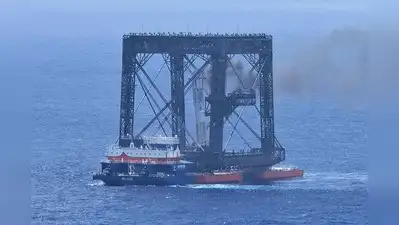
China has recovered an orbital-class booster for the first time — and it did so in a way nobody else has attempted.
Rather than landing on legs like a SpaceX Falcon 9, the Long March 10B booster descended toward an offshore platform and was caught in a net.
The reusable rocket club just gained a member, and the new entrant did not copy anyone’s homework.
What Happened on Friday
The Long March 10B lifted off from the Hainan commercial space launch site in southern China at 12:15 p.m., according to state media, and successfully placed a satellite into its designated orbit.
The interesting part came afterward.
Roughly six minutes after separating from the rocket’s upper stage, the booster descended vertically toward an offshore platform. Four hooks on the booster engaged a net suspended above the platform, capturing it.
No landing legs. No touchdown. A catch.
Why Not Just Use Legs?
The obvious question is why China departed from a method SpaceX has proven works.
Chen Muye, an expert at the China Academy of Launch Vehicle Technology, laid out the reasoning to state media agency Xinhua.
The net approach, he said, simplifies the rocket’s onboard structure and reduces weight — which in turn could increase payload capacity. Every kilogram of landing hardware a booster carries is a kilogram of satellite it cannot.
There is a second advantage, and it may be the more important one.
“It is also highly adaptable to landing-point deviations, as coordinated net systems can effectively expand the capture window,” Chen said.
Translation: a legged booster must hit a precise spot. A net can be repositioned and coordinated to accommodate error. The margin for imperfection is wider.
A Decade of Failures Behind It
This success did not come easily.
China has spent nearly ten years developing reusable launch technology, driven by the same economics that motivated SpaceX — launch costs are the primary barrier to scaling satellite deployment, and throwing away the rocket every time is expensive.
Previous attempts failed at the hardest moment.
Both private company LandSpace and the state-owned China Aerospace Science and Technology Corporation attempted booster recoveries last year. Both failed during the final landing stage.
The final stage is where these programs live or die. Getting a booster back to the vicinity of a landing site is difficult. Bringing it down intact is another problem entirely.
The Lunar Connection
The Long March 10B is not a standalone experiment.
It belongs to the broader Long March 10 family, which China is developing for planned crewed lunar missions before 2030.
That makes Friday’s flight more than a cost-saving exercise. Data gathered from the recovery could help validate technologies feeding directly into China’s crewed Moon program.
The reusability push and the lunar ambition are the same project.
How It Compares to Falcon 9
The natural benchmark is SpaceX, and the comparison is instructive.
- Long March 10B: at least 16 metric tons to low-Earth orbit
- Falcon 9: maximum payload of 22.8 metric tons
So the Chinese vehicle is smaller, though in the same broad class.
The operational gap is far wider than the payload gap.
SpaceX first landed a Falcon 9 booster after an orbital mission in December 2015 — more than a decade ago. It now launches the rocket roughly 150 times per year, and routinely reuses individual boosters dozens of times each.
China has recovered one booster, once.
That is not a criticism. It is context. SpaceX needed years to move from first landing to reliable, high-cadence reuse. The engineering challenge shifts from “can we catch it” to “can we catch it every time, and fly it again cheaply.”
The Market Noticed
Investors responded immediately.
Shares in several Chinese aerospace companies surged following the test. China Spacesat and China Satellite Communications both hit their daily trading limits.
The reaction reflects what reusability actually unlocks: dramatically cheaper access to orbit, which in turn makes large commercial satellite constellations economically viable.
What This Actually Means
Three powers can now recover orbital-class boosters. That club was, until Friday, extremely small.
China’s entry matters for several reasons:
- It reduces launch costs for a rapidly expanding commercial satellite sector
- It supports a crewed lunar program with a hard deadline
- It demonstrates a genuinely novel engineering approach rather than replication
- It narrows a capability gap that had defined the modern space race
The net-catch method is unproven at scale. It may turn out to be brilliant, or it may reveal problems that only appear after twenty attempts.
But the fundamental barrier has been cleared. The booster came down, and it was caught.
Everything after this is iteration.
Author