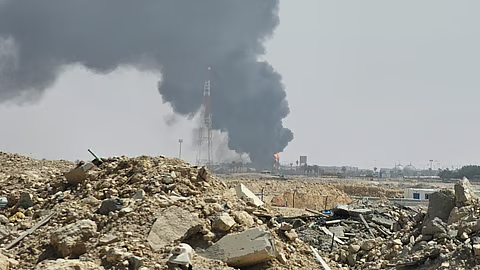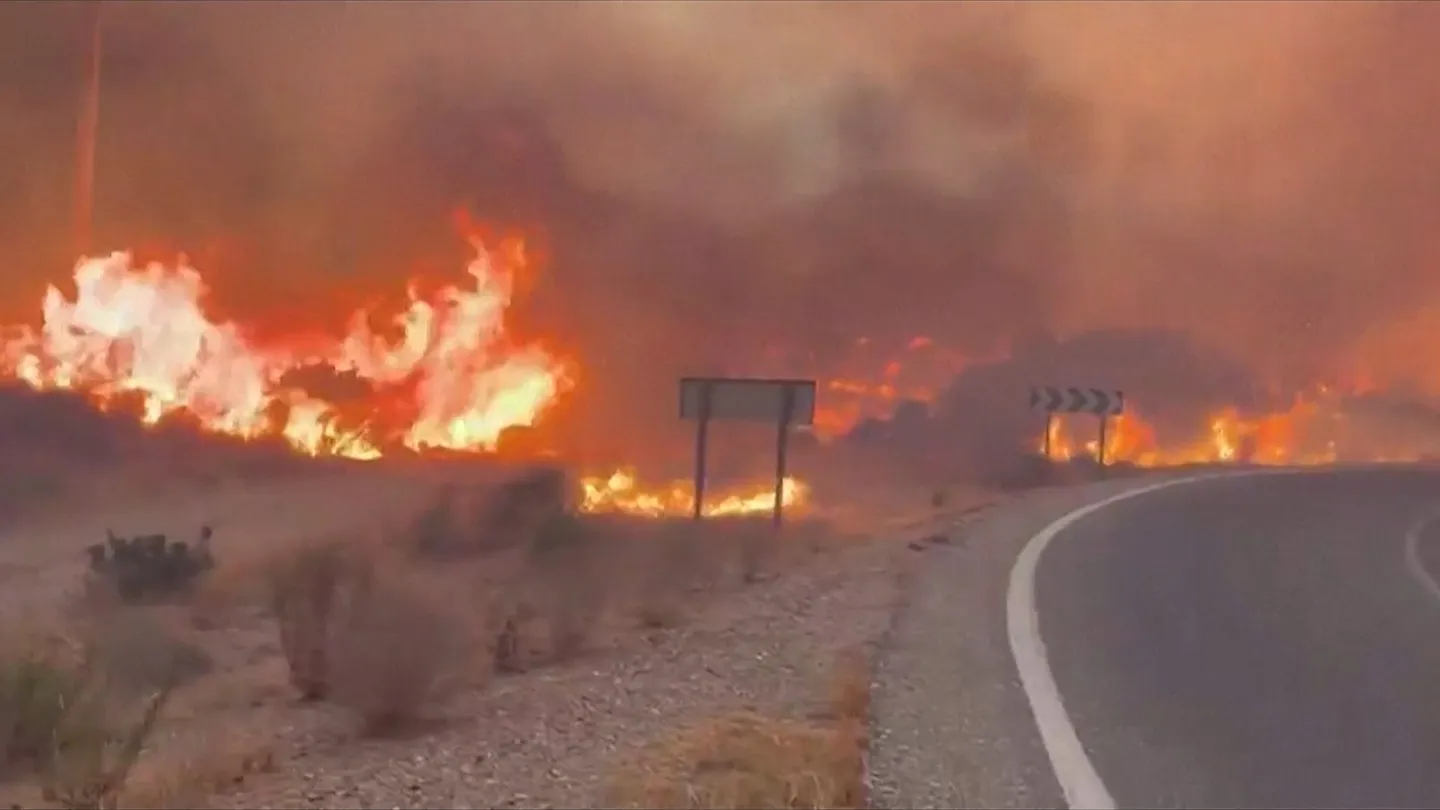
A 93-year-old British woman has become the thirteenth person to die in the Spain wildfire that swept through Almería province — and with her death, the questions about what warnings were given, and to whom, are growing louder.
She was hospitalized Friday with burns across roughly 20 percent of her body. Her death was confirmed Sunday afternoon.
At least four of the thirteen victims are believed to be British. Four bodies were recovered from a burnt-out car with a right-hand steering wheel.
The Missing
Ten people are now registered as missing.
Spain’s forensic services data unit, the CID, confirmed Sunday night that two additional cases had been logged after it began coordinating with authorities in France, Britain and Belgium.
The unit is now allowing families abroad to report missing relatives and provide DNA samples in their own countries. It expects more reports in the days ahead.
Found Alive, Barely
Amid the grim accounting came one extraordinary rescue.
Two British hikers — a man and a woman, unidentified — were discovered alive but with burns covering an estimated 40 percent of their bodies, according to Spanish broadcaster RTVE.
They were found by Civil Guards who had already searched that area once.
Sergeant Pedro Barre explained why they returned.
“That experience we accumulate over the years is what tells you: take another look, give it one last try, check again just in case.”
The team called out and used whistles. Eventually they heard something they initially mistook for an echo.
Rescuer Rafael Zea reflected on what it must have cost the couple to make that sound. Given their injuries, he said, it must have taken a “Titanic effort” to raise their voices.
The rescue took more than two hours, with help from firefighters and emergency services. Both are in serious condition, though their lives are not believed to be in danger.
The Central Dispute: Were They Warned?
Spanish authorities believe all the victims were foreign tourists who abandoned their vehicles and attempted to flee on foot through rugged terrain.
The implication — that they disregarded advice to shelter in place — has been furiously rejected by at least one grieving family.
Thomas-Wolf Verdonckt, a Belgian virologist, says he spoke to his father by phone just before 9 p.m. on Thursday as flames advanced on the mountain village of Bédar.
His father, 63-year-old businessman Stanislas Verdonckt, was among eight victims found dead in a valley below the Paraje el Curato area where he lived.
The son traveled to Spain afterward and spoke with surviving neighbours. His conclusion was unambiguous.
“The people who died did not fail to follow any orders because no orders were given. No information was provided,” he said.
“They only started to run when the flames were almost upon them. That was their absolute last resort.”
What Happened That Night
According to Verdonckt, the sequence unfolded like this:
- The group first tried to drive out on a paved road and were turned back by flames
- Nobody had warned them which direction the fire was approaching from
- They then attempted to escape by car along a dead-end dirt lane hugging the mountainside
- When that too became impassable, they abandoned the vehicles
- Some ran toward the valley on foot
“It was not a choice,” Verdonckt said. “They drove to the end of the trail, and when even that was in flames, some people chose to run and try to get into the valley.”
One neighbour who survived by staying in his home told him the flames came close enough to touch the building.
A Man Who Knew the Terrain
Verdonckt was insistent that his father was not careless.
Stanislas was a keen hiker and photographer who had owned a home in the area for years. He knew the landscape. He spoke Spanish.
During their final phone call, his son said, he was working methodically through his options — plan A, plan B, plan C.
“My father is one of the smartest people I know. He’s always very analytical and was just checking boxes: ‘Can we do this? Can we do that?'” Verdonckt said. “At that point, it was just minutes before they were engulfed and they were trapped.”
The Government’s Account
Andalusia’s regional government disputes this version.
In a statement Sunday night, it said Bédar’s mayor, Ángel Collado, had urged the group including Stanislas Verdonckt to shelter in place.
It also explained why no mass text alert was issued: the correct advice varied by location in the mountainous, wooded terrain, and conditions were changing rapidly.
Instead, local mayors and police went door-to-door or telephoned residents individually — either directing them along a safe evacuation route or instructing them to stay put.
The statement acknowledged the families’ pain while defending the decision.
“We understand the families’ grief and respect the fact that, in times of immense suffering such as these, anger and a sense of helplessness in the face of tragedy can lead to a different perception of what happened,” it said.
The government further backed the mayor’s shelter-in-place order as “the option that offered the greatest guarantees of safety given the conditions of the fire as, unfortunately, the tragic outcome has made clear.”
An Unresolvable Question
Both accounts cannot be true.
Either the residents of Paraje el Curato were told to stay in their homes, or they were not.
What is certain is that the door-to-door method — however well-intentioned — depends entirely on reaching every household in time. In a fast-moving fire across mountainous terrain, that is an enormous assumption.
Where Things Stand
More than 1,000 residents in evacuated villages north of Los Gallardos were cleared to return home Sunday afternoon.
Post-mortem examinations have been completed and DNA samples collected for identification, according to Antonio Sanz, head of Andalusia’s emergency services.
Thirteen dead. Ten missing. Two survivors with catastrophic burns.
And a dispute about warnings that no investigation will fully resolve for the families now waiting on DNA results.
Author