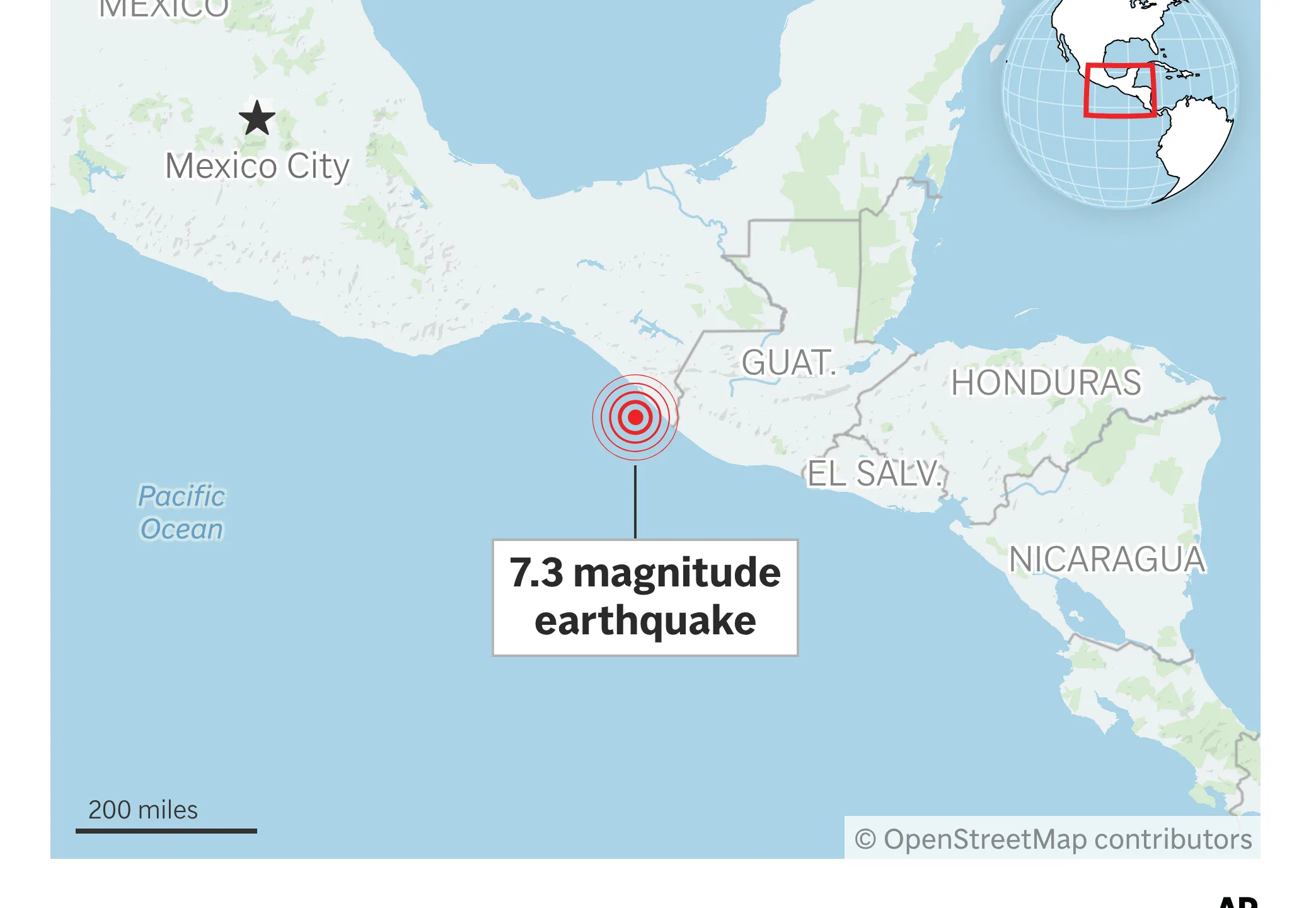
The Mexico Guatemala earthquake that struck Friday registered magnitude 7.3 and was felt across an enormous area — from Mexico City down through Guatemala and into El Salvador — yet produced remarkably little damage.
Authorities in both countries reported no severe destruction and no fatalities. Two people were injured in southern Mexico.
The Technical Details
The U.S. Geological Survey placed the epicenter 30 miles southwest of Aquiles Serdán, near the coast of Chiapas, at a depth of 9 miles.
A smaller quake preceded it, with an epicenter slightly farther out to sea.
At least 10 aftershocks followed, ranging from magnitude 4.9 to 6 — substantial events in their own right, and a reminder that the ground remained unsettled well after the main shock.
The relatively shallow depth of 9 miles typically means stronger surface shaking, which explains why the quake was felt so far from its origin.
Inside the Shaking
In Tapachula, the principal city on Mexico’s southern border, the tremor built gradually rather than arriving all at once.
Alejandra Mendoza, an administrative employee at a public hospital, described being on the second floor when the shaking started. The initial assumption was that it would pass. When it intensified instead, the group moved downstairs and evacuated in an orderly way to the front courtyard.
That progression — mild, then serious enough to force evacuation — is characteristic of larger quakes and is part of what makes them disorienting.
The Injuries
Demetrio Martínez, who heads Tapachula’s Civil Protection agency, described the more serious of the two injuries.
A Haitian migrant woman in her 30s suffered a panic response and jumped roughly 13 feet from an apartment building. She was hospitalised with fractures, though Martínez said her life is not in danger.
The second injury was minor, caused by a window breaking at a nearby business.
Both illustrate a pattern common in earthquakes: harm frequently comes from the reaction rather than from structural collapse.
Panic in the Tall Buildings
In Tuxtla Gutiérrez, the capital of Chiapas, the few high-rise buildings in the city produced scenes of alarm, according to an Agence France-Presse journalist on the ground.
Araceli Sánchez, a government employee inside a 15-story building, described the experience as horrible. She fled down the emergency stairs, and said some people were crying.
Height amplifies shaking. A tremor that feels manageable at ground level can be considerably more violent 15 floors up.
Guatemala’s Rush Hour Scare
In Guatemala City, the quake’s duration was what unsettled people most.
It struck as the workday was beginning, sending crowds into the streets during rush hour.
Guatemala’s National Coordinator for Disaster Reduction reported no immediate damage. Social media users did post video of landslides, particularly along roads heading west.
The Ministry of Education suspended in-person classes in four departments closest to the epicenter: San Marcos, Quetzaltenango, Suchitepéquez, and Retalhuleu.
The Alert That Didn’t Sound in Mexico City
Buildings creaked and shook in parts of the Mexican capital, but the city’s earthquake alert never activated.
The government explained that the energy radiated during the first few seconds of the quake did not exceed the system’s activation thresholds.
Early warning systems make a judgment call in the opening moments based on initial energy readings. Distant quakes that build in intensity can fall below the trigger point even when shaking eventually reaches populated areas.
The Tsunami Warning
The U.S. Tsunami Warning System initially cautioned that hazardous waves were possible along coasts within 186 miles of the epicenter.
That warning was subsequently withdrawn once the threat had passed.
Mexico’s navy recommended staying away from beaches for six hours as a precaution. The Meteorological Service of Chiapas had initially projected possible waves of up to 3.3 feet along the Mexican and Guatemalan coasts.
In Suchiate, the town on the river dividing Mexico from Guatemala, Mayor Elmer Vázquez Gallardo said coastal areas were being monitored.
President Claudia Sheinbaum said preliminary reports indicated no damage.
Reaction in El Salvador
The quake was felt strongly in San Salvador, though no deaths or damage were reported.
The Ministry of Environment noted a separate, smaller earthquake off the coast of Usulután department in the country’s east — a reminder of how seismically active the entire region is.
Why This Region Keeps Shaking
The Mexico-Guatemala border sits in one of the world’s more active seismic zones, and the historical record is grim.
Earlier this year, a strong quake struck southern and central Mexico, killing two. In 2017, a magnitude 7.1 event killed hundreds in Mexico City.
The timing of Friday’s quake also lands against a fresh regional tragedy. Venezuela is still recovering from twin tremors on June 24 that killed more than 4,800 people and collapsed hundreds of buildings in the coastal state of La Guaira.
Against that backdrop, a magnitude 7.3 producing two injuries reads as a substantial piece of good fortune.
Why the Damage Was So Limited
Several factors likely worked in the region’s favour.
The epicenter was offshore, which put distance between the rupture and dense population centres. The affected areas of Chiapas have relatively few tall structures. And building standards in Mexico have been strengthened considerably following past disasters, particularly the 1985 and 2017 events.
None of that guarantees the same outcome next time. Aftershocks in the magnitude 5 to 6 range continued after the main event, and structures weakened but not visibly damaged can fail under repeated stress.
For now, a quake capable of enormous destruction passed through three countries and left almost everyone standing.
Author