Ukraine Sends 400 Drones at Moscow as Zelenskyy Faces Protests Over Defence Shake-Up
The Ukraine drone attack Moscow absorbed overnight involved more than 400 aircraft, according to the Russian capital’s mayor — the latest exchange in a cycle of retaliation that has made any negotiated end to the four-year invasion look increasingly remote.
The assault followed hours after Russia struck Kyiv and other Ukrainian cities with ballistic missiles.
Meanwhile, President Volodymyr Zelenskyy is managing a political crisis at home, saying he would hold key talks Monday to contain fallout from a government reshuffle that exposed a generational rift inside Ukraine’s military establishment.
What Reached Moscow
Mayor Sergei Sobyanin said over 400 Ukrainian drones were launched toward the capital from late Sunday into Monday morning. Most, he said, were shot down well short of the city, with 85 intercepted in the immediate Moscow area.
Andrei Vorobyov, who heads the region surrounding Moscow, reported 10 people wounded, along with damage to several residential buildings and civilian infrastructure.
The attack sparked a fire at the Yuzhnye Vrata industrial park roughly 30 kilometres south of Moscow, according to Yevgeniya Khrustaleva of the Domodedovo area administration.
The Astra news outlet reported an additional fire at an oil depot in Podolsk, around 20 kilometres south of the capital, though no official confirmation followed.
Ukraine’s Account
Zelenskyy said Ukrainian forces struck logistics facilities and an oil depot in the Moscow region — targets more than 400 kilometres from Ukraine’s border.
He also claimed strikes on two vessels belonging to Russia’s so-called shadow fleet carrying sanctioned oil, plus four dry cargo ships in the Black Sea.
Neither side’s claims could be independently verified.
Why Oil Facilities Keep Getting Hit
Ukraine’s long-range drone capability has developed rapidly during the war, creating a problem Russia struggles to solve: a landmass too vast to defend comprehensively.
Kyiv has concentrated on refineries, depots and fuel infrastructure specifically, producing fuel shortages inside Russia and delivering visible embarrassment to President Vladimir Putin.
The strategic logic is straightforward. Oil revenue funds the war, and fuel shortages affect ordinary Russians in ways that battlefield news does not. Attacks on energy infrastructure carry political consequences alongside economic ones.
The scale of these operations has grown considerably. In May, Russia’s Defence Ministry said air defences downed 1,054 Ukrainian drones within a single 24-hour period.
Russia Shifts Toward Ballistic Missiles
Moscow has responded by leaning harder on its most difficult-to-intercept weapons.
Ballistic missiles travel faster than sound and can reach Kyiv within minutes, leaving air defences almost no reaction time and civilians little chance to reach shelter. That speed is precisely why Ukraine has been pressing foreign partners for sophisticated interceptors capable of countering them.
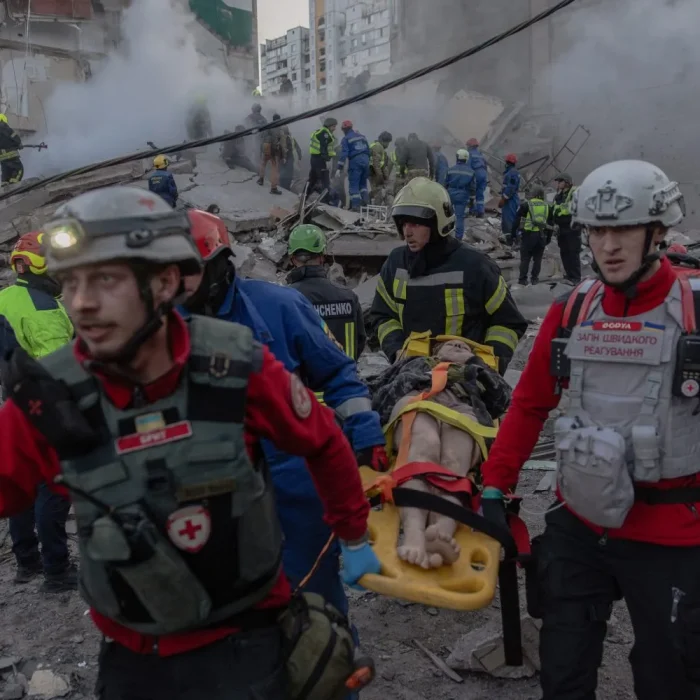
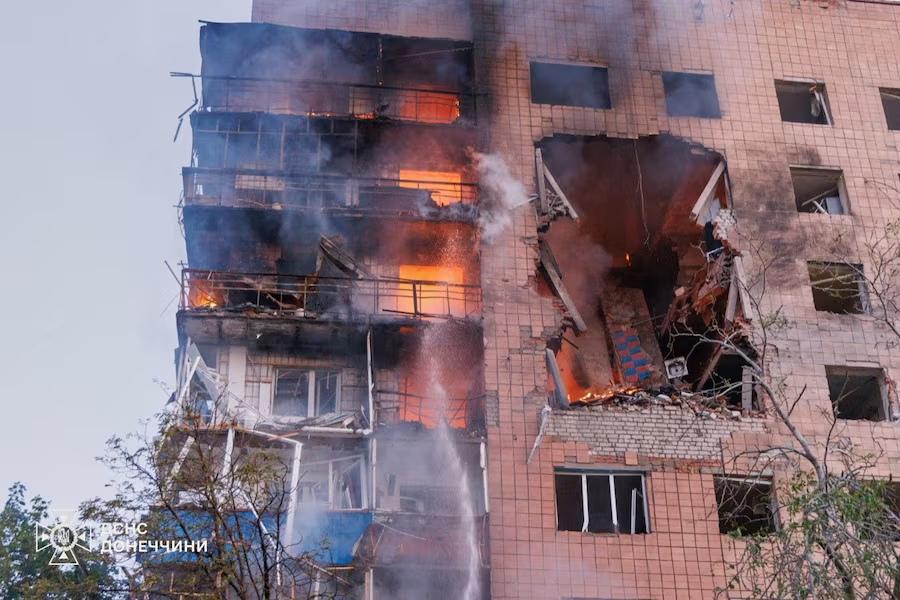
Sunday’s bombardment killed at least six people and wounded dozens, according to Ukrainian officials.
The Institute for the Study of War flagged something notable about the pace. The Washington-based think tank said Russia has launched more ballistic missiles at Ukraine in July than it reportedly manufactures in a month, suggesting Moscow is drawing down existing stockpiles because these weapons succeed at higher rates than drones or cruise missiles.
That observation cuts two ways. Depleting reserves indicates urgency — but reserves are finite, and a sustained rate above production cannot continue indefinitely.
The Overnight Toll in Ukraine
A Russian strike on Pavlohrad in the central Dnipropetrovsk region injured 13 people, according to military administration head Oleksandr Hanzha. Eleven were hospitalized, including a 13-year-old girl.
Russia’s Defence Ministry said its forces hit fuel tanks in the southern port of Odesa overnight.
Ukraine’s air force reported that Russia fired two missiles and 94 long-range strike drones across the country. Air defences jammed or intercepted 81 drones, while nine drones and one missile caused damage across nine locations.
The Crisis Inside Kyiv
While that exchange unfolded, Zelenskyy faced a problem no air defence system addresses.
Last week’s government reshuffle removed 35-year-old Mykhailo Fedorov as defence minister while retaining 60-year-old Soviet-trained General Oleksandr Syrskyi as armed forces chief.
The decision exposed a fault line that has been building throughout the war — between an older generation trained in Soviet military doctrine and younger figures associated with the technological innovation that has defined Ukraine’s most effective operations.
Days of street protests followed, with demonstrators backing Fedorov and opposing Syrskyi.
Why This Split Matters
The disagreement is substantive rather than personal.
Ukraine’s successes against a larger adversary have depended heavily on asymmetric methods — drone warfare, electronic systems, rapid iteration of new technology. Fedorov, previously associated with digital transformation, represented that approach institutionally.
Syrskyi’s background reflects conventional military organization and formal command structures.
Both perspectives have arguments behind them. Wars are not won by innovation alone, and conventional capability still matters enormously on a contested front line. But the public reaction suggests significant portions of Ukrainian society believe the country’s edge lies with the innovators.
Zelenskyy’s task in Monday’s talks is to convince Ukrainians that this personnel decision won’t undermine the war effort — a difficult argument while people are in the streets making the opposite case.
A War Without an Exit
Four years on, the pattern has settled into something grinding and reciprocal.
Ukraine strikes Russian energy infrastructure. Russia strikes Ukrainian cities. Both sides claim successes that cannot be independently confirmed. Casualties accumulate. Neither party’s position on terms has moved appreciably.
The domestic political strain in Kyiv adds a dimension that Moscow will be watching closely. Wars of this duration test societies as much as armies, and cohesion becomes its own strategic asset.
For now, the drones and missiles continue flying in both directions, and the settlement everyone claims to want remains as distant as it has been at any point in the conflict.
Author