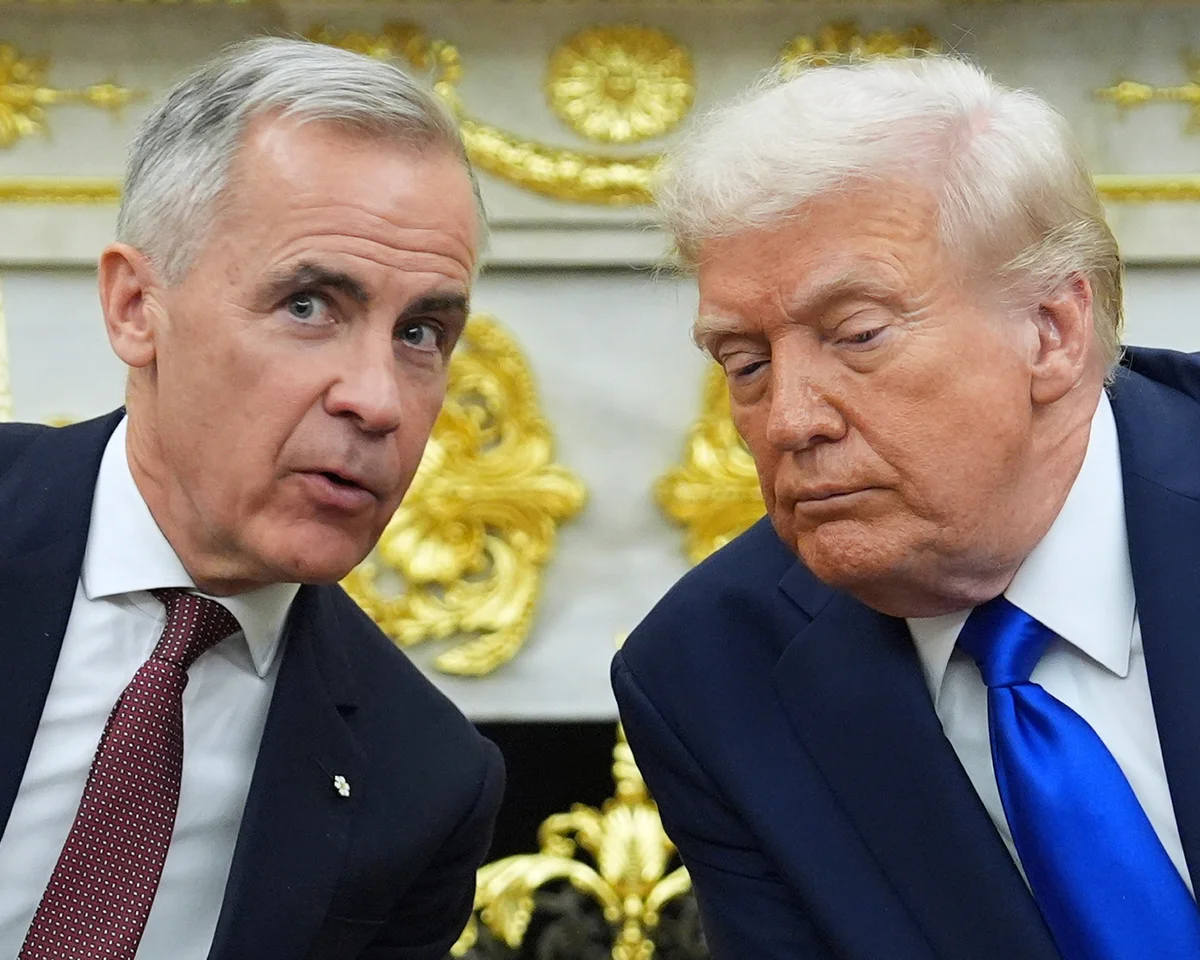
The new Canada tariffs landed Monday, and by Tuesday morning Prime Minister Mark Carney was already on the phone with the man who imposed them.
President Trump announced 50% tariffs on most Canadian goods, accusing Canada of unfair treatment of American autos, alcohol and dairy. The measures are scheduled to take effect 30 days from Monday.
Carney’s response was not retaliation. It was acceleration.
Ottawa Chooses the Negotiating Table
“I spoke this morning with the U.S. president and we agreed to deepen and speed up our negotiations over the next few weeks,” Carney said in Ottawa.
He added a line clearly aimed at a domestic audience watching nervously: “Canada will do all that is necessary to support our jobs, our workers, our farmers and to make Canada stronger, more independent and more resilient.”
The two leaders agreed to intensify talks on a trade arrangement covering Canada, the United States and Mexico. Whether those talks move fast enough to matter before the tariffs bite is the immediate question.
What the Tariffs Actually Cover
The scope here matters more than the headline number, and it’s narrower than the initial reaction suggested.
Exempted from the 50% rate:
- Energy products
- Potash
- Fish
- Critical minerals
Included, notably, are goods that had been shielded under the United States-Mexico-Canada Agreement. Washington declined to renew that 2020 pact, opening a fresh round of negotiations that could stretch as far as 2036.
An administration official previewing the move said Canada was among the very few countries besides China to retaliate against Trump’s earlier tariffs, and therefore had to be held accountable.
The Economic Damage, Measured
Canadian economists put the impact well below worst-case fears. The tariffs are expected to touch roughly 5% of Canadian exports to the United States.
Robert Kavcic, senior economist at the Bank of Montreal, told clients the measures cover about 28 billion Canadian dollars, or roughly 19.8 billion US dollars, in annual exports. That works out to about 0.8% of Canada’s economy.
The heaviest exposure falls on chemicals, plastics, electronics and industrial equipment, followed by consumer goods and forestry products. Miscellaneous manufacturing machinery and agricultural and food products round out the list.
The affected goods make for an odd catalog: honey, liquor, cement, hockey sticks.
Still, 0.8% of an economy is not nothing, and the risks extend past the direct hit. Analysts have warned about renewed inflation pressure and further damage to a relationship that was genuinely warm before Trump returned to office.
The Premiers Are Not Playing Nice
Carney planned a virtual meeting with provincial premiers later Tuesday, and several of them had already made their views public. The tone varied from frustrated to openly combative.
British Columbia Premier David Eby was the sharpest.
“This feels like an increasingly desperate and flailing approach to relationships with our country,” he said from Charlottetown, where premiers and territorial leaders were gathered. He warned the tariffs would hurt families in his province and said Trump is mistaken if he believes he can bully Canada into compliance.
Then came the line that traveled furthest.
“I feel sorry for Americans,” Eby said. “If you can’t be friends with Canada, then you almost certainly do not have friends anywhere in the world, and that is a very lonely place to be.”
Saskatchewan Premier Scott Moe took a more economic tack, arguing the damage runs both directions.
“When tariffs are applied it increases the cost for families and to do business on both sides of the border,” he said. “These tariffs do nothing for making a more competitive North American economy.”
Ford Wants a Fight
Ontario Premier Doug Ford broke with Carney’s approach entirely, calling for direct retaliation rather than deeper negotiation.
“We always seem to be on our back heels,” Ford said. “We need to be on the offense. Not constantly on the defense with President Trump. We need to stand up to the bully, and we need to hit him tariff to tariff, all the way across the board.”
That split between federal caution and provincial aggression is now one of the more interesting dynamics in Canadian politics. Carney is betting that talks produce a better outcome than escalation. Ford is betting the opposite.
Trump’s Framing
Speaking to reporters in the Oval Office on Tuesday, Trump softened his tone toward Canadians while sharpening it toward Canada.
He said he loves the Canadian people but insisted the country depends on the United States for its survival. “Canada’s been very, very tough on us over the years, for many years, and no other president’s done anything about it,” he said.
He also clarified that these tariffs are separate from his threatened penalties over wildfire smoke that drifted into the Great Lakes, Northeast and Mid-Atlantic regions, affecting millions of Americans. He repeated his complaint that Canada mismanages its forests.
That means a second front may still be coming.
The Liquor Fight Nobody Is Backing Down From
One specific irritant sits underneath the broader dispute: eight Canadian provinces have pulled American alcohol from provincially operated liquor store shelves.
Carney said the decision belongs to the provinces, effectively declining to intervene.
Eby left no ambiguity about where British Columbia stands.
“There is not a chance in hell that U.S. alcohol is going back on the shelf in British Columbia,” he said.
Where This Goes
Three things are worth watching over the next 30 days.
The first is whether accelerated negotiations produce anything before the tariffs take effect. A month is a short runway for a deal involving three countries and an expired framework agreement.
The second is whether Carney can hold his own side together. Ford’s call for tariff-for-tariff retaliation has obvious political appeal, and pressure will grow if talks stall.
The third is the wildfire smoke threat, which Trump has kept alive as a separate lever. Canada is currently negotiating one dispute while a second sits loaded.
For now, Ottawa is choosing the table over the trenches. Whether that reads as strategy or capitulation will depend entirely on what the next few weeks produce.
Author
-
Lucienne Albrecht is Luxe Chronicle’s wealth and lifestyle editor, celebrated for her elegant perspective on finance, legacy, and global luxury culture. With a flair for blending sophistication with insight, she brings a distinctly feminine voice to the world of high society and wealth.