The France wildfires tourists are describing this week turned ordinary summer holidays into something closer to an evacuation drill — phones shrieking at four in the morning, suitcases thrown into hire cars, and families driving within metres of flames taller than the pine forests they had come to walk through.
Blazes tearing through south-west France and central Spain have forced more than 220,000 people from their homes and accommodation. The French military has been deployed to assist, and the Spanish government has declared a national emergency. Wind and persistent heat continue to drive the fires, with visitors far from the affected zones reporting the sharp smell of smoke, likened by some to a bonfire.
Flights into Bordeaux and Madrid, the nearest major cities to the fire zones, are so far running normally.
Four Alerts and a Peninsula Emptied
Zac Morrison arrived at Cap Ferret on Thursday, a pine-covered peninsula roughly 40 miles south-west of Bordeaux, with ten members of his family.
The 21-year-old from London woke to two text alerts, one at 4am and another at 6am, instructing him to evacuate by any means available. Gendarmes were moving door to door. He described the scene as something out of a film, with the family grabbing everything they had.
The initial panic gave way to what he called a well-organised effort to clear the entire peninsula. But the danger kept shifting. He received four separate evacuation alerts in total, the last at 5pm on Friday, after the family moved away from one fire only to find themselves in the path of another.
They sheltered on a beach in nearby Arcachon before a relative offered them somewhere to stay. His 11-year-old brother Nate is still processing what he saw.
Morrison described people sleeping in schools and warehouses, and beaches filled with holidaymakers sitting beside their suitcases waiting for permission to move. His family is now waiting to learn whether their holiday, booked through mid-August, can continue at all.
Rain fell overnight, he said, but word is circulating that electricity across the peninsula may be cut, particularly as ash clouds drift toward Bordeaux. He has heard of houses burning down within an hour — frightening, he said, though locals seem to be growing accustomed to it.
Fifteen Minutes to Pack
David Morton had spent most of a week in the same area with his wife and two teenage sons, enjoying the forest under heavy sun.
On day five, the combination of tinder-dry pine and extreme heat ended the holiday abruptly. The family was woken on Friday morning by every phone in the house flashing and sounding at once, carrying an order to leave immediately via the single road off the peninsula.
They threw belongings into suitcases and were in their hire car within fifteen minutes.
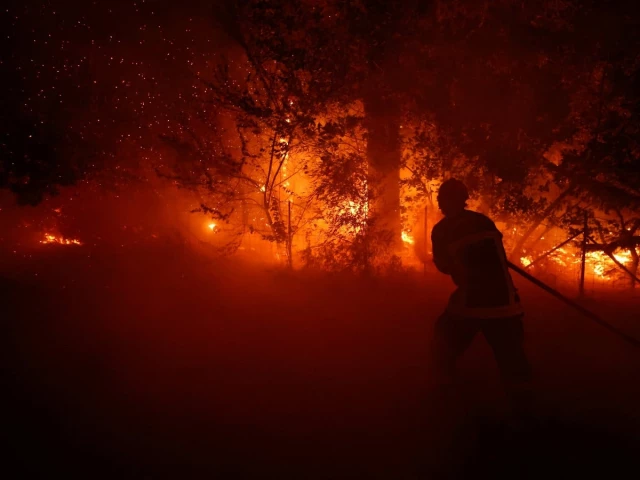
At one point they passed within 500 metres of the main fire. Morton said the flames rose higher than mature forest pines — five or six storeys — and it was obvious the blaze was beyond control.
The family stayed with friends until their flight home from Bordeaux on Saturday.
Left Behind in an Empty Town
Not everyone got out. Rebecca Papin, a French-American at her holiday home in Biscarrosse near the Cap Ferret peninsula, first noticed a large plume of smoke on Thursday.
Three hours later, arriving home that night, she watched water-dropping aircraft and firefighting helicopters working against what she described as a wall of flame stretching across the horizon. It was still some distance from her house but plainly visible from the upper floor.
Authorities appeared overwhelmed, she said, and no evacuation order reached her. She slept beside her young children wearing earplugs — and missed the overnight evacuation entirely.
She woke to find herself nearly alone in a town that had emptied around her. The main roads were closed because they were burning. At 7.30am on Friday, police advised her to remain inside under any circumstances. Ash was falling from the sky like snow.
Others Simply Moved On
Two British families told the BBC they had relocated roughly 100 miles away to continue their holidays elsewhere in France.
BBC South’s Joanna Kent, who had been staying on the Cap Ferret peninsula earlier in the week, recalled returning to find her campsite abandoned after two vanloads of police gave tourists thirty minutes to leave.
Official Advice: Come Anyway
The UK Foreign Office is not currently advising against travel to either France or Spain.
Éléonore Caroit, France’s minister for international partnerships, described the fires as a tragedy while urging visitors not to abandon their plans. Speaking on Saturday, she pointed out that entire regions remain unaffected, that similar events are unfolding in Spain and elsewhere, and that Paris and most other areas are functioning normally. Her advice was to travel but stay informed about conditions wherever you go.
That balance reflects a real dilemma for tourism-dependent regions. Cancellations cause economic damage across areas that never came close to danger, while under-communicating risk leaves visitors unprepared.
The Situation in Spain
Around Madrid, the fires are burning well outside the city centre in the wider region, where crews are working to prevent separate fire fronts from merging into a single uncontrollable blaze.
The flames have already forced the closure of a NASA facility roughly 37 miles west of the capital.
Isabel Díaz Ayuso, president of the Madrid region, called it the worst fire in the region’s history, describing a perfect storm of extreme temperatures, unrelenting wind and converging fire fronts.
Practical Advice for Travellers
For anyone heading to southern Europe during fire season, a few habits make a genuine difference:
- Keep emergency alerts enabled on your phone and do not silence it overnight in high-risk areas
- Know the single road out before you need it, particularly on peninsulas and in forested areas
- Keep passports, medication and car keys in one grab bag from the day you arrive
- Register with your embassy or consulate where that service exists
- Follow local authority accounts rather than relying on secondhand reports
The most repeated detail in these accounts is timing. Families had fifteen minutes, or thirty. The people who left quickly were the ones who did not have to decide what to take.
Author
-
Lucienne Albrecht is Luxe Chronicle’s wealth and lifestyle editor, celebrated for her elegant perspective on finance, legacy, and global luxury culture. With a flair for blending sophistication with insight, she brings a distinctly feminine voice to the world of high society and wealth.