The Berlin Pride attack has left a city that prides itself on openness trying to work out what openness costs — and what it means to keep insisting on it anyway.
For Ali Darwich, a 34-year-old Berliner, Saturday night’s violence near the Pride festival struck at the identity of the city itself: its diversity, its tolerance, its commitment to freedom. It also struck at nearly every part of who he is.
Born a Muslim, living as a gay man, working as a police officer — he said the attack touched each of those aspects of himself, struggling to hold back tears as he described it.
What Happened
A van ramming and stabbing near the festival in Tiergarten park on Saturday evening killed one person and wounded many others. Authorities believe it was an Islamic extremist attack.
The suspect was killed by police on Sunday evening in a Berlin suburb. Officials identified him as Abdul Ballout, a 21-year-old German citizen of Lebanese descent, and said he appeared to run toward officers holding a sharp instrument before at least one shot was fired.
The Crash Site Becomes a Memorial
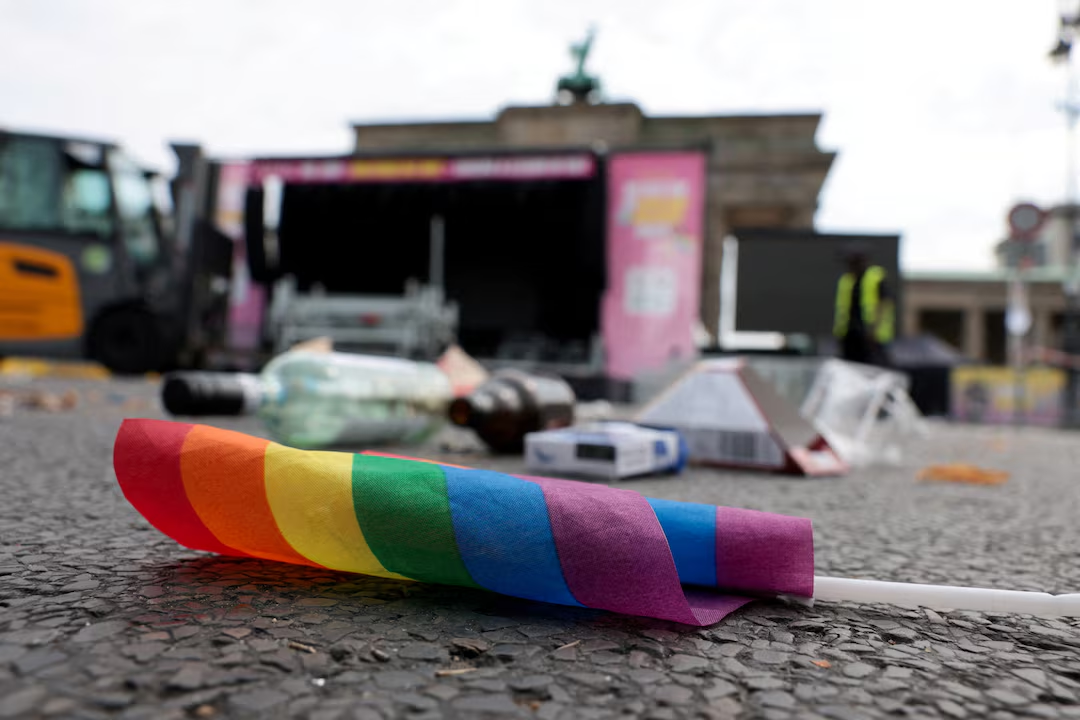
By Sunday, the park had transformed. Members of the LGBTQ+ community arrived in growing numbers, laying flowers, embracing one another and staring in disbelief at the wrecked van, still cordoned off behind dozens of officers.
Many of them had spent the previous afternoon doing the opposite — celebrating, marching for equality and warning about a rise in hate crimes targeting their community.
Darwich had been among them. He described wearing a rainbow shirt and carrying a banner reading “Why are some people afraid of love but not of hate?” He was heading to an afterparty when friends began calling to check whether he was safe.
Once he understood what had happened, he cancelled his plans and went home. The full weight of it only landed the next morning.
Three Questions in One Person
What Darwich described waking up to was a set of questions that came at him from different directions at once.
As a police officer, he asked himself why he had not run toward the scene to help his colleagues. As a gay man, he wondered whether his community would now have to live with even more fear on top of the bullying and hostility already present. As a Muslim, he worried that his community would face intensified racism in the aftermath.
Born in Berlin to a family with Lebanese and Palestinian roots, he expressed concern that the attack would deepen divisions across German society.
He admitted to feeling something close to despair. Hatred, he said, cannot simply be removed from people who hold it, and it seems to keep growing. He works as a gay Muslim influencer and usually posts content aimed at striking a hopeful note, which made the difficulty of that morning sharper.
Still, he refused to concede the point. He said he did not want to let hate win, and that he still believed Berliners would find a way to work together — that something better might come out of this.
Anger, and a Longer Pattern
Others gathered at the impromptu vigil expressed shock alongside a hardening resolve.
Andre Lehmann, a senior official with LSVD+, the main national LGBTQ+ association, said the community was simply stunned. The attack, he argued, struck at the heart of queer life in Germany.
He was pointed about what it targeted. The people on the streets of Berlin that weekend were there to fight for their rights and their diversity, he said, which makes the attack a political act rather than merely violence against people celebrating.
Lehmann also placed it in a longer context that has received little attention. Anti-queer hate crime in Germany, he said, has increased tenfold within a few years. His frustration extended to the response: for years, he said, nothing was done — and for years there was no outcry from society.
That observation is worth sitting with. Communities experiencing a sustained rise in targeted violence often describe the same sequence, in which incremental harm goes unremarked until something catastrophic forces attention.
“They’ll Never Erase Us”
Ashley Jump, 26, had travelled from the United Kingdom for Saturday’s parade and left the celebrations before the attack occurred. Still shaken, they returned on Sunday to leave flowers at the memorial near the scene.
Their voice unsteady, Jump said the community would never be erased. As long as humanity has existed, they said, queer people have existed, and as long as humanity continues, they will continue. They will not be removed.
The Pressures Now Facing Berlin
Several difficult conversations will follow, and they pull in different directions.
One concerns security at public gatherings. Pride events across Europe are deliberately open — that openness is much of the point. Hardening them with barriers, screening and heavy police presence protects participants while changing the character of what is being protected.
Another concerns the risk of collective blame. Darwich’s fear about rising racism toward Muslims is not abstract. Attacks attributed to extremists have repeatedly produced backlash against entire communities, including against people like him who belong simultaneously to the targeted group and the group being blamed.
A third concerns whether the tenfold rise in anti-queer hate crime that Lehmann described finally prompts policy attention, or whether the response stops at condemnation.
Germany has grappled with these questions before, and the outcome has varied depending on how quickly public attention moved on.
What the Vigil Suggested
The gathering in Tiergarten offered one answer, at least provisionally.
People returned to the exact place where the violence happened. They brought flowers to a spot still guarded by police, beside a vehicle that had not yet been removed. Nobody suggested that this would prevent anything.
That is not typically the point of such gatherings. Their function is to demonstrate that the space has not been surrendered, that the people who were there on Saturday intend to be there again — and that intimidation, whatever else it accomplished, did not accomplish absence.
Berlin will spend the coming weeks arguing about security measures, extremism and the state of its social fabric. Sunday in the park established the terms the community wanted set first.
Author
-
Lucienne Albrecht is Luxe Chronicle’s wealth and lifestyle editor, celebrated for her elegant perspective on finance, legacy, and global luxury culture. With a flair for blending sophistication with insight, she brings a distinctly feminine voice to the world of high society and wealth.