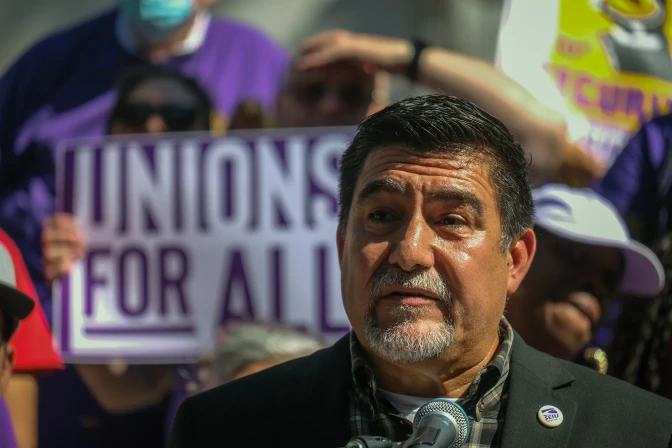
The David Huerta charge dropped this week brings a quiet close to a prosecution that once carried the weight of a federal felony and a social media announcement to match. Federal prosecutors in Los Angeles asked a court on Monday to end the criminal matter against the head of Service Employees International Union California, a labor organization whose membership exceeds 750,000 janitors, security officers and service workers across the state.
The dismissal is not yet final. Under the terms prosecutors described, the case will be permanently withdrawn within weeks provided Huerta keeps meeting the conditions of his pretrial release and avoids further trouble. He has already satisfied those conditions for over a year.
The Deal Behind the Dismissal
What makes this resolution more revealing than a simple dropped charge is the paperwork underneath it.
A letter setting out the terms of Huerta’s diversion agreement shows that both sides signed off on an agreed version of events. Huerta acknowledged that he went to the location where the search warrant was being executed, stationed himself in the driveway outside the front gate to register opposition to the enforcement tactics he was watching, and urged others present to do the same. The stipulation also states that as a result, at least one federal agent involved in the operation had a credible belief that he could not get through the gate.
That framing lets each side walk away with something. Prosecutors can point to conduct that interfered with a lawful warrant. Huerta can point to conduct that consisted of standing in a driveway and encouraging people to protest.
Where It Started
The arrest took place in June 2025 outside a Los Angeles business where federal agents were conducting an immigration-related investigation. Huerta had gone there to demonstrate.
Officials say he seated himself in front of a vehicle gate and directed other demonstrators to circle the area in a way calculated to prevent agents from entering or exiting. When an officer told him to move and then reached to physically guide him clear of an approaching vehicle, authorities say Huerta pushed back.
The context surrounding that afternoon was volatile. Demonstrations against expanded immigration enforcement were spreading across California, and the unrest reached a level that prompted President Donald Trump to deploy the National Guard to Los Angeles, an extraordinary step in the nation’s second-largest city.
From Defendant to Emblem
Huerta’s detention did not stay a local story for long.
Rallies demanding his release sprang up in cities around the country, organized by unions and immigrant rights groups who read the arrest as an attempt to make an example of someone visible. Within days he had become the recognizable face of resistance to the administration’s push to increase immigration arrests.
The political response followed quickly. Senate Democratic Leader Chuck Schumer joined California’s two senators in a letter to federal officials seeking answers about the arrest, calling it deeply troubling that an American citizen, union official and respected member of the Los Angeles community would remain in federal custody for observing enforcement activity. Sen. Adam Schiff turned up in person at Huerta’s bond hearing.
Prosecutors were unmoved at the time. Bill Essayli, then the leading federal prosecutor in Los Angeles, made the office’s stance plain, saying that a protester’s identity was beside the point and that anyone who impeded federal agents would face arrest and prosecution.
A Charge That Kept Shrinking
The government’s confidence eroded in stages.
The initial filing was felony obstruction. By October, prosecutors had reduced it to a misdemeanor, a substantial climbdown from the seriousness with which the case had been introduced. Monday’s motion completes the retreat.
The Los Angeles office has not framed any of this as a concession. Its statement stressed that Huerta was charged with interfering with the execution of a judicial search warrant rather than with protesting, and asserted that the Justice Department does not arrest people for demonstrating peacefully. Prosecutors noted his sustained compliance with bond conditions and said that under the agreement reached with his attorneys, they expect full dismissal by the end of next month.
Huerta’s Account
Huerta describes the encounter in considerably harsher terms. He says he was tackled, sprayed with pepper spray and taken into custody for doing something the Constitution protects.
In a statement, he argued that no legitimate case ever existed and that the prosecution amounted to an effort to punish and quiet him. He said he intends to keep protesting what he considers abuses by the administration and to keep pushing for a country that treats immigrant families and working people with dignity.
He placed his own experience inside a broader claim, describing the case as part of a weaponization of the courts against political critics.
His lawyers, Abbe Lowell and Marilyn Bednarski, echoed that reading, saying the charge had no legal foundation and belonged to a pattern of prosecutions aimed at suppressing criticism of immigration policy. Monday’s filing, in their view, demonstrates that the strategy failed.
Not an Isolated Collapse
The outcome fits a trend the Justice Department has been struggling with nationally. Cases brought against people accused of assaulting or obstructing federal officers during immigration protests have repeatedly faltered in courtrooms across multiple districts.
The reasons are largely structural. These prosecutions typically hinge on seconds-long physical interactions in chaotic settings, often recorded from several angles that rarely resolve the question of who did what to whom. Proving intent to obstruct is demanding when a defendant can credibly say he was exercising a right to be present. And juries tend to hesitate when the underlying behavior resembles political expression more than violence.
Diversion agreements like this one offer prosecutors an exit that avoids a verdict. The defendant admits facts without admitting guilt, complies for a set period, and the charge disappears. Nobody is formally vindicated, and nobody is formally defeated.
What Remains
For Huerta, the practical result is that a case which drew national attention and senatorial intervention will end without conviction or penalty. For the union he leads, it functions as validation of the position it took from the first day.
For the Justice Department, it closes a matter that opened with confident public messaging and ends with a filing that concedes nothing while relinquishing everything.
Author
-
Lucienne Albrecht is Luxe Chronicle’s wealth and lifestyle editor, celebrated for her elegant perspective on finance, legacy, and global luxury culture. With a flair for blending sophistication with insight, she brings a distinctly feminine voice to the world of high society and wealth.